


Association of SARS-CoV-2 clades with clinical, inflammatory and virologic outcomes: An observational study
- PMID: 33840632
- PMCID: PMC8027908
- DOI: 10.1016/j.ebiom.2021.103319
Association of SARS-CoV-2 clades with clinical, inflammatory and virologic outcomes: An observational study
Abstract
Background: Host determinants of severe coronavirus disease 2019 include advanced age, comorbidities and male sex. Virologic factors may also be important in determining clinical outcome and transmission rates, but limited patient-level data is available.
Methods: We conducted an observational cohort study at seven public hospitals in Singapore. Clinical and laboratory data were collected and compared between individuals infected with different SARS-CoV-2 clades. Firth's logistic regression was used to examine the association between SARS-CoV-2 clade and development of hypoxia, and quasi-Poisson regression to compare transmission rates. Plasma samples were tested for immune mediator levels and the kinetics of viral replication in cell culture were compared.
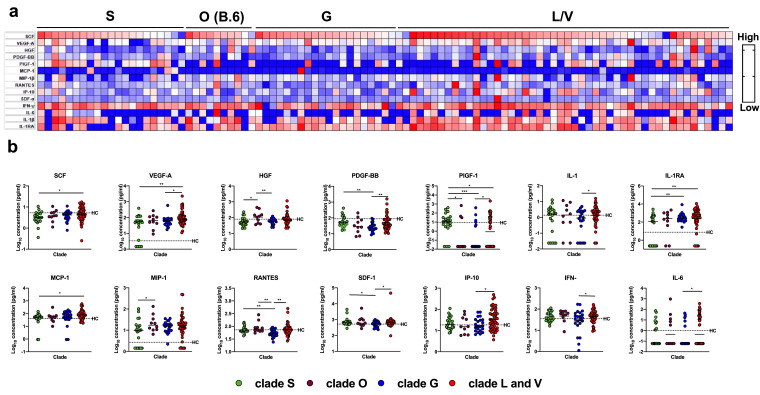
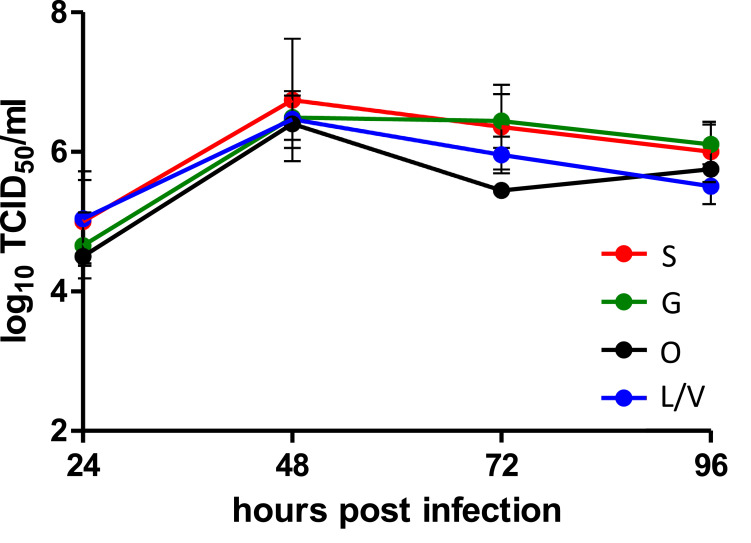
Findings: 319 patients with PCR-confirmed SARS-CoV-2 infection had clinical and virologic data available for analysis. 29 (9%) were infected with clade S, 90 (28%) with clade L/V, 96 (30%) with clade G (containing D614G variant), and 104 (33%) with other clades 'O' were assigned to lineage B.6. After adjusting for age and other covariates, infections with clade S (adjusted odds ratio (aOR) 0·030 (95% confidence intervals (CI): 0·0002-0·29)) or clade O (B·6) (aOR 0·26 (95% CI 0·064-0·93)) were associated with lower odds of developing hypoxia requiring supplemental oxygen compared with clade L/V. Patients infected with clade L/V had more pronounced systemic inflammation with higher concentrations of pro-inflammatory cytokines, chemokines and growth factors. No significant difference in the severity of clade G infections was observed (aOR 0·95 (95% CI: 0·35-2·52). Though viral loads were significantly higher, there was no evidence of increased transmissibility of clade G, and replicative fitness in cell culture was similar for all clades.
Interpretation: Infection with clades L/V was associated with increased severity and more systemic release of pro-inflammatory cytokines. Infection with clade G was not associated with changes in severity, and despite higher viral loads there was no evidence of increased transmissibility.
Keywords: COVID-19; Clade; D614G; SARS-CoV-2; Severity; Transmission.
Copyright © 2021 The Authors. Published by Elsevier B.V. All rights reserved.
Conflict of interest statement
Declaration of Competing Interest BY has received honoraria from Sanofi and Roche, outside the submitted work. All other authors no conflicts of interest declared.
Figures
References
-
- Long Q.X., Tang X.J., Shi Q.L., Li Q., Deng H.J., Yuan J. Clinical and immunological assessment of asymptomatic SARS-CoV-2 infections. Nat Med. 2020;26(8):1200–1204. - PubMed
-
- Young B.E., Ong S.W.X., Ng L.F.P., Anderson D.E., Chia W.N., Chia P.Y. Viral dynamics and immune correlates of COVID-19 disease severity. Clin Infect Dis Off Publ Infect Dis Soc Am. 2020 Aug 28ciaa1280Online ahead of print.
-
- Zhang X., Tan Y., Ling Y., Lu G., Liu F., Yi Z. Viral and host factors related to the clinical outcome of COVID-19. Nature. 2020;583(7816):437–440. - PubMed
Publication types
MeSH terms
LinkOut - more resources
Full Text Sources
Other Literature Sources
Medical
Miscellaneous
