


Attitudes and Practices of Immune Checkpoint Inhibitors in Chinese Patients With Cancer: A National Cross-Sectional Survey
- PMID: 33841138
- PMCID: PMC8025873
- DOI: 10.3389/fphar.2021.583126
Attitudes and Practices of Immune Checkpoint Inhibitors in Chinese Patients With Cancer: A National Cross-Sectional Survey
Abstract
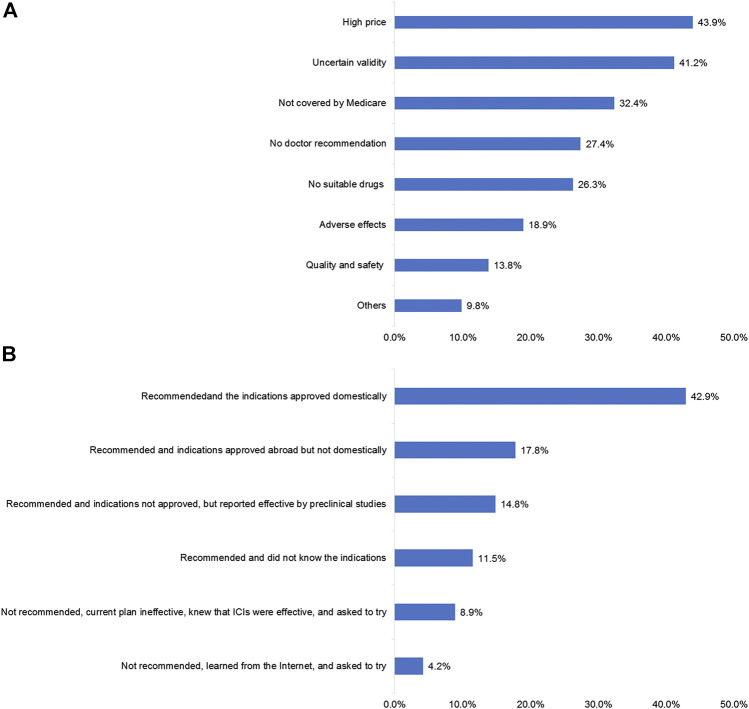
Immune-checkpoint inhibitors (ICIs) are revolutionizing the field of immuno-oncology. Side effects and tumor microenvironment currently represent the most significant obstacles to using ICIs. In this study, we conducted an extensive cross-sectional survey to investigate the concept and practices regarding the use of ICIs in cancer patients in China. The results provide real-world data on the adverse events (AEs) of ICIs and the factors influencing the use of ICIs. This survey was developed by the Expert Committee on Immuno-Oncology of the Chinese Society of Clinical Oncology (CSCO-IO) and the Expert Committee on Patient Education of the Chinese Society of Clinical Oncology (CSCO-PE). The surveys were distributed using a web-based platform between November 29, 2019 and December 21, 2019. A total of 1,575 patients were included. High costs (43.9%), uncertainty about drug efficacy (41.2%), and no reimbursement from medical insurance (32.4%) were the factors that prevented the patients from using ICIs. The patients were most concerned about the onset time or effective duration of ICIs (40.3%), followed by the indications of ICIs and pre-use evaluation (33.4%). Moreover, 9.0, 57.1, 21.0, and 12.9% of the patients reported tumor disappearance, tumor volume reduction, no change in tumor volume, and increased tumor volume. Among the patients who received ICIs, 65.7% reported immune-related AEs (irAEs); 96.1% reported mild-to-moderate irAEs. Cancer patients in China had a preliminary understanding of ICIs. Yet, the number of patients treated with ICIs was small.
Keywords: adverse effects; attitude; immunotherapy; practice; survey.
Copyright © 2021 Zhang, Wang, Zhang, Chu, Su, Wu, Chen, Wang, Yin, Zhu and Sun.
Conflict of interest statement
The authors declare that the research was conducted in the absence of any commercial or financial relationships that could be construed as a potential conflict of interest.
Figures
References
-
- Dawe D. E., Christiansen D., Swaminath A., Ellis P. M., Rothney J., Rabbani R., et al. (2016). Chemoradiotherapy versus radiotherapy alone in elderly patients with stage III non-small cell lung cancer: a systematic review and meta-analysis. Lung Cancer 99, 180–185. 10.1016/j.lungcan.2016.07.016 - DOI - PubMed
LinkOut - more resources
Full Text Sources
Other Literature Sources
