. 2021 Feb 25:12:618597.
doi: 10.3389/fimmu.2021.618597. eCollection 2021.

Polluted Air Exposure Compromises Corneal Immunity and Exacerbates Inflammation in Acute Herpes Simplex Keratitis

Affiliations

Polluted Air Exposure Compromises Corneal Immunity and Exacerbates Inflammation in Acute Herpes Simplex Keratitis

Victor G Sendra et al. Front Immunol. .

Abstract

Air pollution is a serious environmental issue worldwide in developing countries' megacities, affecting the population's health, including the ocular surface, by predisposing or exacerbating other ocular diseases. Herpes simplex keratitis (HSK) is caused by the herpes simplex virus type 1 (HSV-1). The primary or recurring infection in the ocular site causes progressive corneal scarring that may result in visual impairment. The present study was designed to study the immunopathological changes of acute HSK under urban polluted air, using the acute HSK model combined with an experimental urban polluted air exposure from Buenos Aires City. We evaluated the corneal clinical outcomes, viral DNA and pro-inflammatory cytokines by RT-PCR and ELISA assays, respectively. Then, we determined the innate and adaptive immune responses in both cornea and local lymph nodes after HSV-1 corneal by immunofluorescence staining and flow cytometry. Our results showed that mice exposed to polluted air develop a severe form of HSK with increased corneal opacity, neovascularization, HSV-1 DNA and production of TNF-α, IL-1β, IFN-γ, and CCL2. A high number of corneal resident immune cells, including activated dendritic cells, was observed in mice exposed to polluted air; with a further significant influx of bone marrow-derived cells including GR1+ cells (neutrophils and inflammatory monocytes), CD11c+ cells (dendritic cells), and CD3+ (T cells) during acute corneal HSK. Moreover, mice exposed to polluted air showed a predominant Th1 type T cell response over Tregs in local lymph nodes during acute HSK with decreased corneal Tregs. These findings provide strong evidence that urban polluted air might trigger a local imbalance of innate and adaptive immune responses that exacerbate HSK severity. Taking this study into account, urban air pollution should be considered a key factor in developing ocular inflammatory diseases.

Keywords: air pollution; corneal immune cells; draining lymph nodes (dLNs); herpes simplex keratitis (HSK); immune response.


Conflict of interest statement

The authors declare that the research was conducted in the absence of any commercial or financial relationships that could be construed as a potential conflict of interest.

Figures
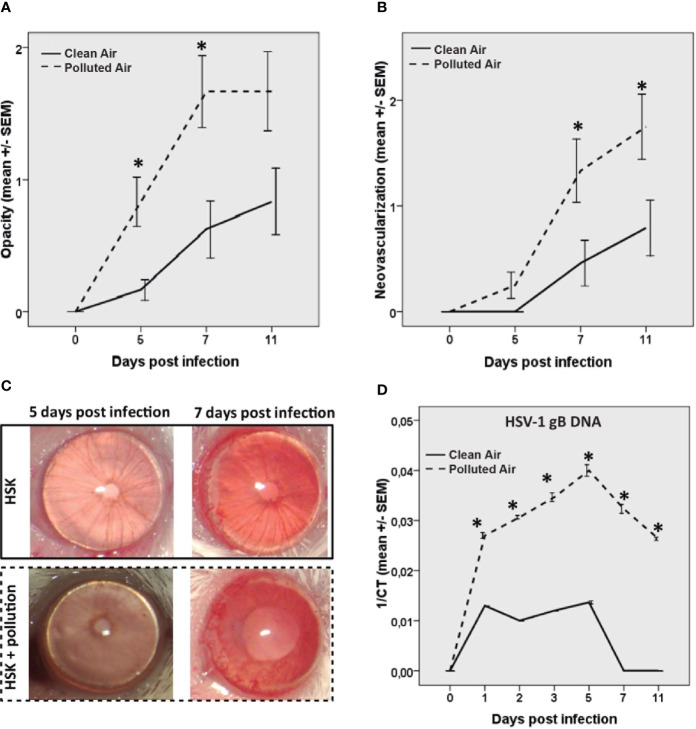
Figure 1
Figure 1
Corneal opacity (A) and corneal neovascularization (B) were measured and compared between the groups during acute herpes simplex keratitis (HSK) until day 11. Representative corneas pictures of HSK mice at 5 and 7 dpi are shown (C). HSV-1 gB DNA measured by real time PCR at different time points of the acute phase of the infection (D) in mice exposed to polluted (dashed line —) and clear air (continued line —). *p < 0.05, differences between groups are statistically significant.
Figure 2
Figure 2
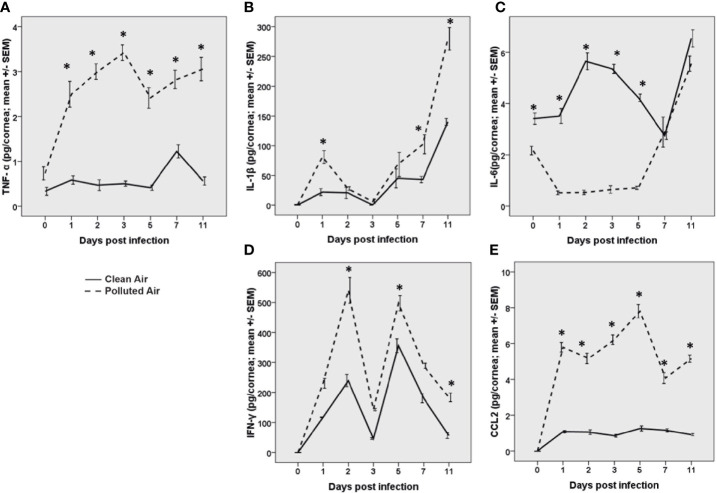
Pro-inflammatory cytokine quantification of TNF-α (A), IL-1β (B), IL-6 (C), IFN-γ (D), and the chemokine CCL2 (E) measured by ELISA during acute herpes simplex keratitis (HSK) in mice exposed to polluted (dashed line —) and clear air (continued line —) at days 0, 1, 2, 3, 5, 7, and 11 post-infection. *p < 0.05, differences between groups are statistically significant.
Figure 3
Figure 3
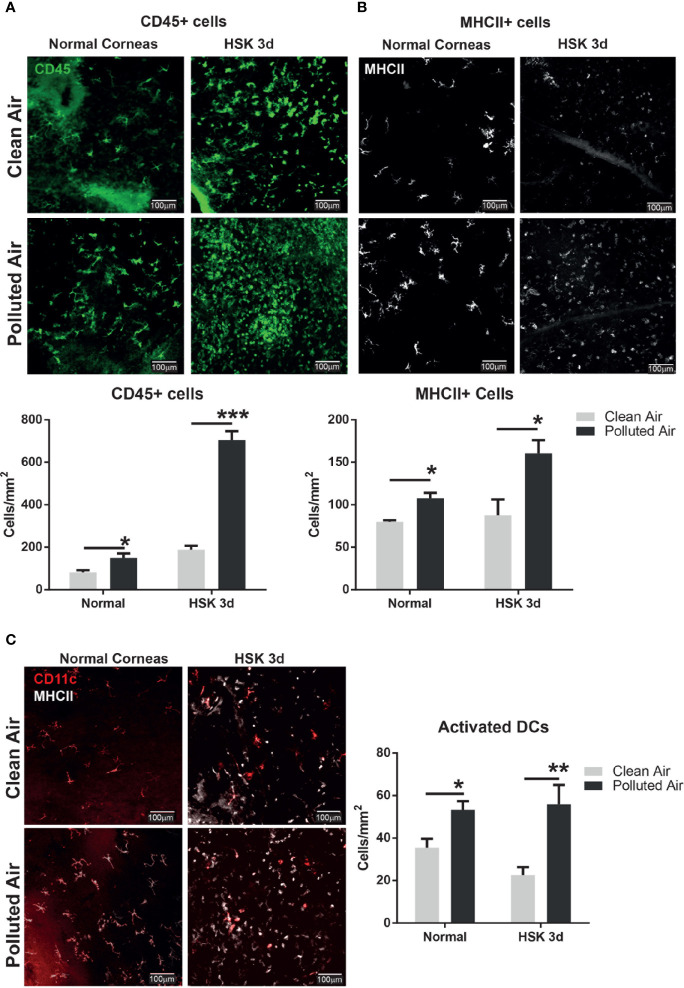
Corneal immune cell infiltration analysis by immunofluorescence in normal uninfected and early HSV-1 infected corneas. Whole mount corneas staining and quantification for leucocytes marker CD45 (A) and activation marker MHCII (B) in normal uninfected corneas and during early HSK at day 3 from mice exposed to clean air (top panel, gray bars) or polluted air (bottom panel, black bars). Whole mount corneas staining and quantification for dendritic cells marker CD11c and activation marker, MHCII (C) in normal non-infected and early HSK at day 3 from mice exposed to clean air (top panel, gray bars) or polluted air (bottom panel, black bars). Graph results are presented as mean ± standard error of the mean (SEM). *p < 0.05, **p < 0.01, ***p < 0.001, differences between groups are statistically significant.
Figure 4
Figure 4
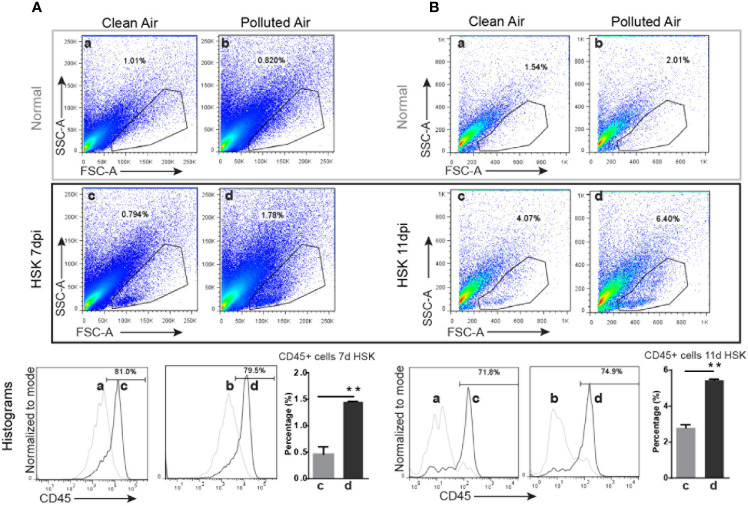
Corneal immune cell infiltration analysis by flow cytometry in normal uninfected and in HSV-1 infected corneas exposed to clean or polluted air. A gate was selected based on size, morphology and granularity (SSC vs. FCS) for normal uninfected and HSV-infected corneas at days 7 (A) and 11 (B) (top gray and bottom black panels respectively) from mice exposed to clean and polluted air (left and right respectively columns) were analyzed for cell infiltration. Then, the percentage of leucocyte (CD45 positive cells) for each gate; normal uninfected mice exposed to clean or polluted air (a and b respectively) and corneal HSV-1 infected mice exposed to clean or polluted air (c and d respectively). Bar graph shows corneal CD45+ cells quantification during HSK at days 7 and 11 from mice group exposed to clean (a) or polluted air (d). Graph results are presented as mean ± standard error of the mean (SEM). *p < 0.05, differences between groups are statistically significant.
Figure 5
Figure 5
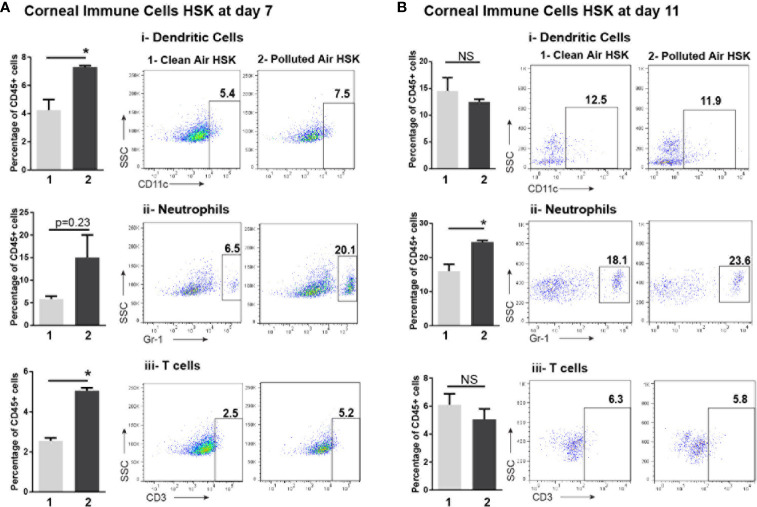
Corneal immune cell subpopulations analysis by flow cytometry during acute HSV-1 keratitis mice exposed to clean or polluted air. The gate for total leucocytes CD45+ were characterized for dendritic cell as CD11c+, neutrophils and inflammatory monocytes as GR-1+ and T-cell CD3+ markers in mice at days 7 (A) and 11 (B) during acute HSV-1 keratitis exposed to clean (1) or polluted air (2). Graph results are presented as mean ± standard error of the mean (SEM). *p < 0.05, differences between groups are statistically significant. NS: differences between groups are not statistically significant.
Figure 6
Figure 6
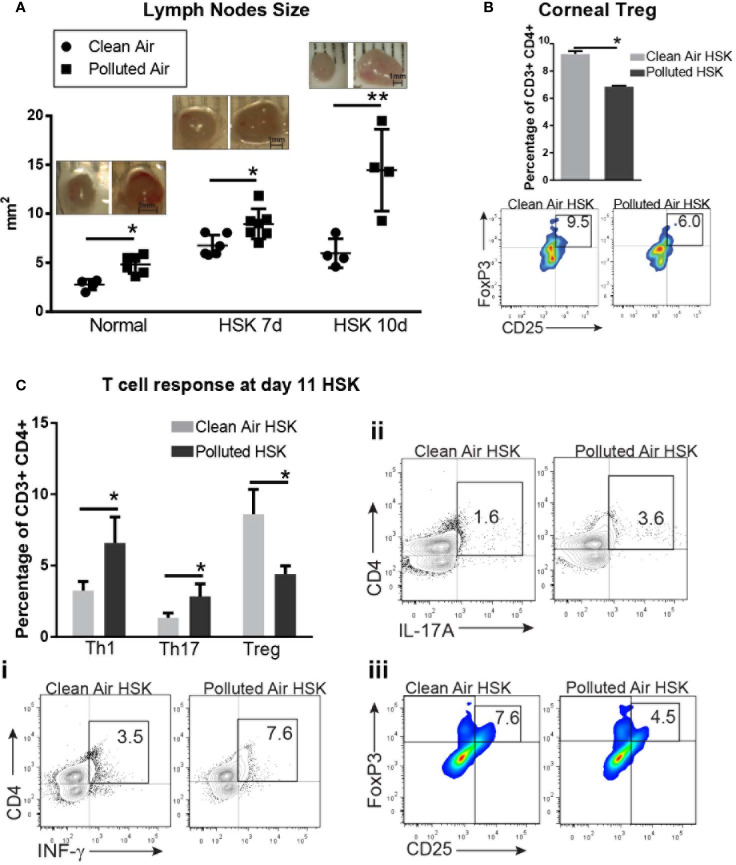
Corneal draining lymph node immune cell subpopulations analysis by flow cytometry during acute HSV-1 keratitis mice exposed to clean or polluted air. Draining lymph nodes size are expressed in mm2 in normal mice and during HSV-1 keratitis from mice exposed to clean (●) or polluted (◾) air (A). Corneal regulatory T cells, Tregs (FoxP3+, CD25+) from HSV-1 infected corneas at 10dpi from mice exposed to clean (gray bar) or polluted air (black bar) expressed as percentage of gated CD3+ CD4+ T cells (B). T cell response Th1 (IFN-γ+) (i), Th17 (IL-17A+) (ii) and regulatory T cells, Treg (CD25+, FoxP3+) (iii) in local lymph nodes from HSV-1 infected corneas at 10 dpi from mice exposed to clean, n=4 (gray bar) or polluted air, n=5 (black bar) expressed as percentage of gated CD3+ CD4+ T cells (C). Graph results are presented as mean ± standard error of the mean (SEM). *p < 0.05, **p < 0.01, differences between groups are statistically significant.

References

    1. Streilein JW. Ocular immune privilege: therapeutic opportunities from an experiment of nature. Nat Rev Immunol (2003) 3(11):879–89. 10.1038/nri1224 - DOI - PubMed
    1. Foulsham W, et al. . When Clarity Is Crucial: Regulating Ocular Surface Immunity. Trends Immunol (2017). 10.1016/j.it.2017.11.007 - DOI - PMC - PubMed
    1. Jung SJ, Mehta JS, Tong L. Effects of environment pollution on the ocular surface. Ocul Surf (2018) 16(2):198–205. 10.1016/j.jtos.2018.03.001 - DOI - PubMed
    1. Novaes P, et al. . The effects of chronic exposure to traffic derived air pollution on the ocular surface. Environ Res (2010) 110(4):372–4. 10.1016/j.envres.2010.03.003 - DOI - PubMed
    1. World Health Organization . Reducing Global Health Risks Through Mitigation of Short-Lived Climate Pollutants. Switzerland: Scoping Report For Policy-makers; (2015).

Publication types

MeSH terms