Early identification of patients with severe COVID-19 at increased risk of in-hospital death: a multicenter case-control study in Wuhan
- PMID: 33841931
- PMCID: PMC8024856
- DOI: 10.21037/jtd-20-2568
Early identification of patients with severe COVID-19 at increased risk of in-hospital death: a multicenter case-control study in Wuhan
Abstract
Background: Most evidence regarding the risk factors for early in-hospital mortality in patients with severe COVID-19 focused on laboratory data at the time of hospital admission without adequate adjustment for confounding variables. A multicenter, age-matched, case-control study was therefore designed to explore the dynamic changes in laboratory parameters during the first 10 days after admission and identify early risk indicators for in-hospital mortality in this patient cohort.
Methods: Demographics and clinical data were extracted from the medical records of 93 pairs of patients who had been admitted to hospital with severe COVID-19. These patients had either been discharged or were deceased by March 3, 2020. Data from days 1, 4, 7, and 10 of hospital admission were compared between survivors and non-survivors. Univariate and multivariate conditional logistic regression analyses were employed to identify early risk indicators of in-hospital death in this cohort.
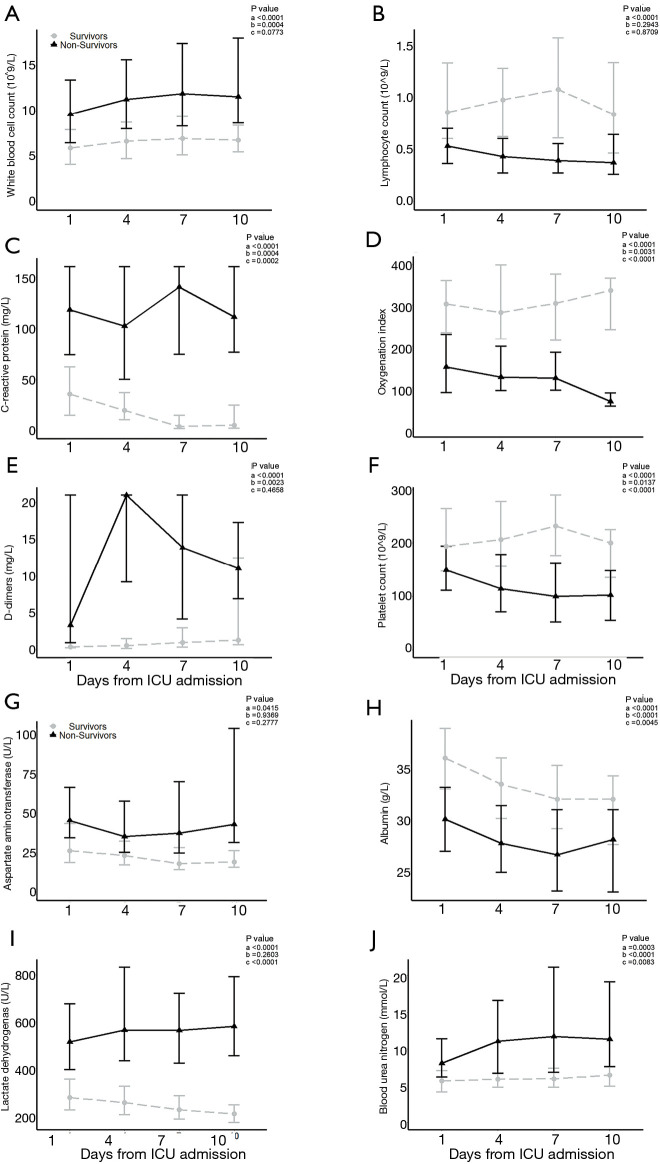
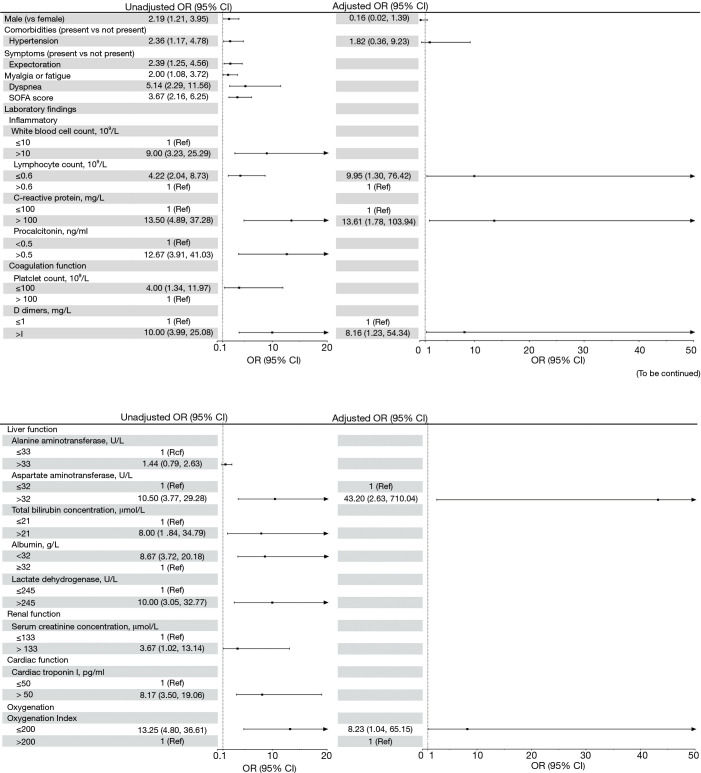
Results: On admission, in-hospital mortality was associated with five risk indicators (ORs in descending order): aspartate aminotransferase (AST, >32 U/L) 43.20 (95% CI: 2.63, 710.04); C-reactive protein (CRP) greater than 100 mg/L 13.61 (1.78, 103.941); lymphocyte count lower than 0.6×10⁹/L 9.95 (1.30, 76.42); oxygen index (OI) less than 200 8.23 (1.04, 65.15); and D-dimer over 1 mg/L 8.16 (1.23, 54.34). Sharp increases in D-dimer at day 4, accompanied by decreasing lymphocyte counts, deteriorating OI, and persistent remarkably high CRP concentration were observed among non-survivors during the early stages of hospital admission.
Conclusions: The potential risk factors of high D-dimer, CRP, AST, low lymphocyte count and OI could help clinicians identify patients at high risk of death early in the hospital admission. This might assist with rationalization of health care resources.
Keywords: COVID-19; case-control; early risk indicator; in-hospital mortality; severe.
2021 Journal of Thoracic Disease. All rights reserved.
Conflict of interest statement
Conflicts of Interest: All authors have completed the ICMJE uniform disclosure form (available at http://dx.doi.org/10.21037/jtd-20-2568). The authors have no conflicts of interest to declare.
Figures
References
-
- Organization WH. Coronavirus disease 2019 (COVID-19): Situation Report, 72. 2020.
-
- Organization WH. Coronavirus disease 2019 (COVID-19): situation report, 41. 2020.
LinkOut - more resources
Full Text Sources
Other Literature Sources
Research Materials
Miscellaneous