


Decrease in Admissions and Change in the Diagnostic Landscape in a Newborn Care Unit in Northern Ghana During the COVID-19 Pandemic
- PMID: 33842411
- PMCID: PMC8027062
- DOI: 10.3389/fped.2021.642508
Decrease in Admissions and Change in the Diagnostic Landscape in a Newborn Care Unit in Northern Ghana During the COVID-19 Pandemic
Abstract
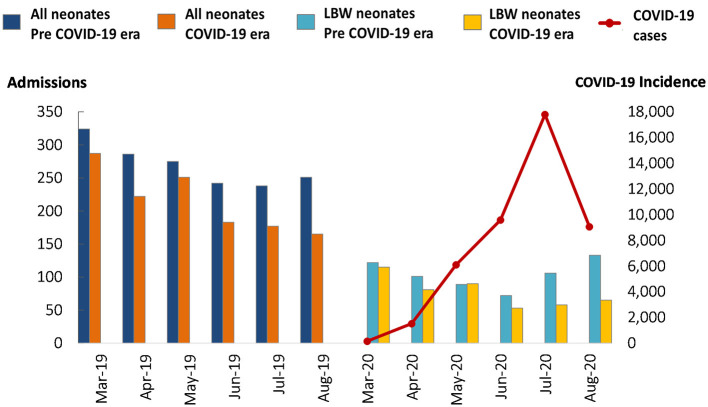
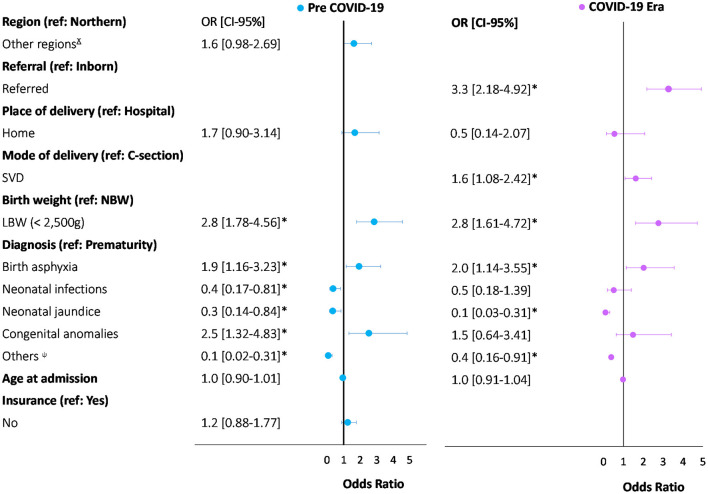
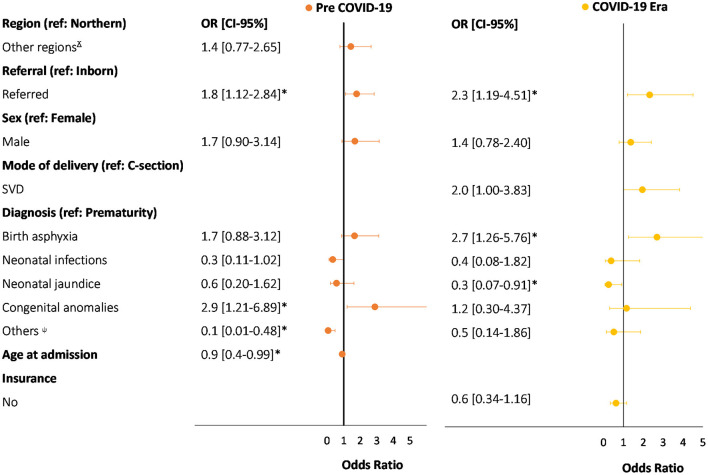
Background: The coronavirus disease (COVID-19) has spread worldwide with an increasing number of patients, including pregnant women and neonates. This study aims to evaluate morbidity and mortality in the COVID-19 era compared to the preceding year in the Neonatal Intensive Care Unit (NICU) at Tamale Teaching Hospital, Ghana. Methods: This is a cross-sectional study carried out on neonates admitted to NICU between March 1st to August 31st, 2019 (pre-COVID-19 era) and March 1st to August 31st, 2020 (COVID-19 era). Multivariate logistic regression was performed to identify predictors of mortality for both periods. Results: From 2,901 neonates, 1,616 (56%) were admitted before, and 1,285 (44%) were admitted during the pandemic. Admissions decreased during the COVID-19 era, reaching their lowest point between June and August 2020. Compared to the previous year, during the COVID-19 era, admissions of patients born at TTH, delivered at home, and with infections decreased from 50 to 39%, 7 to 4%, and 22 to 13%, respectively. Referred status (OR = 3.3) and vaginal delivery (OR = 1.6) were associated with an increased likelihood of mortality. For low- birth weight neonates, admissions of patients born at TTH, with vaginal and home delivery decreased from 62 to 48%, 8 to 2%, and 59 to 52%, respectively. Neonatal infections and congenital anomalies decreased from 8 to 4%, 5 to 3%, respectively. The likelihood of mortality among referred patients increased by 50%. Conclusion: We observed a marked decrease in admissions and change in the diagnosis landscape and related mortality during the pandemic. Underlying challenges, including fear, financing, and health system capacity, might intensify delays and lack of access to newborn care in northern Ghana, leading to higher rates of lifelong disabilities and mortality. Immediate damage control measures, including an improved home-based continuum of care and equipping families to participate in the newborn care with complemented m-health approaches, are needed with urgency.
Keywords: COVID-19; neonatal mortality; newborn care; northern Ghana; pandemic impact.
Copyright © 2021 Abdul-Mumin, Cotache-Condor, Bimpong, Grimm, Kpiniong, Yakubu, Kwarteng, Fuseini and Smith.
Conflict of interest statement
The authors declare that the research was conducted in the absence of any commercial or financial relationships that could be construed as a potential conflict of interest.
Figures
References
-
- WHO Director-General's Remarks at the Media Briefing on 2019-nCoV on 11 February 2020. Available online at: https://www.who.int/dg/speeches/detail/who-director-general-s-remarks-at... (accessed September 20, 2020).
-
- WHO Director-General's Opening Remarks at the Media Briefing on COVID-19 - 11 March 2020. Available online at: https://www.who.int/dg/speeches/detail/who-director-general-s-opening-re... (accessed September 20, 2020).
LinkOut - more resources
Full Text Sources
Other Literature Sources
