GPR120/FFAR4 Pharmacology: Focus on Agonists in Type 2 Diabetes Mellitus Drug Discovery
- PMID: 33843223
- PMCID: PMC8154576
- DOI: 10.1021/acs.jmedchem.0c01002
GPR120/FFAR4 Pharmacology: Focus on Agonists in Type 2 Diabetes Mellitus Drug Discovery
Abstract
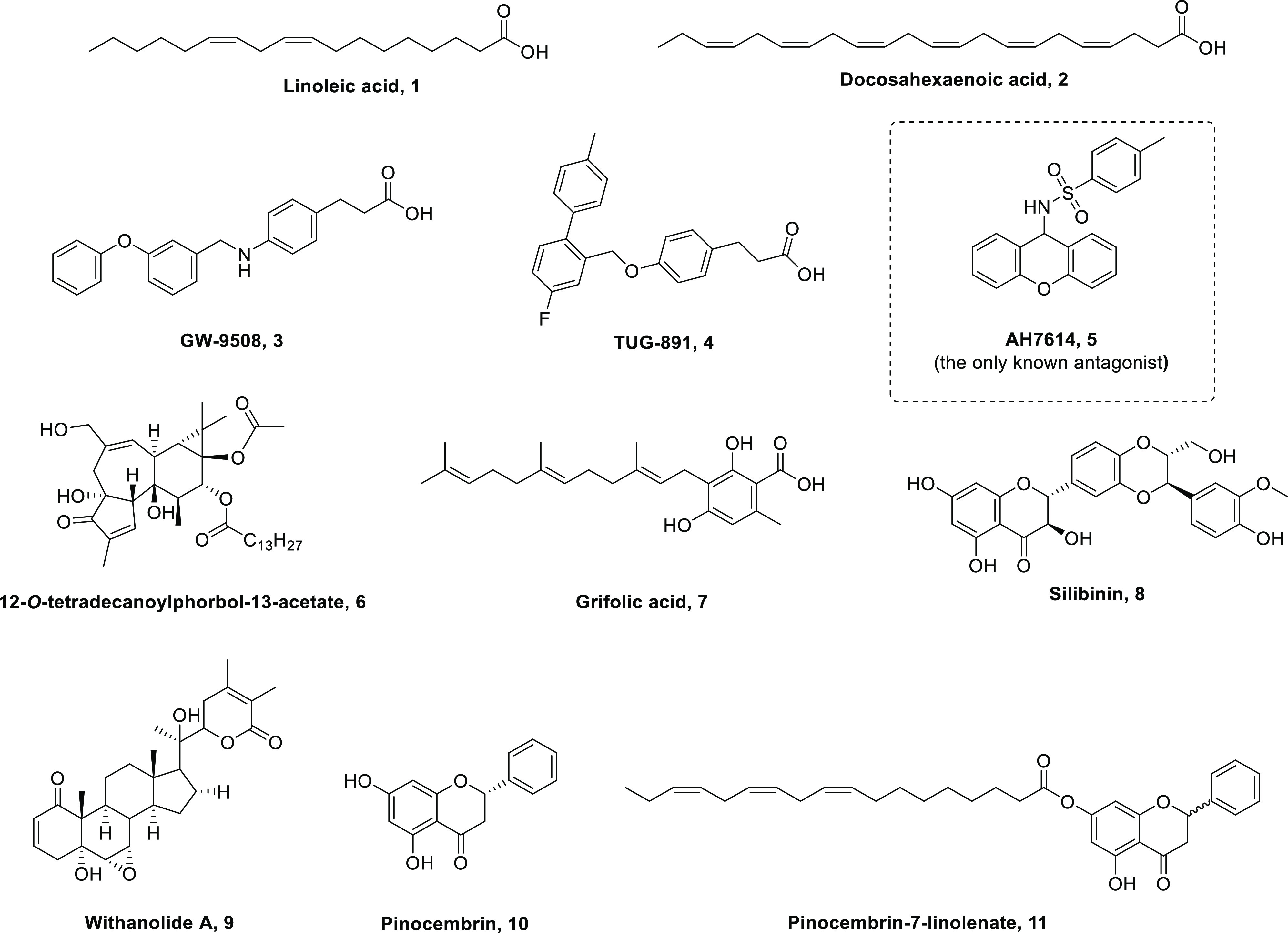
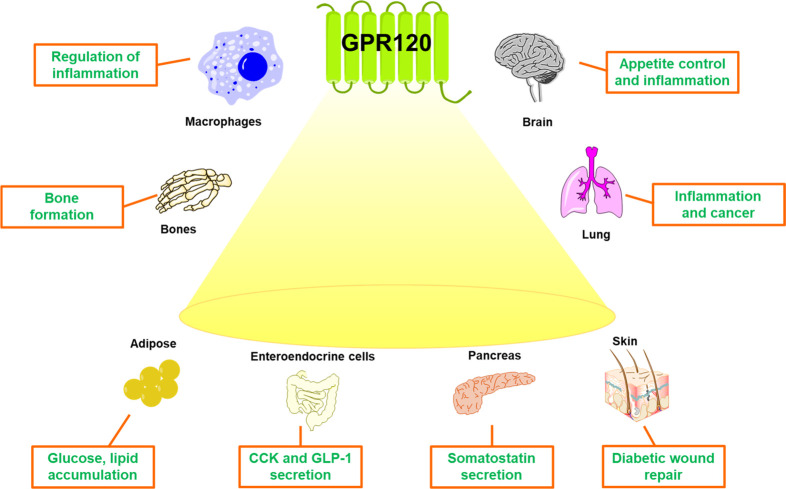
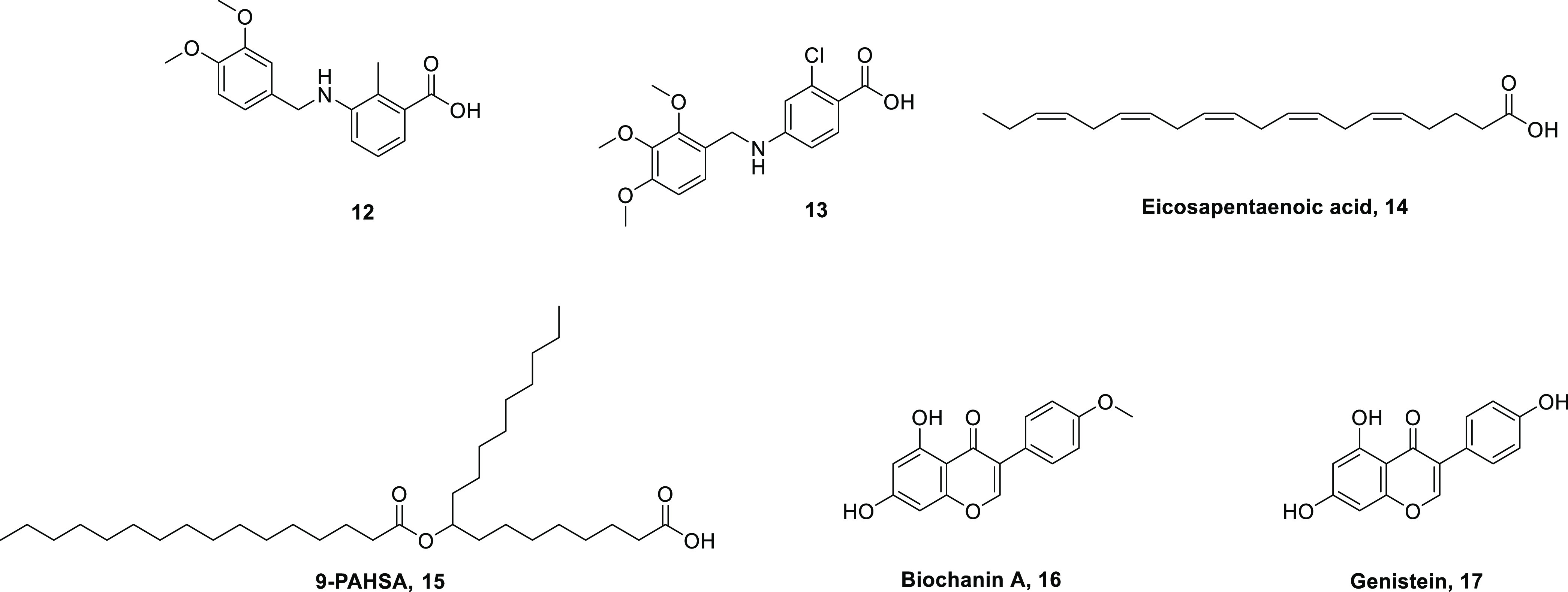
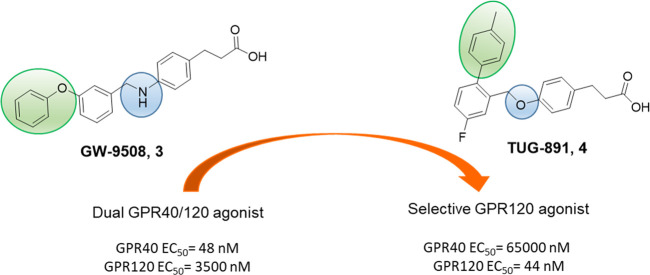
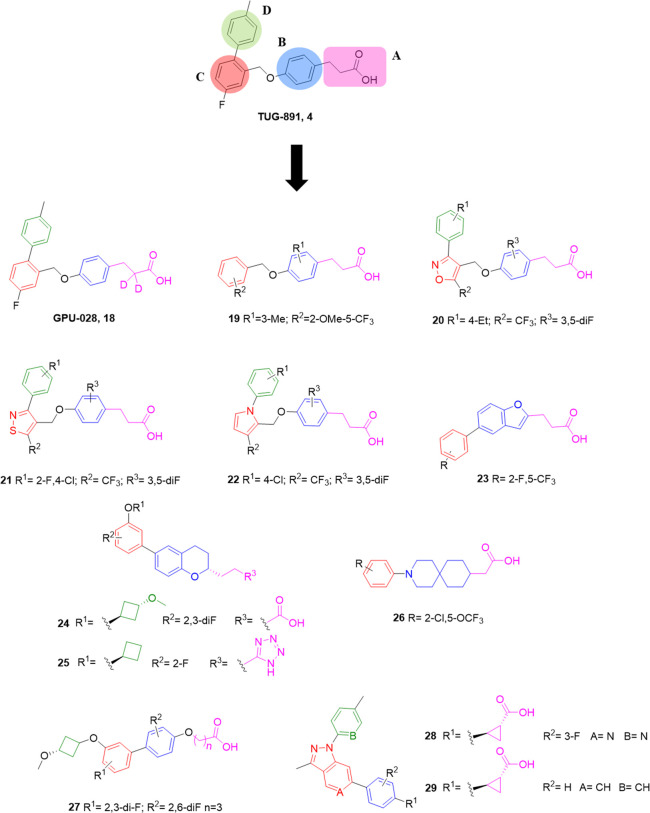
The G-protein coupled receptors (GPCRs) activated by free fatty acids (FFAs) have emerged as new and exciting drug targets, due to their plausible translation from pharmacology to medicines. This perspective aims to report recent research about GPR120/FFAR4 and its involvement in several diseases, including cancer, inflammatory conditions, and central nervous system disorders. The focus is to highlight the importance of GPR120 in Type 2 diabetes mellitus (T2DM). GPR120 agonists, useful in T2DM drug discovery, have been widely explored from a structure-activity relationship point of view. Since the identification of the first reported synthetic agonist TUG-891, the research has paved the way for the development of TUG-based molecules as well as new and different chemical entities. These molecules might represent the starting point for the future discovery of GPR120 agonists as antidiabetic drugs.
Conflict of interest statement
The authors declare no competing financial interest.
Figures
Similar articles
-
Design, synthesis and SAR of a novel series of heterocyclic phenylpropanoic acids as GPR120 agonists.Bioorg Med Chem Lett. 2017 Aug 1;27(15):3272-3278. doi: 10.1016/j.bmcl.2017.06.028. Epub 2017 Jun 12. Bioorg Med Chem Lett. 2017. PMID: 28642104
-
Discovery of N-arylpyrroles as agonists of GPR120 for the treatment of type II diabetes.Bioorg Med Chem Lett. 2018 Mar 1;28(5):841-846. doi: 10.1016/j.bmcl.2018.02.013. Epub 2018 Feb 8. Bioorg Med Chem Lett. 2018. PMID: 29456108
-
Biological characteristics and agonists of GPR120 (FFAR4) receptor: the present status of research.Future Med Chem. 2015;7(11):1457-68. doi: 10.4155/fmc.15.75. Future Med Chem. 2015. PMID: 26230883 Review.
-
Novel GPR120 Agonists with Improved Pharmacokinetic Profiles for the Treatment of Type 2 Diabetes.Molecules. 2021 Nov 16;26(22):6907. doi: 10.3390/molecules26226907. Molecules. 2021. PMID: 34833999 Free PMC article.
-
Recent Updates on Free Fatty Acid Receptor 1 (GPR-40) Agonists for the Treatment of Type 2 Diabetes Mellitus.Mini Rev Med Chem. 2021;21(4):426-470. doi: 10.2174/1389557520666201023141326. Mini Rev Med Chem. 2021. PMID: 33100202 Review.
Cited by
-
Hydroxynonenal Causes Hepatocyte Death by Disrupting Lysosomal Integrity in Nonalcoholic Steatohepatitis.Cell Mol Gastroenterol Hepatol. 2022;14(4):925-944. doi: 10.1016/j.jcmgh.2022.06.008. Epub 2022 Jul 1. Cell Mol Gastroenterol Hepatol. 2022. PMID: 35787976 Free PMC article.
-
Metabolic responses of light and taste receptors - unexpected actions of GPCRs in adipocytes.Rev Endocr Metab Disord. 2022 Feb;23(1):111-120. doi: 10.1007/s11154-021-09667-9. Epub 2021 Jul 1. Rev Endocr Metab Disord. 2022. PMID: 34195966 Free PMC article. Review.
-
Synthetic free fatty acid receptor (FFAR) 2 agonist 4-CMTB and FFAR4 agonist GSK13764 inhibit colon cancer cell growth and migration and regulate FFARs expression in in vitro and in vivo models of colorectal cancer.Pharmacol Rep. 2024 Dec;76(6):1403-1414. doi: 10.1007/s43440-024-00667-5. Epub 2024 Oct 21. Pharmacol Rep. 2024. PMID: 39432182 Free PMC article.
-
Rhodium catalyzed tunable amide homologation through a hook-and-slide strategy.Science. 2023 Nov 24;382(6673):951-957. doi: 10.1126/science.adk1001. Epub 2023 Nov 23. Science. 2023. PMID: 37995236 Free PMC article.
-
Free fatty acid receptors beyond fatty acids: A computational journey to explore peptides as possible binders of GPR120.Curr Res Food Sci. 2024 Mar 4;8:100710. doi: 10.1016/j.crfs.2024.100710. eCollection 2024. Curr Res Food Sci. 2024. PMID: 38496766 Free PMC article.
References
-
- Htike Z. Z.; Zaccardi F.; Papamargaritis D.; Webb D. R.; Khunti K.; Davies M. J. Efficacy and Safety of Glucagon-like Peptide-1 Receptor Agonists in Type 2 Diabetes: A Systematic Review and Mixed-Treatment Comparison Analysis. Diabetes, Obes. Metab. 2017, 19 (4), 524–536. 10.1111/dom.12849. - DOI - PubMed
Publication types
MeSH terms
Substances
LinkOut - more resources
Full Text Sources
Other Literature Sources
Chemical Information
Medical