


Hearing Loss, Tinnitus, and Dizziness in COVID-19: A Systematic Review and Meta-Analysis
- PMID: 33843530
- PMCID: PMC8267343
- DOI: 10.1017/cjn.2021.63
Hearing Loss, Tinnitus, and Dizziness in COVID-19: A Systematic Review and Meta-Analysis
Abstract
Objectives: Extensive studies indicate that severe acute respiratory syndrome coronavirus (SARS-CoV-2) involves human sensory systems. A lack of discussion, however, exists given the auditory-vestibular system involvement in CoV disease 2019 (COVID-19). The present systematic review and meta-analysis were performed to determine the event rate (ER) of hearing loss, tinnitus, and dizziness caused by SARS-CoV-2.
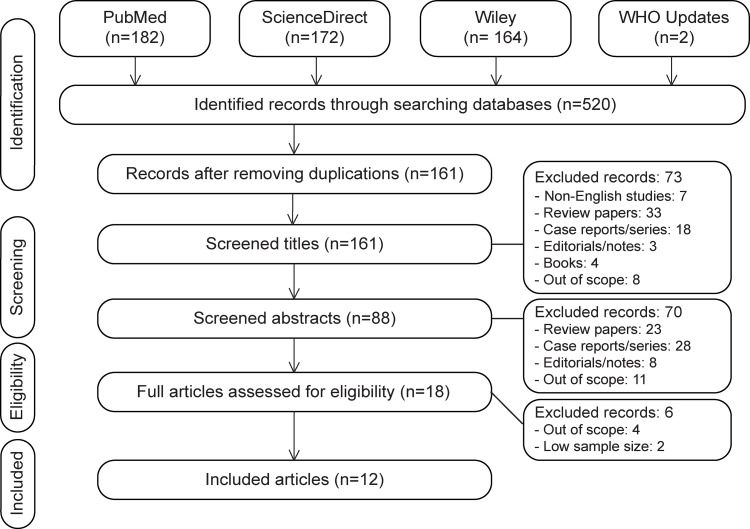
Methods: Databases (PubMed, ScienceDirect, Wiley) and World Health Organization updates were searched using combined keywords: 'COVID-19,' 'SARS-CoV-2,' 'pandemic,' 'auditory dysfunction,' 'hearing loss,' 'tinnitus,' 'vestibular dysfunction,' 'dizziness,' 'vertigo,' and 'otologic symptoms.'
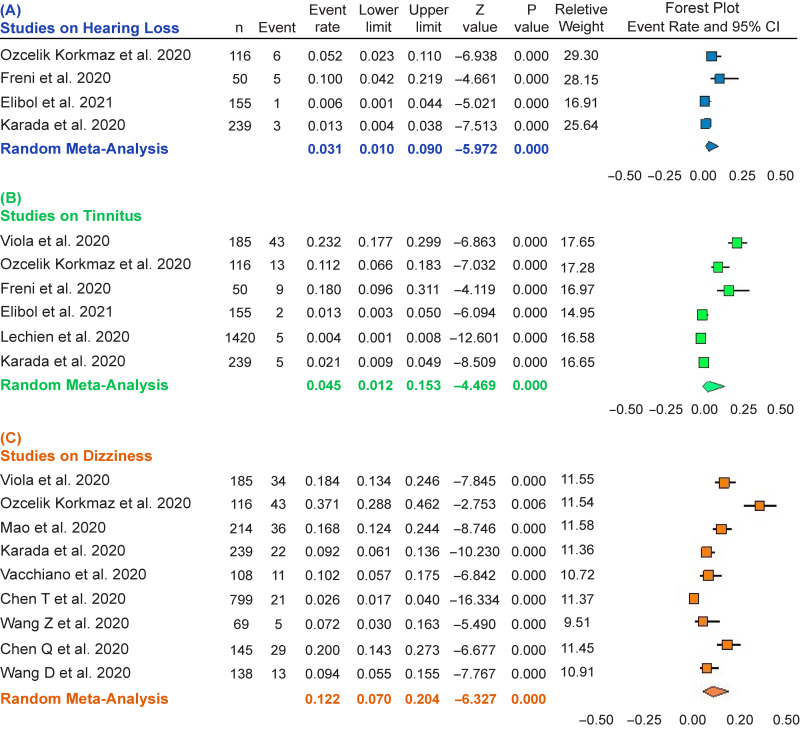
Results: Twelve papers met the eligibility criteria and were included in the study. These papers were single group prospective, cross-sectional, or retrospective studies on otolaryngologic, neurologic, or general clinical symptoms of COVID-19 and had used subjective assessments for data collection (case histories/medical records). The results of the meta-analysis demonstrate that the ER of hearing loss (3.1%, CIs: 0.01-0.09), tinnitus (4.5%, CIs: 0.012-0.153), and dizziness (12.2%, CIs: 0.070-0.204) is statistically significant in patients with COVID-19 (Z ≤ -4.469, p ≤ 0.001).
Conclusions: COVID-19 can cause hearing loss, tinnitus, and dizziness. These findings, however, should be interpreted with caution given insufficient evidence and heterogeneity among studies. Well-designed studies and follow-up assessments on otologic symptoms of SARS-CoV-2 using standard objective tests are recommended.
Pertes auditives, acouphènes et étourdissements chez des patients atteints de la COVID-19 : une étude systématique et une méta-analyse.
Objectifs :: Des études approfondies indiquent désormais que le syndrome respiratoire aigu sévère lié au coronavirus (SRAS-CoV-2) peut affecter les systèmes sensoriels humains. L’impact du virus sur les systèmes auditif et vestibulaire est tel qu’on peut considérer qu’il existe à l’heure actuelle un manque de discussions quant à cet impact. L’étude systématique et la méta-analyse qui suivent ont été effectuées afin de déterminer justement la fréquence des pertes auditives, des acouphènes et des étourdissements causés à partir de 2019 par le SRAS-CoV-2.
Méthodes :: Nous avons interrogé certaines bases de données (PubMed, ScienceDirect, Wiley) mais aussi les mises à jour de l’Organisation mondiale de la santé (OMS) au moyen des mots-clés combinés suivants : « COVID-19 », « SRAS-CoV-2 », « pandémie », « dysfonction auditive », « pertes auditives », « acouphènes », « dysfonction vestibulaire », « étourdissements », « vertiges » et « symptômes otologiques ».
Résultats :: Au total, 12 articles ont satisfait à nos critères d’admissibilité et ont été inclus dans cette étude. Ces articles étaient prospectifs et basés sur un seul groupe, de nature transversale, de nature oto-rhino-laryngologique et rétrospective, de nature neurologique ou axés sur les symptômes cliniques généraux de la COVID-19. Tous ont recouru à des évaluations subjectives dans la collecte des données (historique des cas, dossiers médicaux). Les résultats de la méta-analyse ont ainsi démontré que les fréquences de pertes auditives (3,1 %, IC : 0,01-0,09), d’acouphènes (4,5 %, IC : 0,012-0,153) et d’étourdissements (12,2 %, IC : 0,070-0,204) étaient statistiquement significatives chez des patients atteints de la COVID-19 (Z ≤ −4,469, p ≤ 0,001).
Conclusions :: La COVID-19 peut entraîner des pertes auditives, des acouphènes et des étourdissements. Ces résultats devraient toutefois être interprétés prudemment étant donné le manque de preuves et l’hétérogénéité des articles en cause. Des études bien conçues et des évaluations des symptômes otologiques du SRAS-CoV-2 lors de suivis à l’aide de tests standardisés objectifs sont donc recommandées.
Keywords: Coronavirus; Dizziness; Hearing loss; Otologic symptoms; SARS-CoV-2; Tinnitus; Vertigo.
Figures
References
-
- Cascella C, Rajnik M, Cuomo A, Dulebohn S, Di Napoli R. Features, Evaluation, and Treatment of Coronavirus (COVID-19). Treasure Island (FL): StatPearls; 2020. - PubMed
Publication types
MeSH terms
LinkOut - more resources
Full Text Sources
Other Literature Sources
Medical
Miscellaneous
