Effects of a Self-directed Web-Based Strengthening Exercise and Physical Activity Program Supported by Automated Text Messages for People With Knee Osteoarthritis: A Randomized Clinical Trial
- PMID: 33843948
- PMCID: PMC8042569
- DOI: 10.1001/jamainternmed.2021.0991
Effects of a Self-directed Web-Based Strengthening Exercise and Physical Activity Program Supported by Automated Text Messages for People With Knee Osteoarthritis: A Randomized Clinical Trial
Abstract
Importance: Exercise therapies are advocated in osteoarthritis (OA) clinical guidelines. However, challenges to accessing exercise may be limiting widespread uptake.
Objective: To evaluate the effects of a self-directed web-based strengthening exercise and physical activity program supported by automated behavior-change text messages on knee pain and function for people with knee OA.
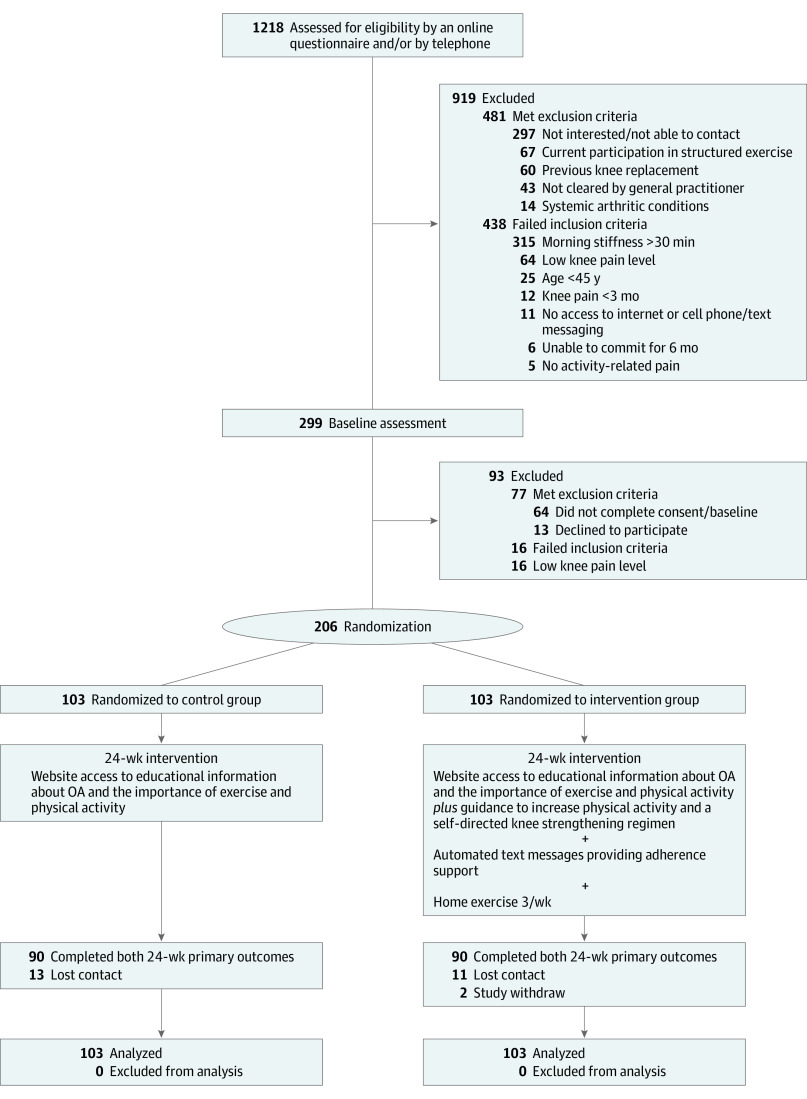
Design, setting, and participants: The participant-blinded and assessor-blinded randomized clinical trial enrolled 206 people who met clinical criteria for knee OA in communities across Australia from July 2018 to August 2019, with follow-up taking place at 24 weeks.
Interventions: The control group was given access to a custom-built website with information on OA and the importance of exercise and physical activity. The intervention group was given access to the same information plus a prescription for a 24-week self-directed strengthening regimen and guidance to increase physical activity, supported by automated behavior-change text messages encouraging exercise adherence.
Main outcomes and measures: Primary outcomes were change in overall knee pain (numeric rating scale, 0-10) and difficulty with physical function (Western Ontario and McMaster Universities Osteoarthritis Index, 0-68) over 24 weeks. Secondary outcomes were another knee pain measure, sport and recreation function, quality of life, physical activity, self-efficacy, overall improvement, and treatment satisfaction.
Results: Of 206 participants, 180 (87%; mean [SD] age, 60 [8.4] years; 109 [61%] women) completed both 24-week primary outcomes. The intervention group showed greater improvements in overall knee pain (mean difference, 1.6 units; 95% CI, 0.9-2.2 units; P < .001) and physical function (mean difference, 5.2 units; 95% CI, 1.9-8.5 units; P = .002) compared with the control. There was evidence of differences in the proportion of participants exceeding the minimal clinically important improvement in pain (intervention group, 72.1%, vs control, 42.0%; risk difference, 0.30 [95% CI, 0.16-0.44]; P <. 001) and function (intervention group, 68%, vs control, 40.8%; risk difference, 0.27 [95% CI, 0.13-0.41]; P < .001) favoring the intervention. Between-group differences for all secondary outcomes favored the intervention except for physical activity, self-efficacy for function, and self-efficacy for exercise, for which there was no evidence of differences.
Conclusions and relevance: This randomized clinical trial found that a self-directed web-based strengthening exercise regimen and physical activity guidance supported by automated behavior-change text messages to encourage exercise adherence improved knee pain and function at 24 weeks. This unsupervised, free-to-access digital intervention is an effective option to improve patient access to recommended OA exercise and/or to support clinicians in providing exercise management for people with knee OA at scale across the population.
Trial registration: Australian New Zealand Clinical Trials Registry Identifier: ACTRN12618001167257.
Conflict of interest statement
Figures
Comment in
-
Critically appraised paper: A self-directed, web-based exercise and physical activity program supported with text messages improves knee pain and function for people with knee osteoarthritis [synopsis].J Physiother. 2021 Oct;67(4):309. doi: 10.1016/j.jphys.2021.08.004. Epub 2021 Sep 10. J Physiother. 2021. PMID: 34511384 No abstract available.
-
Critically appraised paper: A self-directed, web-based exercise and physical activity program supported with text messages improves knee pain and function for people with knee osteoarthritis [commentary].J Physiother. 2021 Oct;67(4):309. doi: 10.1016/j.jphys.2021.08.003. Epub 2021 Sep 10. J Physiother. 2021. PMID: 34518148 No abstract available.
References
-
- National Institute for Health and Clinical Excellence . United Kingdom. Clinical guideline: osteoarthritis care and management in adults. 2014. Accessed March 4, 2021. https://www.nice.org.uk/guidance/cg177
Publication types
MeSH terms
LinkOut - more resources
Full Text Sources
Other Literature Sources
Medical
Miscellaneous