


Feasibility of assessing progression of transthyretin amyloid polyneuropathy using nerve conduction studies: Findings from the Transthyretin Amyloidosis Outcomes Survey (THAOS)
- PMID: 33844361
- PMCID: PMC8360174
- DOI: 10.1111/jns.12444
Feasibility of assessing progression of transthyretin amyloid polyneuropathy using nerve conduction studies: Findings from the Transthyretin Amyloidosis Outcomes Survey (THAOS)
Abstract
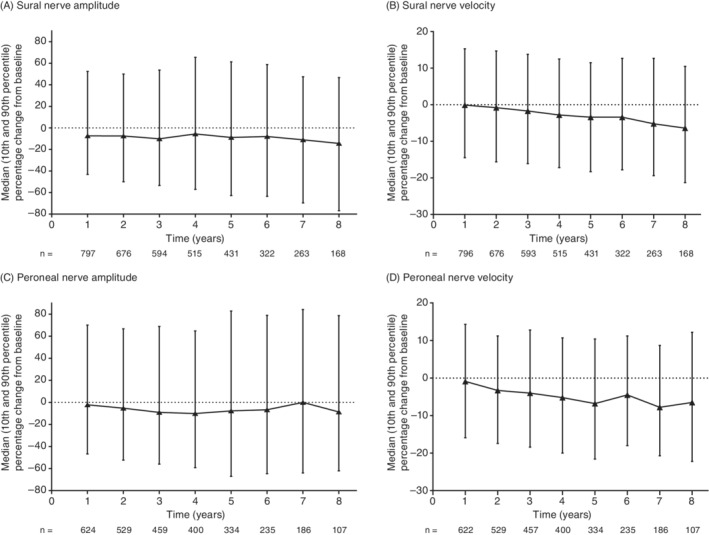
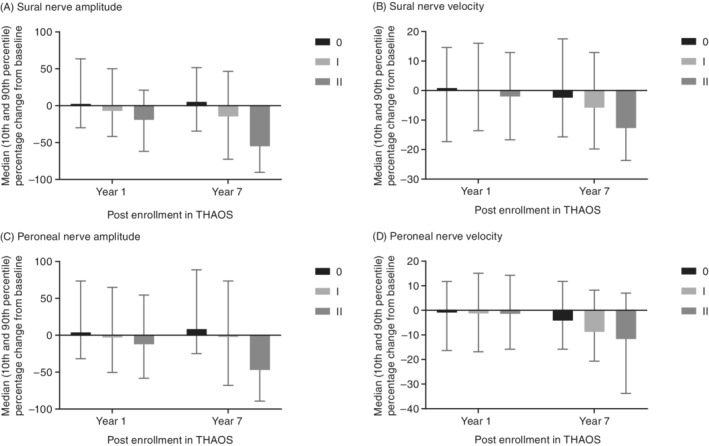
Patients with transthyretin amyloid polyneuropathy (ATTR-PN) show decreased motor and sensory nerve amplitudes and conduction. Electrophysiological changes over time may be sensitive indicators of progression. This analysis from the Transthyretin Amyloidosis Outcomes Survey (THAOS) assessed longitudinal changes in nerve conduction as signals of neurologic disease progression in patients with hereditary ATTR (ATTRv) amyloidosis. Patients with ATTRv in THAOS with recorded nerve conduction values were included (data cut-off: January 6, 2020); changes in nerve amplitude and velocity over time were assessed. Patients (n = 1389) were 45.0% male; 80.4% were the Val30Met (p.Val50Met) genotype. Mean (SD) age at enrollment was 43.6 (14.5) years; duration of symptoms was 9.3 (6.4) years. Median (10th, 90th percentile) sural nerve amplitude and velocity was 18.0 (4.9, 35.0) μV and 50.7 (41.0, 57.9) m/s; peroneal conduction was 13.0 (4.4, 27.0) μV and 51.0 (41.7, 59.7) m/s, respectively. Median (10th, 90th percentile) percentage change from baseline in sural nerve amplitude was variable, but generally decreased over time from -7.4 (-43.2, 52.4) at year 1 to -14.4 (-76.9, 46.7) at year 8. Percent change from baseline in sural nerve velocity declined similarly: -0.1 (-14.5, 15.3) at year 1 and - 6.4 (-21.3, 10.5) at year 8. The decline was more pronounced in patients with greater disability at baseline. Similar patterns were observed for the peroneal nerve. These data show an association between nerve amplitudes and velocities and disease severity, suggesting progressive deterioration in nerve conduction may be an indicator of ATTRv amyloidosis disease progression.
Keywords: ATTR-PN; nerve amplitude; nerve conduction; transthyretin amyloid polyneuropathy.
© 2021 The Authors. Journal of the Peripheral Nervous System published by Wiley Periodicals LLC on behalf of Peripheral Nerve Society.
Conflict of interest statement
Márcia Waddington‐Cruz received research funding, consulting fees, and travel support for advisory boards and meetings from FoldRx Pharmaceuticals and Pfizer. Yukio Ando declares receipt of consulting fee or honorarium, support for travel to meetings, and provision for writing assistance from Pfizer. Yoshiki Sekijima has received royalties from Pfizer related to tafamidis patents and has received speaker honoraria from Pfizer. Leslie Amass, Doug Chapman, and Jan Kiszko are full‐time employees of Pfizer and hold stock and/or stock options with Pfizer.
Figures
References
-
- Yamashita T, Ando Y, Okamoto S, et al. Long‐term survival after liver transplantation in patients with familial amyloid polyneuropathy. Neurology. 2012;78:637‐643. - PubMed
-
- Falk RH, Comenzo RL, Skinner M. The systemic amyloidoses. N Engl J Med. 1997;337:898‐909. - PubMed
-
- Planté‐Bordeneuve V, Said G. Familial amyloid polyneuropathy. Lancet Neurol. 2011;10:1086‐1097. - PubMed
-
- Planté‐Bordeneuve V. Transthyretin familial amyloid polyneuropathy: an update. J Neurol. 2018;265:976‐983. - PubMed
MeSH terms
Substances
Supplementary concepts
Grants and funding
LinkOut - more resources
Full Text Sources
Other Literature Sources
Research Materials
