


Quantifying the effect of trypsin and elastase on in vitro SARS-CoV infections
- PMID: 33845063
- PMCID: PMC8043718
- DOI: 10.1016/j.virusres.2021.198423
Quantifying the effect of trypsin and elastase on in vitro SARS-CoV infections
Abstract
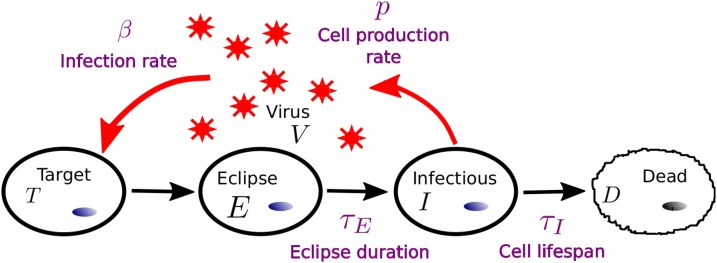
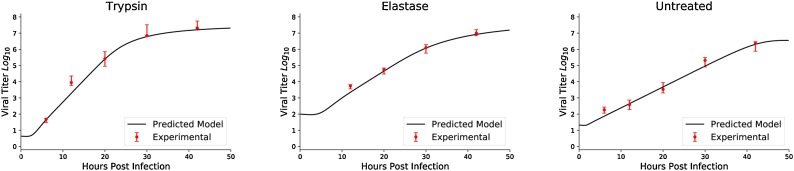
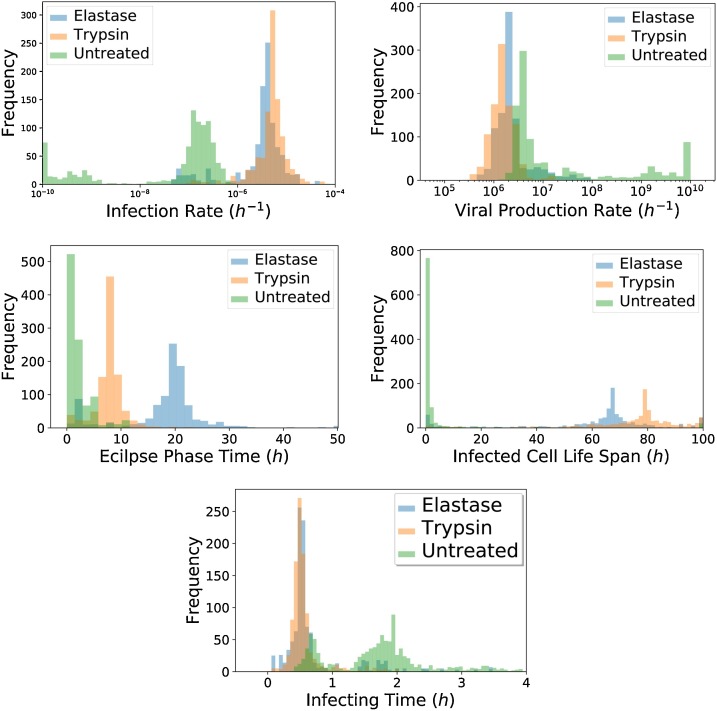
The SARS coronavirus (SARS-CoV) has the potential to cause serious disease that can spread rapidly around the world. Much of our understanding of SARS-CoV pathogenesis comes from in vitro experiments. Unfortunately, in vitro experiments cannot replicate all the complexity of the in vivo infection. For example, proteases in the respiratory tract cleave the SARS-CoV surface protein to facilitate viral entry, but these proteases are not present in vitro. Unfortunately, proteases might also have an effect on other parts of the replication cycle. Here, we use mathematical modeling to estimate parameters characterizing viral replication for SARS-CoV in the presence of trypsin or elastase, and in the absence of either. In addition to increasing the infection rate, the addition of trypsin and elastase causes lengthening of the eclipse phase duration and the infectious cell lifespan.
Keywords: Coronavirus; In vitro infections; Mathematical model; Parameter estimation; Protease.
Copyright © 2021 Elsevier B.V. All rights reserved.
Figures
References
-
- Ami Y., Nagata N., Shirato K., Watanabe R., Iwata N., Nakagaki K., Fukushi S., Saijo M., Morikawa S., Taguchi F. Co-infection of respiratory bacterium with severe acute respiratory syndrome coronavirus induces an exacerbated pneumonia in mice. Microbiol. Immunol. 2008;52(2):118–127. doi: 10.1111/j.1348-0421.2008.00011.x. - DOI - PMC - PubMed
MeSH terms
Substances
LinkOut - more resources
Full Text Sources
Other Literature Sources
Miscellaneous
