


Clinical characteristics and outcome of influenza virus infection among adults hospitalized with severe COVID-19: a retrospective cohort study from Wuhan, China
- PMID: 33845787
- PMCID: PMC8040362
- DOI: 10.1186/s12879-021-05975-2
Clinical characteristics and outcome of influenza virus infection among adults hospitalized with severe COVID-19: a retrospective cohort study from Wuhan, China
Abstract
Background: Coronavirus disease 2019 (COVID-19) is an emerging infectious disease that rapidly spreads worldwide and co-infection of COVID-19 and influenza may occur in some cases. We aimed to describe clinical features and outcomes of severe COVID-19 patients with co-infection of influenza virus.
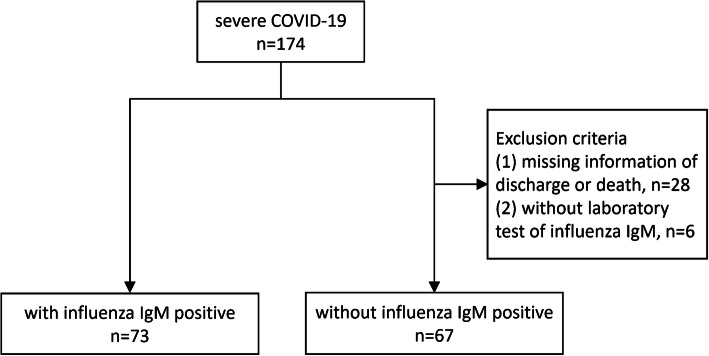
Methods: Retrospective cohort study was performed and a total of 140 patients with severe COVID-19 were enrolled in designated wards of Sino-French New City Branch of Tongji Hospital between Feb 8th and March 15th in Wuhan city, Hubei province, China. The demographic, clinical features, laboratory indices, treatment and outcomes of these patients were collected.
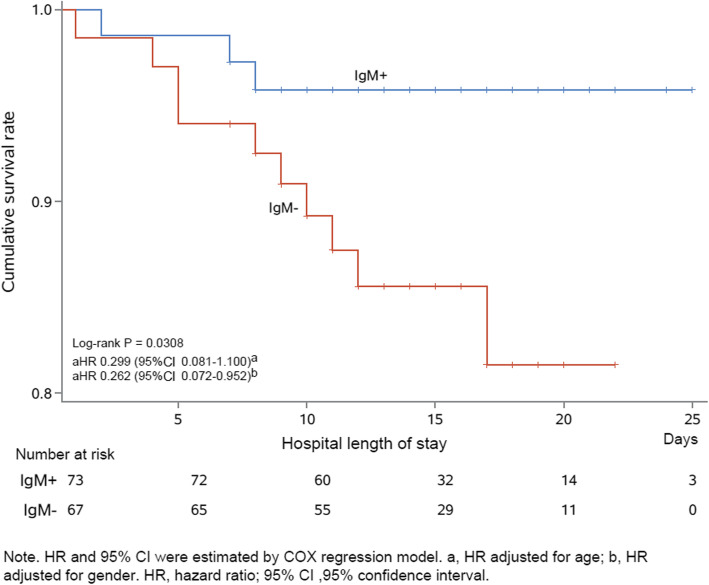
Results: Of 140 severe COVID-19 hospitalized patients, including 73 patients (52.14%) with median age 62 years were influenza virus IgM-positive and 67 patients (47.86%) with median age 66 years were influenza virus IgM-negative. 76 (54.4%) of severe COVID-19 patients were males. Chronic comorbidities consisting mainly of hypertension (45.3%), diabetes (15.8%), chronic respiratory disease (7.2%), cardiovascular disease (5.8%), malignancy (4.3%) and chronic kidney disease (2.2%). Clinical features, including fever (≥38 °C), chill, cough, chest pain, dyspnea, diarrhea and fatigue or myalgia were collected. Fatigue or myalgia was less found in COVID-19 patients with IgM-positive (33.3% vs 50/7%, P = 0.0375). Higher proportion of prolonged activated partial thromboplastin time (APTT) > 42 s was observed in COVID-19 patients with influenza virus IgM-negative (43.8% vs 23.6%, P = 0.0127). Severe COVID-19 Patients with influenza virus IgM positive have a higher cumulative survivor rate than that of patients with influenza virus IgM negative (Log-rank P = 0.0308). Considering age is a potential confounding variable, difference in age was adjusted between different influenza virus IgM status groups, the HR was 0.29 (95% CI, 0.081-1.100). Similarly, difference in gender was adjusted as above, the HR was 0.262 (95% CI, 0.072-0.952) in the COX regression model.
Conclusions: Influenza virus IgM positive may be associated with decreasing in-hospital death.
Keywords: COVID-19; Influenza virus IgM; SARS-CoV-2.
Conflict of interest statement
The authors declare that they have no competing interests.
Figures
References
-
- Zhou P, Yang XL, Wang XG, Hu B, Zhang L, Zhang W, Si HR, Zhu Y, Li B, Huang CL, Chen HD, Chen J, Luo Y, Guo H, Jiang RD, Liu MQ, Chen Y, Shen XR, Wang X, Zheng XS, Zhao K, Chen QJ, Deng F, Liu LL, Yan B, Zhan FX, Wang YY, Xiao GF, Shi ZL, et al. A pneumonia outbreak associated with a new coronavirus of probable bat origin. Nature. 2020;579(7798):270–273. doi: 10.1038/s41586-020-2012-7. - DOI - PMC - PubMed
-
- World Health Organization. Coronavirus disease (COVID-19) outbreak https://www.who.int. Date last accessed: April 14, 2020.
MeSH terms
Substances
Grants and funding
LinkOut - more resources
Full Text Sources
Other Literature Sources
Medical
Miscellaneous
