. 2021 Jun;47(6):99.
doi: 10.3892/ijmm.2021.4932. Epub 2021 Apr 13.

KIF4A promotes the development of bladder cancer by transcriptionally activating the expression of CDCA3

Affiliations

KIF4A promotes the development of bladder cancer by transcriptionally activating the expression of CDCA3

Pengyi Zheng et al. Int J Mol Med. 2021 Jun.

Retraction in

Abstract

Bladder cancer (BC) is among the most common urinary system tumors with a high morbidity and mortality worldwide. Despite advancements being made in the diagnosis and treatment of bladder cancer, targeted therapy remains the most promising treatment, and novel therapeutic targets are urgently required in to improve the outcomes of patients with BC. Kinesin family member 4A (KIF4A) is a plus‑end directed motor protein involved in the regulation of multiple cellular processes, such as mitosis and axon growth. Notably, KIF4A plays important roles in tumor growth and progression, and its expression is associated with the prognosis of several types of cancer. However, the potential role and molecular mechanisms of KIF4A in bladder cancer development remain unclear. The present study demonstrated that KIF4A was highly expressed in human BC tissues, and its expression was associated with patient clinicopathological characteristics, such as tumor stage (P=0.012) and with the prognosis of patients with BC. It was further found that KIF4A promoted the cell proliferation of bladder cancer both in vitro and in vivo. On the whole, the data presented herein provide evidence that KIF4A promotes the development of BC through the transcriptional activation of the expression of CDCA3. The present study indicates the involvement of KIF4A in the progression of BC and suggests that KIF4A may be a promising therapeutic target for the treatment of BC.

Keywords: bladder cancer; kinesin family member 4A; cell division cycle‑associated protein 3; tumor stage; prognosis.


Conflict of interest statement

The authors declare that they have no competing interests.

Figures
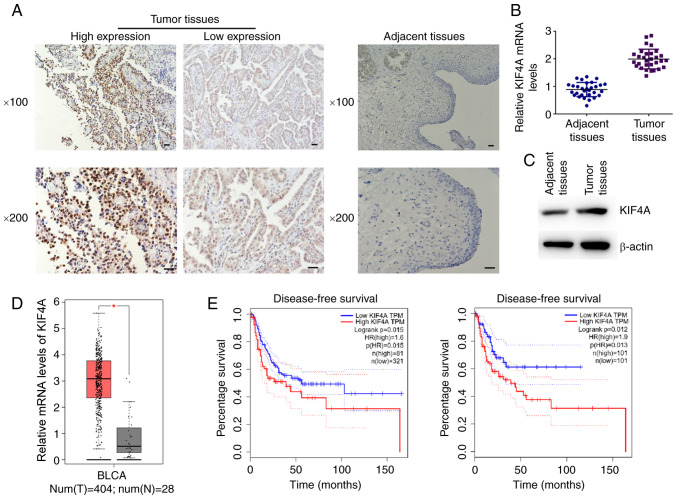
Figure 1
Figure 1
KIF4A is highly expressed in human BC tissues and is associated with a poor prognosis of patients with BC. (A) Representative images of the KIF4A expression level detected by immunohistochemical staining of BC tissues and normal tissues (×100 and ×200 magnification, respectively). Scale bar, 5 mm. (B) RT-qPCR assays showing the mRNA levels of KIF4A in 30 tumor tissues and the corresponding normal tissues from patients with BC. (C) Western blot analysis showing the expression levels of KIF4A in tumor tissues and corresponding normal tissues from patients with BC. (D) mRNA levels of KIF4A in 404 BC tissues and 28 normal tissues were compared according to TCGA data. (E) Kaplan-Meier plot analysis of two sets of data for the disease-free survival rate between high and low KIF4A expression groups according to TCGA data. KIF4A, kinesin family member 4A; BC, bladder cancer.
Figure 2
Figure 2
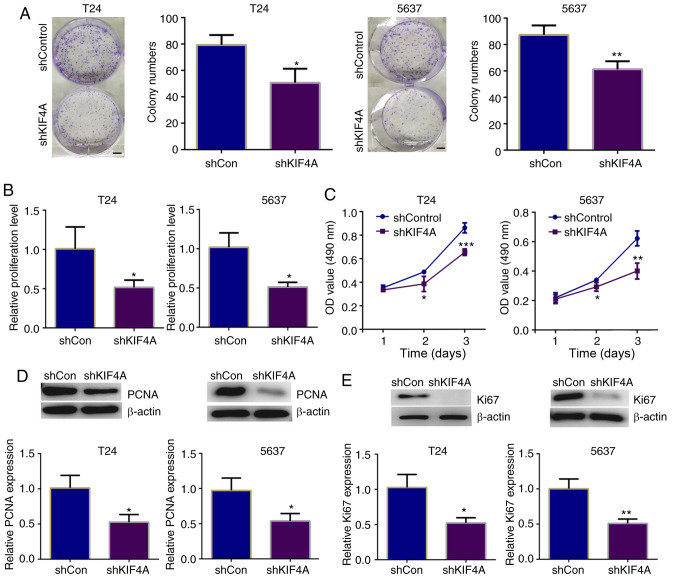
KIF4A promotes the proliferation of BC cells in vitro. (A) Colony formation assays revealed the difference in the proliferative capacity of T24 and 5637 cells transfected with control or KIF4A shRNA plasmids. Scale bar, 5 mm. (B) MTT assays showing the proliferative capacity of BC cells transfected with control or KIF4A shRNA plasmids. (C) CCK-8 assays exhibited the proliferation of BC cells was inhibited after KIF4A depletion. (D) Western blot analysis showing the expression levels of PCNA in control or KIF4A shRNA-transfected T24 and 5637 cells. (E) Western blot analysis showing the expression of Ki67 in control or KIF4A shRNA-transfected BC cells. Results are presented as the mean ± SEM; *P<0.05, **P<0.01 and ***P<0.001, vs. control. KIF4A, kinesin family member 4A; BC, bladder cancer; PCNA, proliferating cell nuclear antigen.
Figure 3
Figure 3
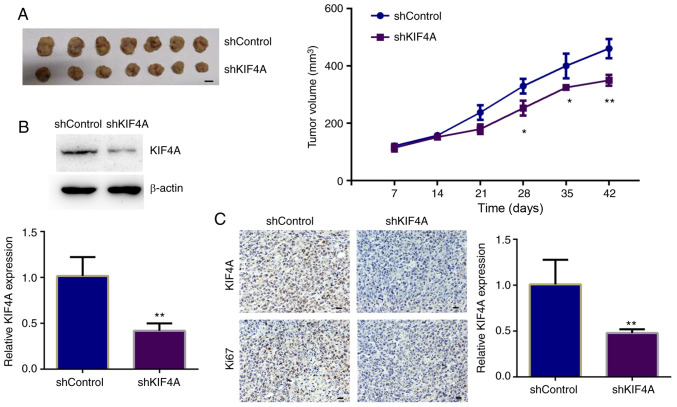
KIF4A promotes tumor growth of BC cells in mice. (A) Representative images of tumors in nude mice formed by T24 cells infected with control or KIF4A shRNA lentivirus (n=5 in each group). Volume of tumors from different groups was measured. Scale bar, 5 mm. (B) Western blot analysis showing the expression level of KIF4A in control tissues and in tumor tissues derived from BC cells in which KIF4A was knocked down. (C) Immunohistochemical staining results revealed the expression level of KIF4A in control and KIF4A-depleted tumor tissues. Scale bar, 5 mm. Results are presented as the mean ± SEM; *P<0.05 and **P<0.01, vs. control. KIF4A, kinesin family member 4A; BC, bladder cancer.
Figure 4
Figure 4
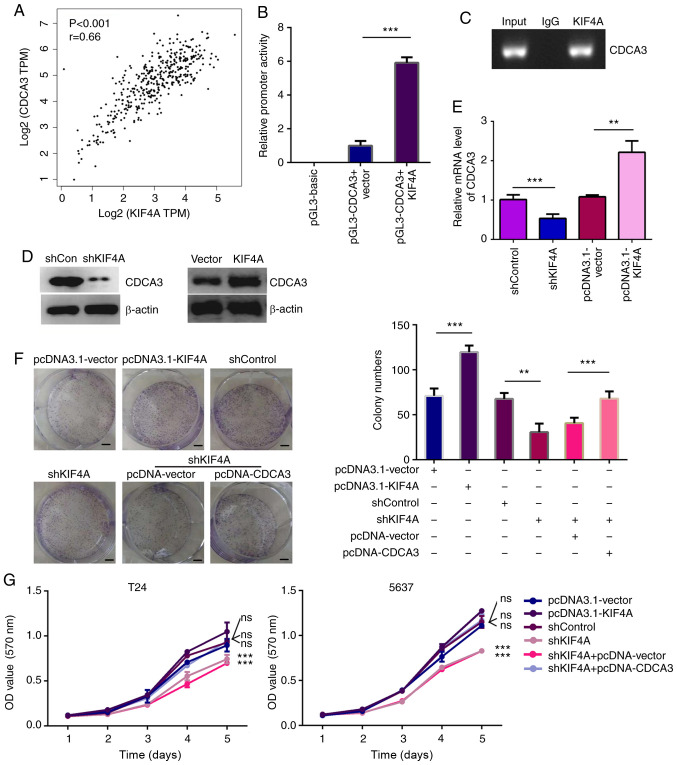
KIF4A transcriptionally activates the expression of CDCA3. (A) TCGA data revealed the correlation between KIF4A and CDCA3 expression in human BC tissues. (B) Luciferase activity of pGL3-Basic, pGL3-CDCA3 in T24 cells co-transfected with pEnter-KIF4A or pEnter-vector plasmids analyzed by luciferase reporter assays. (C) PCR amplification of the anti-IgG or anti-KIF4A antibody enriched CDCA3 promoter fragment in T24 cells performing ChIP assays. (D) KIF4A and CDCA3 expression level in pEnter-vector or pEnter-KIF4A transfected T24 cells were detected by western blot analysis. (E) KIF4A and CDCA3 expression level in control- or KIF4A shRNA-transfected T24 cells were detected by RT-qPCR. (F) Colony formation assays showing the difference in the proliferative capacity between T24 cells transfected with the indicated shRNAs and/or plasmids. (G) Left panel, MTT assays exhibited the difference in the proliferative capacity between T24 cells transfected with the indicated shRNAs and/or plasmids. Right panel, the difference in the proliferative capacity between 5637 cells transfected with the indicated shRNAs and/or plasmids. Scale bar, 5 mm. pcDNA3.1-KIF4A vs. pcDNA3.1-vector, shKIF4A vs. shControl, and shKIF4A + pcDNA3.1-CDCA3 vs. shKIF4A + pcDNA3.1-vector. Results are presented as the mean ± SEM; **P<0.01 and ***P<0.001, vs. respective control. KIF4A, kinesin family member 4A; BC, bladder cancer; CDCA3, cell division cycle-associated protein 3.
Figure 5
Figure 5
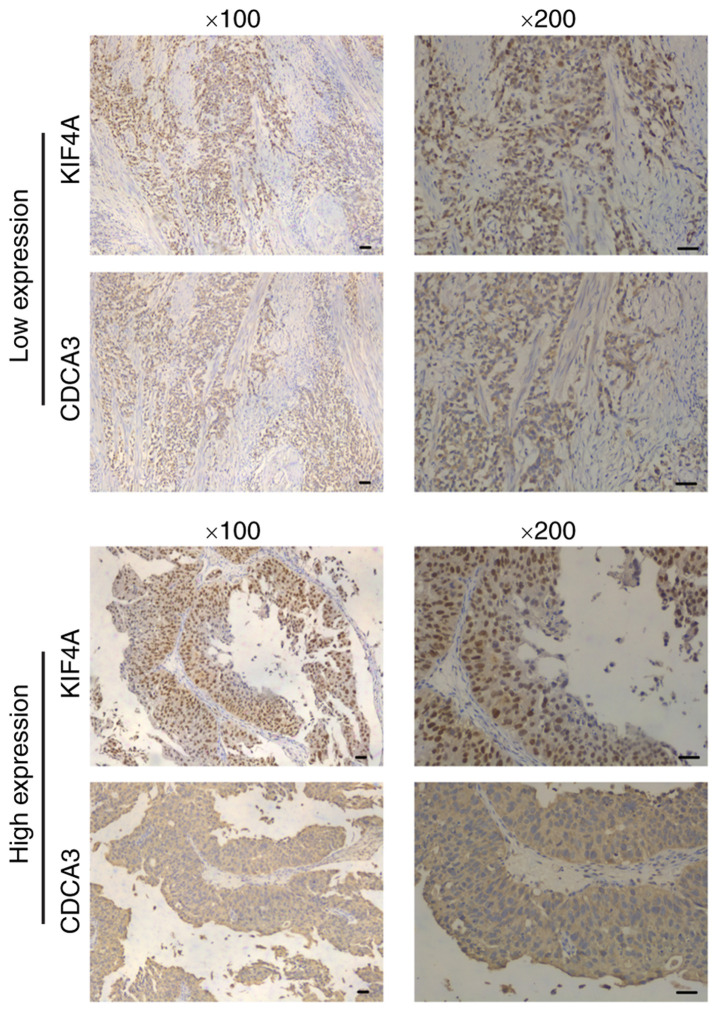
Expression of CDCA3 is positively associated with KIF4A in human BC tissues. Immunohistochemical staining assays showing CDCA3 and KIF4A expression levels in tissues from patients with BC. Scale bar, 5 mm. KIF4A, kinesin family member 4A; BC, bladder cancer; CDCA3, cell division cycle-associated protein 3.
Figure 6
Figure 6
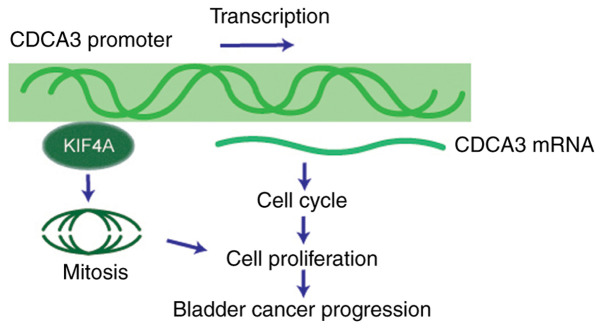
Regulatory model for the role of KIF4A in BC progression. In the present study, it was found that KIF4A transcriptionally activated CDCA3, promoted cell proliferation through the control of cell cycle and further promoted BC development. KIF4A, kinesin family member 4A; BC, bladder cancer; CDCA3, cell division cycle-associated protein 3.

References

    1. Williams SB, Shan Y, Jazzar U, Mehta HB, Baillargeon JG, Huo J, Huo J, Senagore AJ, Orihuela E, Tyler DS, et al. Comparing survival outcomes and costs associated with radical cystectomy and trimodal therapy for older adults with Muscle-Invasive bladder cancer. JAMA Surg. 2018;153:881–889. doi: 10.1001/jamasurg.2018.1680. - DOI - PMC - PubMed
    1. Giulietti M, Occhipinti G, Righetti A, Bracci M, Conti A, Ruzzo A, Cerigioni E, Cacciamani T, Principato G, Piva F. Emerging biomarkers in bladder cancer identified by network analysis of transcriptomic data. Front Oncol. 2018;8:450. doi: 10.3389/fonc.2018.00450. - DOI - PMC - PubMed
    1. Terzic M, Ladjevic IL, Ladjevic N, Terzic S, Dotlic J, Cekerevac M, Arsenovic N, Laganà AS, Vereczkey A. Anaplastic T-cell lymphoma of the urinary bladder with unspecific clinical and radiological characteristics - a unique case report. Eur J Gynaecol Oncol. 2019;40:136–139.
    1. Tan WS, Rodney S, Lamb B, Feneley M, Kelly J. Management of non-muscle invasive bladder cancer: A comprehensive analysis of guidelines from the United States, Europe and Asia. Cancer Treat Rev. 2016;47:22–31. doi: 10.1016/j.ctrv.2016.05.002. - DOI - PubMed
    1. Wang Y, Chang Q, Li Y. Racial differences in Urinary bladder cancer in the United States. Sci Rep. 2018;8:12521. doi: 10.1038/s41598-018-29987-2. - DOI - PMC - PubMed

Publication types