Challenges and perspectives for immunotherapy in oesophageal cancer: A look to the future (Review)
- PMID: 33846775
- PMCID: PMC8041478
- DOI: 10.3892/ijmm.2021.4930
Challenges and perspectives for immunotherapy in oesophageal cancer: A look to the future (Review)
Abstract
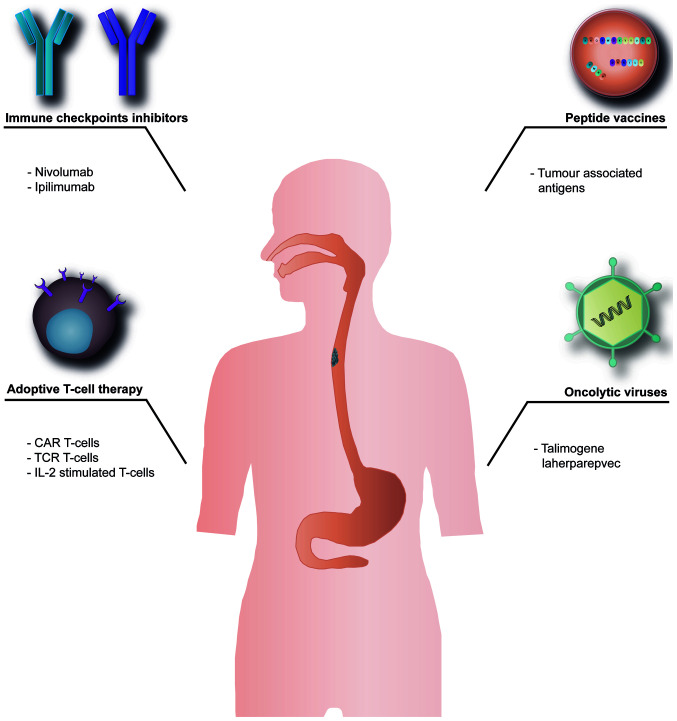
Oesophageal cancer is one of the most aggressive malignancies with limited treatment options, thus resulting in a high morbidity and mortality. With 5‑year survival rates of only 5‑10%, oesophageal cancer holds a dismal prognosis for patients. In order to improve overall survival, the early diagnosis and tools for patient stratification for personalized treatment are urgent needs. A minority of oesophageal cancers belong to the spectrum of Lynch syndrome‑associated cancers and are characterized by microsatellite instability (MSI). Microsatellite instability is a consequence of defective mismatch repair protein functions and it has been well characterized in other gastrointestinal tumours, such as colorectal and gastric cancer. In the latter, high levels of MSI are associated with a better prognosis and with an increased benefit to immune‑based therapies. Therefore, similar therapeutic approaches could offer an opportunity of treatment for oesophageal cancer patients with MSI. Apart from immune checkpoint inhibitors, other immunotherapies such as adoptive T‑cell transfer, peptide vaccine and oncolytic viruses are under investigation in oesophageal cancer patients. In the present review, the rationale and current knowledge about immunotherapies in oesophageal cancer are summarised.
Keywords: immunotherapy; oesophageal cancer; immune checkpoint inhibitors; adoptive T‑cell therapy; peptide vaccine; oncolytic viruses.
Conflict of interest statement
NV received speaker honorarium from the companies, Bayer, Eli-Lilly, Pfizer and Merck. The funders had no role in the design of the study; in the collection, analyses, or interpretation of data; in the writing of the manuscript, or in the decision to publish the results. All other authors (AL, MR, MG, MBM, AFO and JCH) declare that they have no competing interests.
Figures
References
-
- de Vos-Geelen J, Hoebers FJP, Geurts SME, Hoeben A, de Greef BTA, Voncken FEM, Bogers JHA, Braam PM, Muijs CKT, de Jong MA, et al. A national study to assess outcomes of definitive chemoradiation regimens in proximal esophageal cancer. Acta Oncol. 2020;59:895–903. doi: 10.1080/0284186X.2020.1753889. - DOI - PubMed
-
- Bartley AN, Washington MK, Ventura CB, Ismaila N, Colasacco C, Benson AB, III, Carrato A, Gulley ML, Jain D, Kakar S, et al. HER2 testing and clinical decision making in gastroesophageal adenocarcinoma: Guideline from the college of American pathologists American society for clinical pathology, and American society of clinical oncology. Arch Pathol Lab Med. 2016;140:1345–1363. doi: 10.5858/arpa.2016-0331-CP. - DOI - PubMed
Publication types
MeSH terms
Substances
Grants and funding
LinkOut - more resources
Full Text Sources
Other Literature Sources
Medical