


Web-based cognitive behavior therapy for chronic pain patients with aberrant drug-related behavior: How did it work and for whom?
- PMID: 33846875
- PMCID: PMC8658745
- DOI: 10.1007/s10865-021-00219-9
Web-based cognitive behavior therapy for chronic pain patients with aberrant drug-related behavior: How did it work and for whom?
Abstract
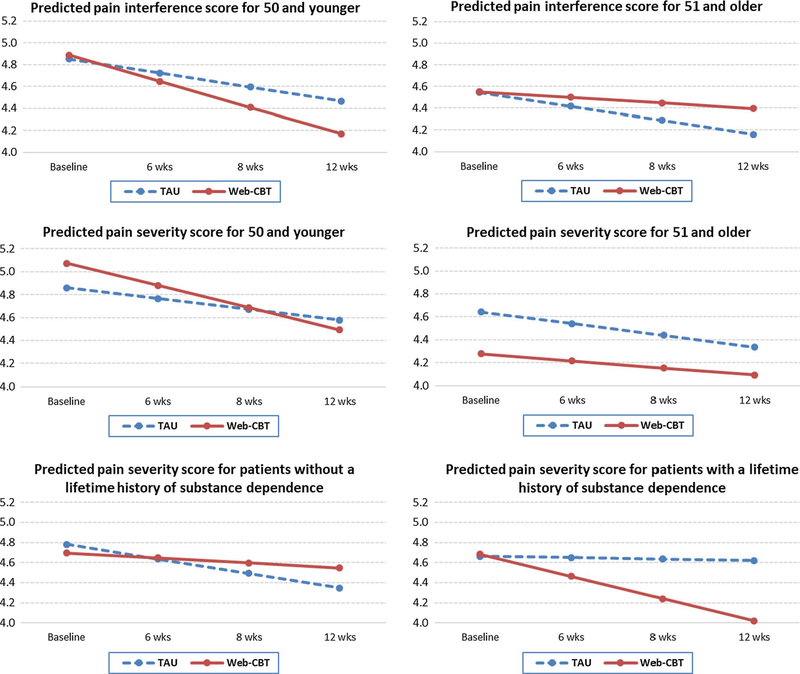
This study explored mediating pathways, moderating factors, and moderated mediation effects of a web-based, cognitive behavioral therapy (CBT) intervention for chronic pain patients with aberrant drug-related behavior (ADRB). In a 2-arm RCT, patients with chronic pain who screened positive for ADRB received treatment-as-usual (TAU, n = 55) or TAU plus a 12-week, web-based CBT intervention (n = 55). Assessments were conducted at weeks 4, 8, and 12, and at 1- and 3-months post intervention. Web-CBT significantly reduced pain catastrophizing, which, in turn, reduced pain interference and pain severity via a pathway of pain catastrophizing. Web-CBT also significantly reduced ADRB both directly and indirectly by reducing pain catastrophizing. For pain interference and pain severity, web-CBT was more effective than TAU for younger patients (≤ age 50). For pain severity, web-CBT was more effective for both younger patients (≤ age 50), and those with a lifetime substance use disorder. Findings suggest that web-CBT's positive impact on pain outcomes and ADRB are mediated by its effect on pain catastrophizing, and its treatment effects may be most robust for younger patients and those with histories of substance dependence.
Keywords: Chronic pain; Cognitive behavior therapy (CBT); Mediation; Moderation and moderated mediation analysis; Opioid use disorder; Web-based interventions.
© 2021. The Author(s), under exclusive licence to Springer Science+Business Media, LLC, part of Springer Nature.
Conflict of interest statement
Figures
References
-
- Baron RM, & Kenny DA (1986). The moderator–mediator variable distinction in social psychological research: Conceptual, strategic, and statistical considerations. Journal of Personality and Social Psychology, 51, 1173. - PubMed
-
- Bender JL, Radhakrishnan A, Diorio C, Englesakis M, & Jadad AR (2011). Can pain be managed through the Internet? A systematic review of randomized controlled trials. Pain®, 152, 1740–1750. - PubMed
-
- Broderick JE, Keefe FJ, Schneider S, Junghaenel DU, Bruckenthal P, Schwartz JE, Kaell AT, Caldwell DS, McKee D, & Gould E (2016). Cognitive behavioral therapy for chronic pain is effective, but for whom? Pain, 157, 2115–2123. - PubMed
Publication types
MeSH terms
Substances
Grants and funding
LinkOut - more resources
Full Text Sources
Other Literature Sources
Medical
