. 2021 Jun;186(3):315-326.
doi: 10.1007/s11046-021-00544-2. Epub 2021 Apr 13.

Taxonomy of the Trichophyton mentagrophytes/T. interdigitale Species Complex Harboring the Highly Virulent, Multiresistant Genotype T. indotineae

Affiliations

Taxonomy of the Trichophyton mentagrophytes/T. interdigitale Species Complex Harboring the Highly Virulent, Multiresistant Genotype T. indotineae

Chao Tang et al. Mycopathologia. 2021 Jun.

Abstract

A severe outbreak of highly virulent and multi-resistant dermatophytosis by species in the Trichophyton mentagrophytes/T. interdigitale complex is ongoing in India. The correct identity of the etiologic agent is a much-debated issue. In order to define species limits, a taxonomic study was undertaken combining molecular, morphological, and physiological characteristics as evidence of classification. Molecular characteristics show that T. mentagrophytes s. str. and T. interdigitale s. str. can be distinguished with difficulty from each other, but are unambiguously different from the Indian genotype, T. indotineae by sequences of the HMG gene. The entities were confirmed by multilocus analysis using tanglegrams. Phenotypic characters of morphology and physiology are not diagnostic, but statistically significant differences are observed between the molecular siblings. These properties may be drivers of separate evolutionary trends. Trichophyton mentagrophytes represents the ancestral, homothallic cloud of genotypes with a probable geophilic lifestyle, while T. indotineae and T. interdigitale behave as anthropophilic, clonal offshoots. The origin of T. indotineae, which currently causes a significant public health problem, is zoonotic, and its emergence is likely due to widespread misuse of antifungals.

Keywords: Dermatophytosis; India; Multiresistance; Outbreak; Trichophyton indotineae.


Figures
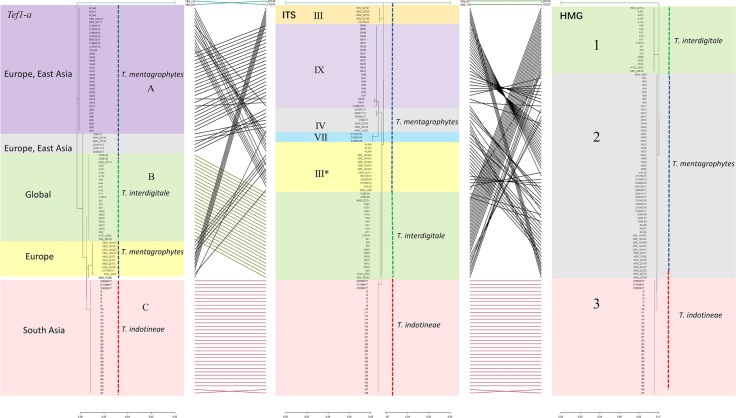
Fig. 1
Fig. 1
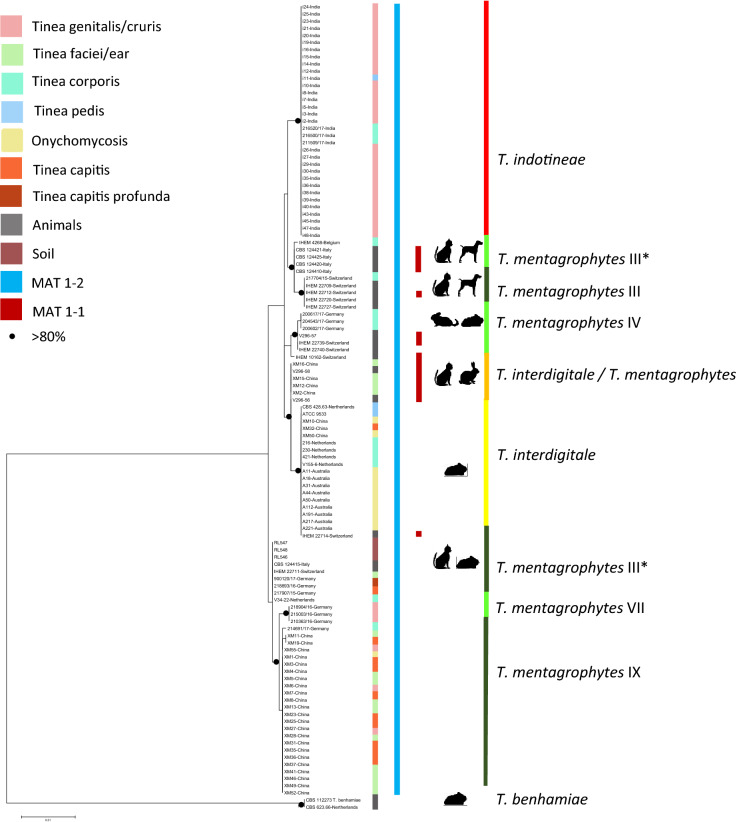
Tanglegram of 113 strains generated from Tef1-α (left) tree, ITS (central) tree, HMG tree (right)
Fig. 2
Fig. 2
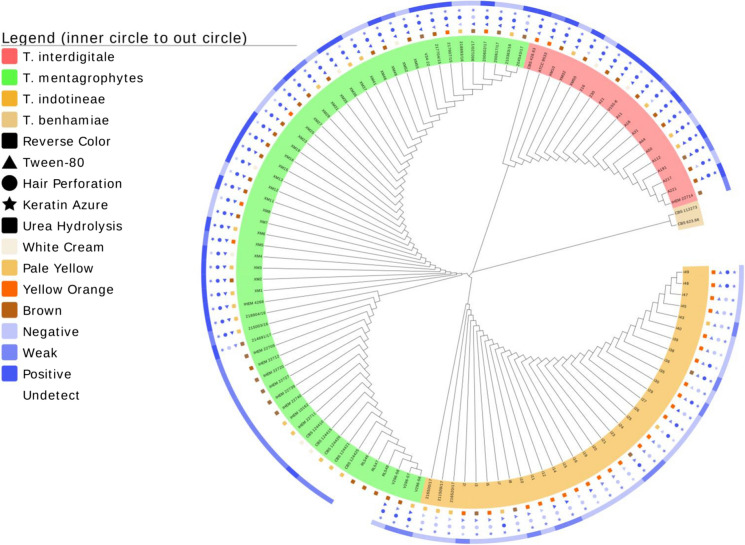
Maximum Likelihood tree generated from Tef1-α, ITS, and HMG sequences of 113 strains, combined with the source data of the strains
Fig. 3
Fig. 3
Maximum likelihood tree constructed using HMG sequences and General Time Reversible model in MEGA7; combined with morphology and physiology results T. Trichophyton
Fig. 4
Fig. 4
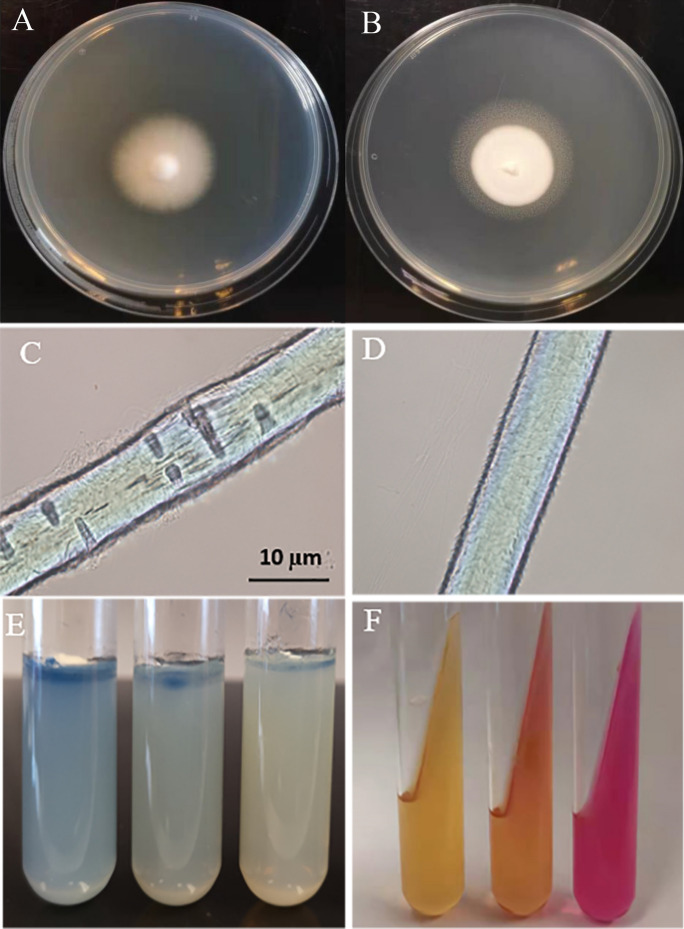
Phenotypic methodology followed in the study. a Tween-80 opacity negative result b Tween-80 opacity positive result. c Hair perforation test positive result. d Hair perforation test negative result e Keratin azure agar evaluation from left to right; positive, weakly positive, negative. f Evaluation of urease activity; from left to right; negative, weakly positive and positive
Fig. 5
Fig. 5
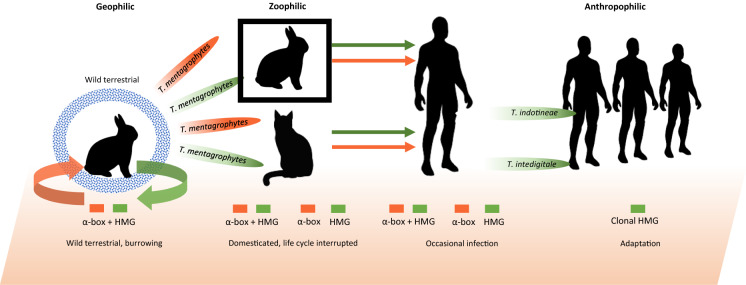
Summary of the hypothesis proposed in the current study. Terrestrial ancestral species harboring both mating types and able to infect burrowing animals is producing populations which are clonal and highly adapted to the human host

References

    1. Brown GD, Denning DW, Gow NAR, Levitz SM, Netea MG, White TC. Hidden killers: human fungal infections. Sci Transl Med. 2012;4:165rv13–165rv13. doi: 10.1126/scitranslmed.3004404. - DOI - PubMed
    1. Havlickova B, Czaika VA, Friedrich M. Epidemiological trends in skin mycoses worldwide. Mycoses. 2008;51:2–15. doi: 10.1111/j.1439-0507.2008.01606.x. - DOI - PubMed
    1. Lakshmanan A, Ganeshkumar P, Raam Mohan S, Hemamalini M, Madhavan R. Epidemiological and clinical pattern of dermatomycoses in rural India. Indian J Med Microbiol. 2015;33:S134–S136. doi: 10.4103/0255-0857.150922. - DOI - PubMed
    1. Singh A, Masih A, Khurana A, Singh PK, Gupta M, Hagen F, et al. High terbinafine resistance in Trichophyton interdigitale isolates in Delhi, India harbouring mutations in the squalene epoxidase gene. Mycoses. 2018;61:477–484. doi: 10.1111/myc.12772. - DOI - PubMed
    1. Vineetha M, Sheeja S, Celine M, Sadeep M, Palackal S, Shanimole P, et al. Profile of dermatophytosis in a tertiary care center. Indian J Dermatol. 2019;64:266. - PMC - PubMed

Substances

LinkOut - more resources