


Male bias in ACE2 basic science research: missed opportunity for discovery in the time of COVID-19
- PMID: 33848207
- PMCID: PMC8203415
- DOI: 10.1152/ajpregu.00356.2020
Male bias in ACE2 basic science research: missed opportunity for discovery in the time of COVID-19
Abstract
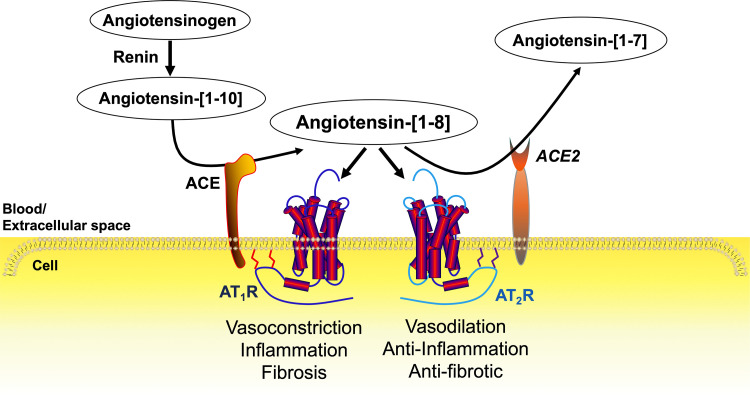
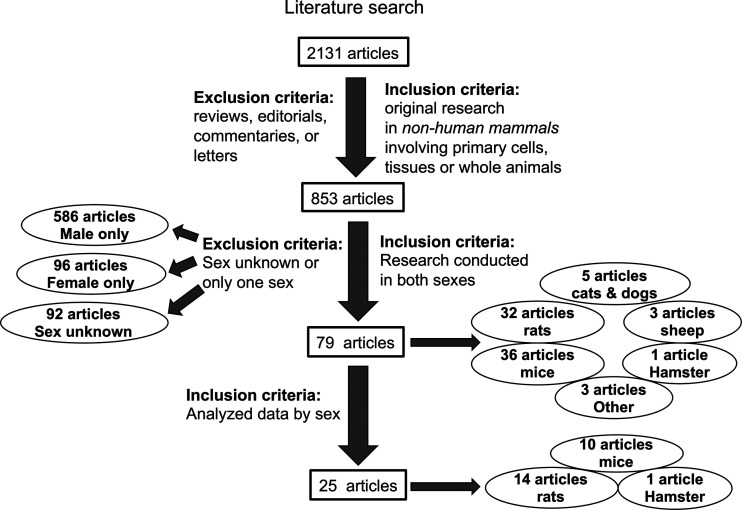
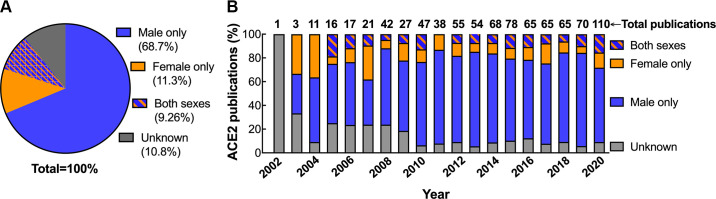
Throughout the world, including the United States, men have worse outcomes from COVID-19 than women. SARS-CoV-2, the causative virus of the COVID-19 pandemic, uses angiotensin-converting enzyme 2 (ACE2) to gain cellular entry. ACE2 is a member of the renin-angiotensin system (RAS) and plays an important role in counteracting the harmful effects mediated by the angiotensin type 1 receptor. Therefore, we conducted Ovid MEDLINE and Embase database searches of basic science studies investigating the impact of the biological variable of sex on ACE2 expression and regulation from 2000, the year ACE2 was discovered, through December 31, 2020. Out of 2,131 publications, we identified 853 original research articles on ACE2 conducted in primary cells, tissues, and/or whole mammals excluding humans. The majority (68.7%) of these studies that cited the sex of the animal were conducted in males, while 11.2% were conducted solely in females; 9.26% compared ACE2 between the sexes, while 10.8% did not report the sex of the animals used. General findings are that sex differences are tissue-specific and when present, are dependent upon gonadal state. Renal, cardiac, and adipose ACE2 is increased in both sexes under experimental conditions that model co-morbidities associated with worse COVID-19 outcomes including hypertension, obesity, and renal and cardiovascular diseases; however, ACE2 protein was generally higher in the males. Studies in Ace2 knockout mice indicate ACE2 plays a greater role in protecting the female from developing hypertension than the male. Studying the biological variable of sex in ACE2 research provides an opportunity for discovery in conditions involving RAS dysfunction and will shed light on sex differences in COVID-19 severity.
Keywords: angiotensin; gonadectomy; heart; kidney; ovariectomy.
Conflict of interest statement
No conflicts of interest, financial or otherwise, are declared by the authors.
Figures
References
-
- Wang Y, Han L, Shen M, Jones ES, Spizzo I, Walton SL, Denton KM, Gaspari TA, Samuel CS, Widdop RE. Serelaxin and the AT2 receptor agonist CGP42112 evoked a similar, nonadditive, cardiac antifibrotic effect in high salt-fed mice that were refractory to candesartan cilexetil. ACS Pharmacol Transl Sci 3: 76–87, 2020. doi: 10.1021/acsptsci.9b00095. - DOI - PMC - PubMed
-
- Santos RA, Simoes e Silva AC, Maric C, Silva DM, Machado RP, de Buhr I, Heringer-Walther S, Pinheiro SV, Lopes MT, Bader M, Mendes EP, Lemos VS, Campagnole-Santos MJ, Schultheiss HP, Speth R, Walther T. Angiotensin-(1–7) is an endogenous ligand for the G protein-coupled receptor Mas. Proc Natl Acad Sci USA 100: 8258–8263, 2003. doi: 10.1073/pnas.1432869100. - DOI - PMC - PubMed
Publication types
MeSH terms
Substances
Grants and funding
LinkOut - more resources
Full Text Sources
Other Literature Sources
Medical
Miscellaneous
