Results of Active Middle Ear Implantation in Patients With Mixed Hearing Loss After Middle Ear Surgery: A Prospective Multicenter Study (the ROMEO Study)
- PMID: 33848418
- PMCID: PMC8901952
- DOI: 10.21053/ceo.2020.01851
Results of Active Middle Ear Implantation in Patients With Mixed Hearing Loss After Middle Ear Surgery: A Prospective Multicenter Study (the ROMEO Study)
Abstract
Objectives: This study was conducted to evaluate the user satisfaction, efficacy, and safety of round window (RW) vibroplasty using the Vibrant Soundbridge (VSB) in patients with persistent mixed hearing loss after mastoidectomy.
Methods: The study included 27 patients (mean age, 58.7 years; age range, 28-76 years; 11 men and 16 women) with mixed hearing loss after mastoidectomy from 15 tertiary referral centers in Korea. The VSB was implanted at the RW. The Korean translation of the Abbreviated Profile of Hearing Aid Benefit (APHAB) questionnaire and the Korean version of the International Outcome Inventory for Hearing Aids (K-IOI-HA) questionnaire were used to evaluate user satisfaction as the primary outcome. The secondary outcome measures were audiological test results and complication rates.
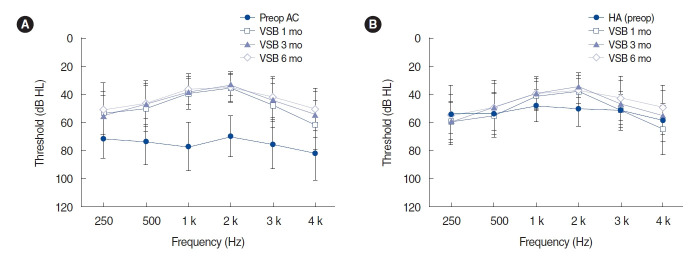
Results: The mean scores for ease of communication (61.3% to 29.7% to 30.2%), reverberation (62.1% to 43.1% to 37.4%), and background noise (63.3% to 37.7% to 34.3%) subscales of the APHAB questionnaire significantly decreased after VSB surgery. The mean K-IOI-HA scores at 3 and 6 months after surgery were significantly higher than the mean preoperative score (18.6 to 27.2 to 28.1). The postoperative VSB-aided thresholds were significantly lower than the preoperative unaided and hearing aid (HA)-aided thresholds. There was no significant difference between preoperative unaided, preoperative HA-aided, and postoperative VSB-aided maximum phonetically balanced word-recognition scores. None of the 27 patients experienced a change in postoperative bone conduction pure tone average. One patient developed temporary facial palsy and two developed surgical wound infections.
Conclusion: RW vibroplasty resulted in improved satisfaction and audiological test results in patients with mixed hearing loss after mastoidectomy, and the complication rate was tolerable.
Keywords: Active Middle Ear Implant; Mixed Hearing Loss; Round Window; Vibrant Soundbridge; Vibroplasty.
Conflict of interest statement
No potential conflict of interest relevant to this article was reported.
Figures


References
-
- Cristobal F, Gomez-Ullate R, Cristobal I, Arcocha A, Arroyo R. Hearing results in the second stage of open mastoidectomy: a comparison of the different techniques. Otolaryngol Head Neck Surg. 2000 May;122(5):748–51. - PubMed
-
- Galm T, Martin TP, Raut V. Open and closed cavity mastoid operations: comparing early hearing results. Eur Arch Otorhinolaryngol. 2013 Jan;270(1):77–80. - PubMed
-
- Cox MD, Trinidade A, Russell JS, Dornhoffer JL. Long-term hearing results after ossiculoplasty. Otol Neurotol. 2017 Apr;38(4):510–5. - PubMed
-
- Gluth MB, Friedman AB, Atcherson SR, Dornhoffer JL. Hearing aid tolerance after revision and obliteration of canal wall down mastoidectomy cavities. Otol Neurotol. 2013 Jun;34(4):711–4. - PubMed
LinkOut - more resources
Full Text Sources
Other Literature Sources