


The influence of awareness campaigns on the spread of an infectious disease: a qualitative analysis of a fractional epidemic model
- PMID: 33851007
- PMCID: PMC8029611
- DOI: 10.1007/s40808-021-01158-9
The influence of awareness campaigns on the spread of an infectious disease: a qualitative analysis of a fractional epidemic model
Abstract
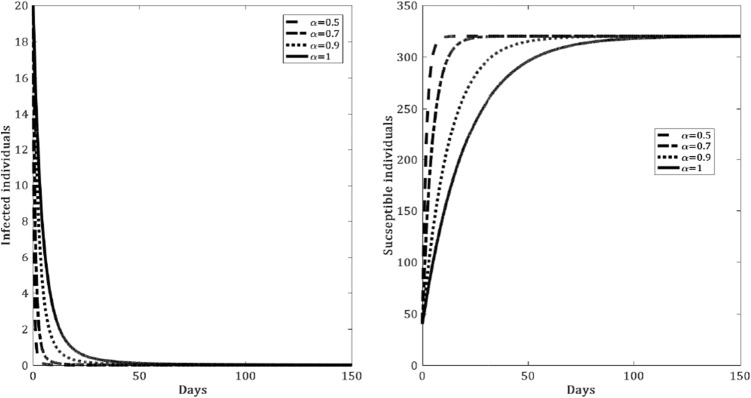
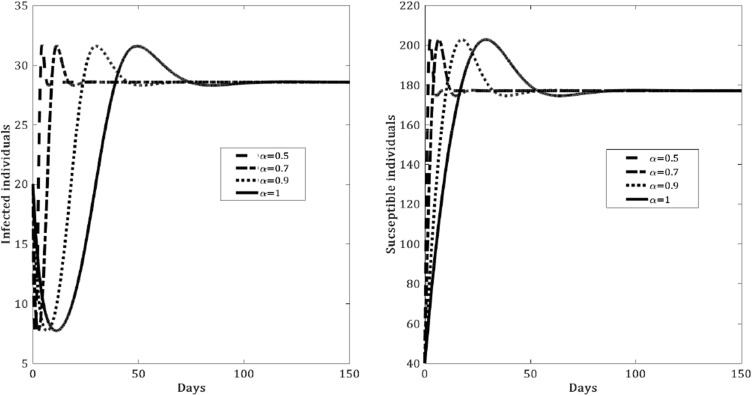
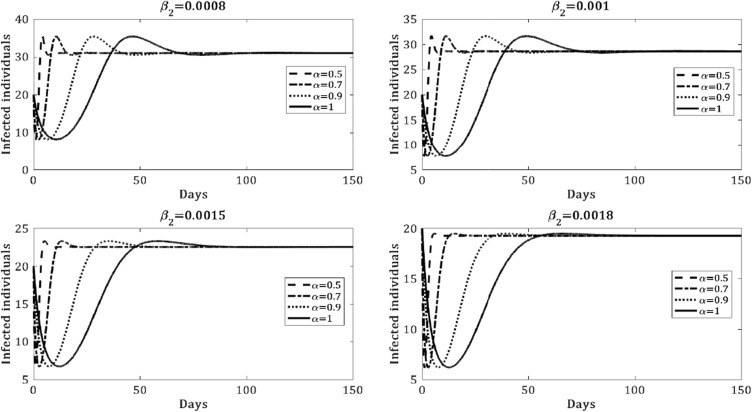
Mass-media coverage is one of the most widely used government strategies on influencing public opinion in times of crisis. Awareness campaigns are highly influential tools to expand healthy behavior practices among individuals during epidemics and pandemics. Mathematical modeling has become an important tool in analyzing the effects of media awareness on the spread of infectious diseases. In this paper, a fractional-order epidemic model incorporating media coverage is presented and analyzed. The problem is formulated using susceptible, infectious and recovered compartmental model. A long-term memory effect modeled by a Caputo fractional derivative is included in each compartment to describe the evolution related to the individuals' experiences. The well-posedness of the model is investigated in terms of global existence, positivity, and boundedness of solutions. Moreover, the disease-free equilibrium and the endemic equilibrium points are given alongside their local stabilities. By constructing suitable Lyapunov functions, the global stability of the disease-free and endemic equilibria is proven according to the basic reproduction number . Finally, numerical simulations are performed to support our analytical findings. It was found out that the long-term memory has no effect on the stability of the equilibrium points. However, for increased values of the fractional derivative order parameter, each solution reaches its equilibrium state more rapidly. Furthermore, it was observed that an increase of the media awareness parameter, decreases the magnitude of infected individuals, and consequently, the height of the epidemic peak.
Keywords: Awareness campaigns; Caputo fractional derivative; Memory effects; SIR epidemic model; Stability.
© The Author(s), under exclusive licence to Springer Nature Switzerland AG 2021.
Conflict of interest statement
Conflict of interestThe authors declare that they have no known competing financial interests or personal relationships that could have appeared to influence the work reported in the above mentioned paper.
Figures
References
-
- Ahmed E, El-Sayed A, El-Saka HA. On some routh-hurwitz conditions for fractional order differential equations and their applications in Lorenz, Rössler, Chua and Chen systems. Phys Lett A. 2006;358(1):1–4. doi: 10.1016/j.physleta.2006.04.087. - DOI
-
- Al-Sulami H, El-Shahed M, Nieto JJ, Shammakh W. On fractional order dengue epidemic model. Math Probl Eng. 2014 doi: 10.1155/2014/456537. - DOI
LinkOut - more resources
Full Text Sources
Other Literature Sources