


Orthostatic Hypertension and Hypotension and Outcomes in CKD: The CRIC (Chronic Renal Insufficiency Cohort) Study
- PMID: 33851116
- PMCID: PMC8039407
- DOI: 10.1016/j.xkme.2020.10.012
Orthostatic Hypertension and Hypotension and Outcomes in CKD: The CRIC (Chronic Renal Insufficiency Cohort) Study
Abstract
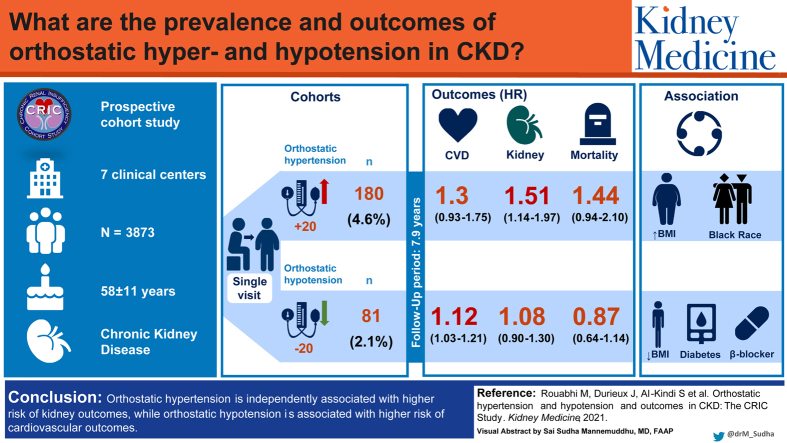
Rationale & objective: There are limited data about the prevalence and prognostic significance of orthostatic hypo- and hypertension in patients with chronic kidney disease. The objective of this study is to determine the prevalence of orthostatic hypo- and hypertension in a cohort of patients with chronic kidney disease and examine their association with clinical outcomes.
Study design: Prospective cohort study: Chronic Renal Insufficiency Cohort (CRIC) Study.
Setting & population: 7 clinical centers, participants with chronic kidney disease.
Exposures: Orthostatic hypotension (decline in systolic blood pressure [BP] > 20 mm Hg) and orthostatic hypertension (increase in systolic BP > 20 mm Hg) from seated to standing position.
Outcomes: Cardiovascular and kidney outcomes and mortality.
Analytical approach: Logistic regression was used to determine factors associated with orthostatic hypo- and hypertension; Cox regression was used to examine associations with clinical outcomes.
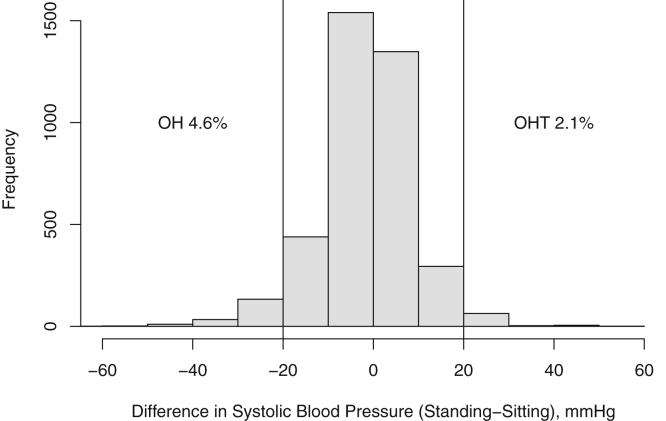
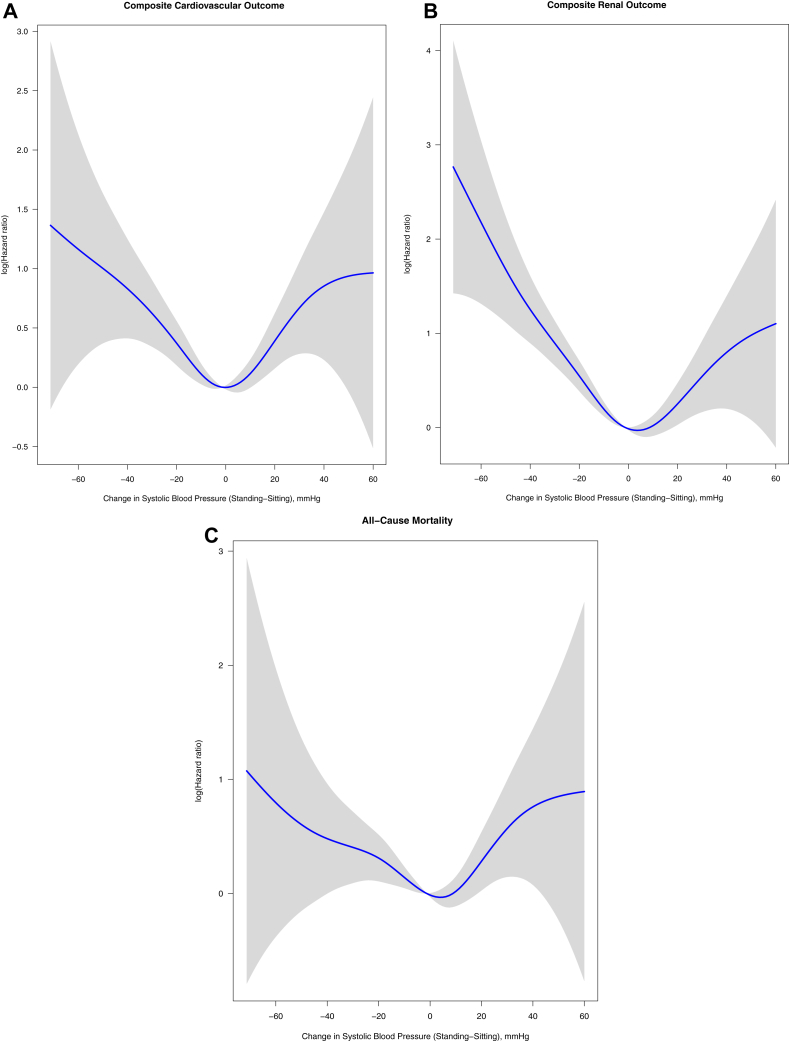
Results: Mean age of study population (n = 3,873) was 58.1 ± 11.0 years. There was a wide distribution of change in systolic BP from seated to standing (from -73.3 to +60.0 mm Hg); 180 participants (4.6%) had orthostatic hypotension and 81 (2.1%) had orthostatic hypertension. Diabetes, reduced body mass index, and β-blocker use were independently associated with orthostatic hypotension. Black race and higher body mass index were independently associated with orthostatic hypertension. After a median follow-up of 7.9 years, orthostatic hypotension was independently associated with high risk for cardiovascular (HR, 1.12; 95% CI, 1.03-1.21) but not kidney outcomes or mortality. Orthostatic hypertension was independently associated with high risk for kidney (HR, 1.51; 96% CI, 1.14-1.97) but not cardiovascular outcomes or mortality.
Limitations: Orthostatic change in BP was ascertained at a single visit.
Conclusions: Orthostatic hypotension was independently associated with higher risk for cardiovascular outcomes, whereas orthostatic hypertension was associated with higher risk for kidney outcomes. These findings highlight the importance of orthostatic BP measurement in practice and the need for future investigation to understand the mechanisms and potential interventions to minimize the risk associated with orthostatic changes in BP.
Keywords: cardiovascular outcomes; chronic kidney disease; chronic renal insufficiency cohort; orthostatic hypertension; orthostatic hypotension; renal outcomes.
© 2021 The Authors.
Figures
References
-
- Eigenbrodt M.L., Rose K.M., Couper D.J., Arnett D.K., Smith R., Jones D. Orthostatic hypotension as a risk factor for stroke: the Atherosclerosis Risk in Communities (ARIC) Study, 1987-1996. Stroke. 2000;31(10):2307–2313. - PubMed
-
- Rose K.M., Tyroler H.A., Nardo C.J. Orthostatic hypotension and the incidence of coronary heart disease: the Atherosclerosis Risk in Communities study. Am J Hypertens. 2000;13:571–578. - PubMed
Grants and funding
LinkOut - more resources
Full Text Sources
Other Literature Sources
