This is a preprint.
Quantitative SARS-CoV-2 viral-load curves in paired saliva and nasal swabs inform appropriate respiratory sampling site and analytical test sensitivity required for earliest viral detection
- PMID: 33851180
- PMCID: PMC8043477
- DOI: 10.1101/2021.04.02.21254771
Quantitative SARS-CoV-2 viral-load curves in paired saliva and nasal swabs inform appropriate respiratory sampling site and analytical test sensitivity required for earliest viral detection
Update in
-
Quantitative SARS-CoV-2 Viral-Load Curves in Paired Saliva Samples and Nasal Swabs Inform Appropriate Respiratory Sampling Site and Analytical Test Sensitivity Required for Earliest Viral Detection.J Clin Microbiol. 2022 Feb 16;60(2):e0178521. doi: 10.1128/JCM.01785-21. Epub 2021 Dec 15. J Clin Microbiol. 2022. PMID: 34911366 Free PMC article.
Abstract
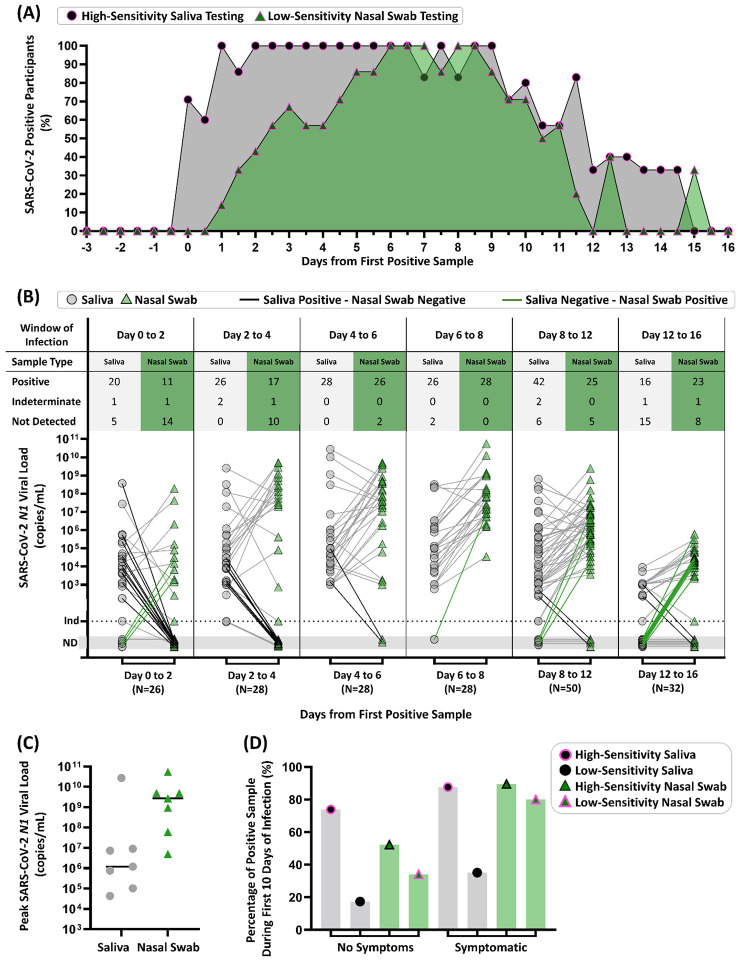
Early detection of SARS-CoV-2 infection is critical to reduce asymptomatic and pre-symptomatic transmission, curb the spread of variants by travelers, and maximize treatment efficacy. Low-sensitivity nasal-swab testing (antigen and some nucleic-acid-amplification tests) is commonly used for surveillance and symptomatic testing, but the ability of low-sensitivity nasal-swab tests to detect the earliest stages of infection has not been established. In this case-ascertained study, initially-SARS-CoV-2-negative household contacts of individuals diagnosed with COVID-19 prospectively self-collected paired anterior-nares nasal-swab and saliva samples twice daily for viral-load quantification by high-sensitivity RT-qPCR and digital-RT-PCR assays. We captured viral-load profiles from the incidence of infection for seven individuals and compared diagnostic sensitivities between respiratory sites. Among unvaccinated persons, high-sensitivity saliva testing detected infection up to 4.5 days before viral loads in nasal swabs reached the limit of detection of low-sensitivity nasal-swab tests. For most participants, nasal swabs reached higher peak viral loads than saliva, but were undetectable or at lower loads during the first few days of infection. High-sensitivity saliva testing was most reliable for earliest detection. Our study illustrates the value of acquiring early (within hours after a negative high-sensitivity test) viral-load profiles to guide the appropriate analytical sensitivity and respiratory site for detecting earliest infections. Such data are challenging to acquire but critical to design optimal testing strategies in the current pandemic and will be required for responding to future viral pandemics. As new variants and viruses emerge, up-to-date data on viral kinetics are necessary to adjust testing strategies for reliable early detection of infections.
Keywords: COVID-19; Case-ascertained; Diagnostics; Household study; Longitudinal sampling; Nasal swab; Pre-Symptomatic; RT-qPCR; Saliva; Surveillance; Transmission.
Conflict of interest statement
COMPETING INTERESTS STATEMENT RFI is a co-founder, consultant, and a director and has stock ownership of Talis Biomedical Corp. In addition, RFI is an inventor on a series of patents licensed by the University of Chicago to Bio-Rad Laboratories Inc. in the context of ddPCR.
Figures
References
-
- WHO. Recommendations for national SARS-CoV-2 testing strategies and diagnostic capacities, https://apps.who.int/iris/bitstream/handle/10665/342002/WHO-2019-nCoV-la... (2021).
-
- Scientific Advisory Group for Emergencies (SAGE). Consensus statement from the Scientific Pandemic Influenza Group on Modelling, Operational sub-group (SPI-M-O); 30 June 2021, https://www.gov.uk/government/publications/spi-m-o-consensus-statement-o... (2021).
Publication types
Grants and funding
LinkOut - more resources
Full Text Sources
Other Literature Sources
Research Materials
Miscellaneous