. 2021 Apr 14;16(4):e0248818.
doi: 10.1371/journal.pone.0248818. eCollection 2021.

Global economic impacts of COVID-19 lockdown measures stand out in high-frequency shipping data

Affiliations

Global economic impacts of COVID-19 lockdown measures stand out in high-frequency shipping data

Jasper Verschuur et al. PLoS One. .

Abstract

The implementation of large-scale containment measures by governments to contain the spread of the COVID-19 virus has resulted in large impacts to the global economy. Here, we derive a new high-frequency indicator of economic activity using empirical vessel tracking data, and use it to estimate the global maritime trade losses during the first eight months of the pandemic. We go on to use this high-frequency dataset to infer the effect of individual non-pharmaceutical interventions on maritime exports, which we use as a proxy of economic activity. Our results show widespread port-level trade losses, with the largest absolute losses found for ports in China, the Middle-East and Western Europe, associated with the collapse of specific supply-chains (e.g. oil, vehicle manufacturing). In total, we estimate that global maritime trade reduced by -7.0% to -9.6% during the first eight months of 2020, which is equal to around 206-286 million tonnes in volume losses and up to 225-412 billion USD in value losses. We find large sectoral and geographical disparities in impacts. Manufacturing sectors are hit hardest, with losses up to 11.8%, whilst some small islands developing states and low-income economies suffered the largest relative trade losses. Moreover, we find a clear negative impact of COVID-19 related school and public transport closures on country-wide exports. Overall, we show how real-time indicators of economic activity can inform policy-makers about the impacts of individual policies on the economy, and can support economic recovery efforts by allocating funds to the hardest hit economies and sectors.


Conflict of interest statement

The authors have declared that no competing interests exist.

Figures
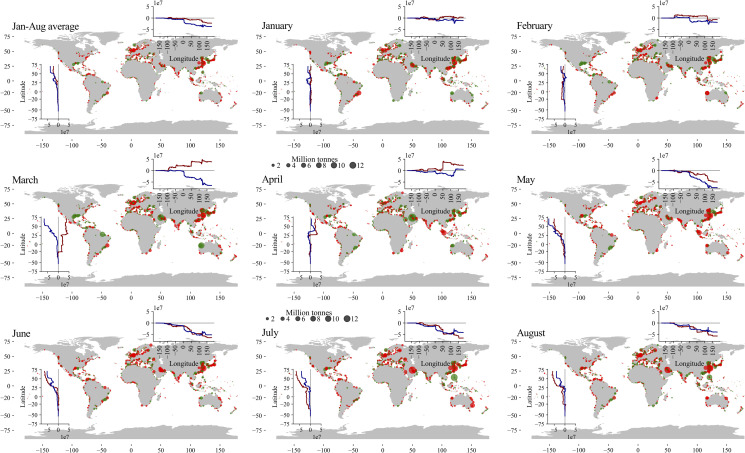
Fig 1
Fig 1. Port-level trade losses over time.
The geographical location and magnitude of trade losses for Jan-Aug 2020 compared to 2019, including the average over the eight months and the losses per month. Green = positive change, red = negative change. The subplots show the cumulative change over latitude and longitude for imports (dark blue) and exports (dark red). This figure was generated using the ‘Geopandas’ package (https://geopandas.org) and Python Programming Language (version 3.7). The underlying basemap is derived from ‘Natural Earth’ global vector data (https://www.naturalearthdata.com).
Fig 2
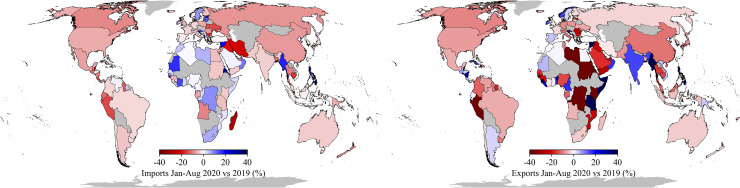
Fig 2. Country-level relative trade losses.
The relative trade losses for Jan-Aug 2020 compared to 2019 expressed in percentage change. Grey countries indicate no data available. This figure was generated using the ‘Geopandas’ package (https://geopandas.org) and Python Programming Language (version 3.7). The underlying basemap is derived from ‘Natural Earth’ global vector data (https://www.naturalearthdata.com).
Fig 3
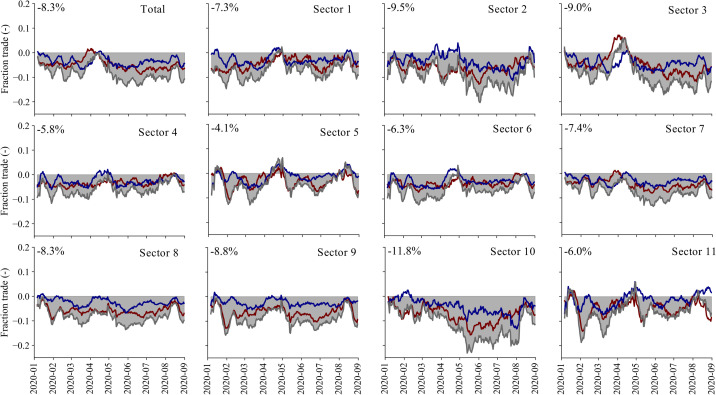
Fig 3. Sector-specific losses over time.
The change in daily global total trade as a fraction of the average daily trade (over 2019). The dark blue line represent imports, the dark red line represent exports, whereas the grey line indicate total trade (import + exports). Sector 1: Agriculture; Sector 2: Fishing; Sector 3: Mining and quarrying; Sector 4: Food and beverages; Sector 5: Textiles and wearing apparel; Sector 6: Wood and paper; Sector 7: Petroleum, chemical and non-metallic mineral products; Sector 8: Metal products; Sector 9: Electrical and machinery; Sector 10: Transport equipment; Sector 11: Other manufacturing.

References

    1. Hsiang S, Allen D, Annan-Phan S, Bell K, Bolliger I, Chong T, et al. The effect of large-scale anti-contagion policies on the COVID-19 pandemic. Nature. 2020. 10.1038/s41586-020-2404-8 - DOI - PubMed
    1. Kraemer MUG, Yang C-H, Gutierrez B, Wu C-H, Klein B, Pigott DM, et al. The effect of human mobility and control measures on the COVID-19 epidemic in China. Science (80). 2020;21: eabb4218. 10.1126/science.abb4218 - DOI - PMC - PubMed
    1. Chinazzi M, Davis JT, Ajelli M, Gioannini C, Litvinova M, Merler S, et al. The effect of travel restrictions on the spread of the 2019 novel coronavirus (COVID-19) outbreak. Science. 2020;9757: 1–12. 10.1126/science.aba9757 - DOI - PMC - PubMed
    1. Tian H, Liu Y, Li Y, Wu C-H, Chen B, Kraemer MUG, et al. An investigation of transmission control measures during the first 50 days of the COVID-19 epidemic in China. Science (80). 2020;368: 638–642. 10.1126/science.abb6105 - DOI - PMC - PubMed
    1. Deb P, Furceri D, Ostry JD, Tawk N. The economic effects of COVID-19 containment measures. Covid Econ Vetted Real-Time Pap. 2020;24: 32–35.

Publication types