


Patterns of Maternal Childhood Maltreatment and Disrupted Interaction Between Mothers and Their 4-Month-Old Infants
- PMID: 33853345
- PMCID: PMC8591699
- DOI: 10.1177/10775595211007567
Patterns of Maternal Childhood Maltreatment and Disrupted Interaction Between Mothers and Their 4-Month-Old Infants
Abstract
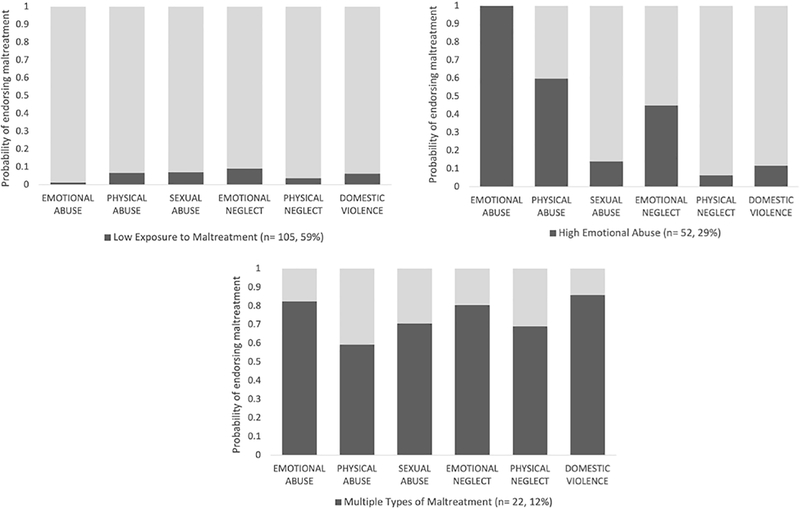
Maternal childhood maltreatment (MCM) is associated with parenting disruptions which may contribute to the intergenerational transmission of negative health and social outcomes. Most prior work has used variable-centered approaches to assess MCM. Complementary person-centered approaches can identify groups of participants characterized by similar patterns of maltreatment. The current study assessed both types and patterns of MCM in relation to disrupted parenting among 179 mothers and their 4-month-olds. In variable-centered analyses, physical abuse was related to negative-intrusive maternal behavior and physical neglect to role-confused behavior. Person-centered analyses derived three classes of MCM, which differed in disrupted parenting. For example, mothers who experienced multiple types of maltreatment displayed more withdrawal than mothers in both other classes. Results document the differential effects of particular types and patterns of MCM on aspects of parenting and reveal that mother's history of maltreatment can affect the quality of mother-child interaction as early as 4 months of age.
Keywords: child maltreatment; infants; parent-child relationships; parent-infant dyads.
Figures
References
-
- Armour C, Elklit A, & Christoffersen MN (2014). A latent class analysis of childhood maltreatment: Identifying abuse typologies. Journal of Loss and Trauma, 19(1), 23–39.
-
- Bailey HN, DeOliveira CA, Wolfe VV, Evans EM, & Hartwick C (2012). The impact of childhood maltreatment history on parenting: A comparison of maltreatment types and assessment methods. Child Abuse and Neglect, 36(3), 236–246. - PubMed
-
- Banfield JD, & Raftery AE (1993). Model-based Gaussian and non-Gaussian clustering. Biometrics, 49, 803–821.
-
- Bozdogan H (1987). Model selection and Akaike’s information criterion (AIC): The general theory and its analytical extensions. Psychometrika, 52(3), 345–370.
-
- Chamberlain C, Gee G, Harfield S, Campbell S, Brennan S, Clark Y, Mensah F, Arabena K, Herman H, Brown S, & ‘Healing the Past by Nurturing the Future’ group (2019). Parenting after a history of childhood maltreatment: A scoping review and map of evidence in the perinatal period. PLoS one, 14(3), e0213460. - PMC - PubMed
Publication types
MeSH terms
Grants and funding
LinkOut - more resources
Full Text Sources
Other Literature Sources
Medical
