. 2021 Jul;41(7):1791-1793.
doi: 10.1177/0271678X211009362. Epub 2021 Apr 14.

Much ado about eating: Intermittent fasting and post-stroke neuroprotection

Affiliations

Much ado about eating: Intermittent fasting and post-stroke neuroprotection

Raghu Vemuganti et al. J Cereb Blood Flow Metab. 2021 Jul.

Abstract

A proper diet is important for health and longevity. Controlling the amount of food consumed is immensely beneficial as it promotes multiple cellular and molecular protective mechanisms and simultaneously prevents toxic mechanisms. Intermittent fasting (IF) is a flexible and easy-to-adopt dietary modification that helps to mitigate metabolic disorders like diabetes and hypertension, and thus the devastating age-related diseases like heart attack, stroke and dementia. The benefits of IF seem to be mediated by altered epigenetic and transcriptional programming leading to reduced oxidative stress, inflammation, mitochondrial damage and cell death.

Keywords: Caloric restriction; cell death; cerebral ischemia; inflammation; preconditioning.


Conflict of interest statement

Declaration of conflicting interests: The author(s) declared no potential conflicts of interest with respect to the research, authorship, and/or publication of this article.

Figures

Figure 1.
Figure 1.
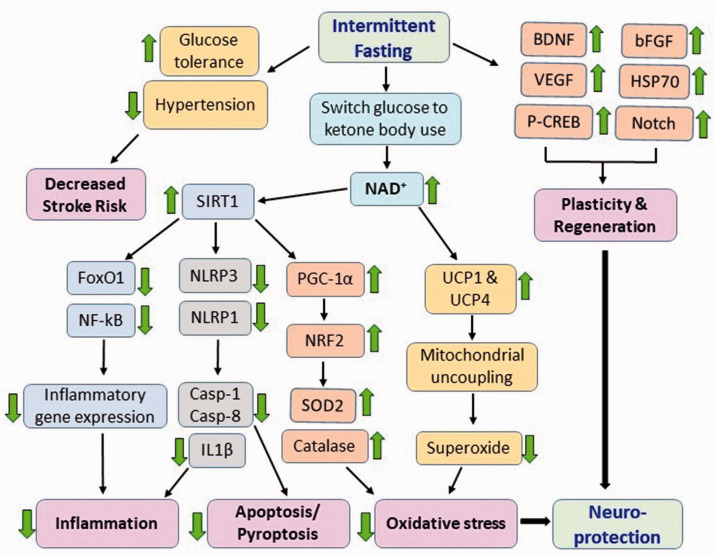
Intermittent fasting (IF) influences the body by multiple mechanisms. IF increases glucose tolerance and controls blood pressure. This leads to better prognosis as diabetes and hypertension are major comorbid conditions for stroke. IF induces several genes that promote plasticity, regeneration and neuroprotection. IF also promotes the pathways that curtail inflammation, oxidative stress and apoptosis leading to neuroprotection after stroke.

References

    1. Kim H, Kang H, Heo RW, et al.. Caloric restriction improves diabetes-induced cognitive deficits by attenuating neurogranin-associated calcium signaling in high-fat diet-fed mice. J Cereb Blood Flow Metab 2016; 36: 1098–1110. - PMC - PubMed
    1. Zhang J, Zhang W, Gao X, et al.. Preconditioning with partial caloric restriction confers long-term protection against grey and white matter injury after transient focal ischemia. J Cereb Blood Flow Metab 2019; 39: 1394–1409. - PMC - PubMed
    1. Mattson MP, Longo VD, Harvie M.Impact of intermittent fasting on health and disease processes. Ageing Res Rev 2017; 39: 46–58. - PMC - PubMed
    1. Fann DY, Ng GY, Poh L, et al.. Positive effects of intermittent fasting in ischemic stroke. Exp Gerontol 2017; 89: 93–102. - PubMed
    1. Fann DY, Santro T, Manzanero S, et al.. Intermittent fasting attenuates inflammasome activity in ischemic stroke. Exp Neurol 2014; 257: 114–119. - PubMed

LinkOut - more resources