How machine learning is embedded to support clinician decision making: an analysis of FDA-approved medical devices
- PMID: 33853863
- PMCID: PMC8054073
- DOI: 10.1136/bmjhci-2020-100301
How machine learning is embedded to support clinician decision making: an analysis of FDA-approved medical devices
Abstract
Objective: To examine how and to what extent medical devices using machine learning (ML) support clinician decision making.
Methods: We searched for medical devices that were (1) approved by the US Food and Drug Administration (FDA) up till February 2020; (2) intended for use by clinicians; (3) in clinical tasks or decisions and (4) used ML. Descriptive information about the clinical task, device task, device input and output, and ML method were extracted. The stage of human information processing automated by ML-based devices and level of autonomy were assessed.
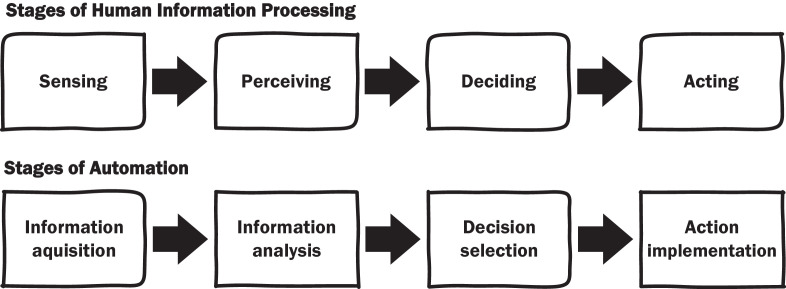
Results: Of 137 candidates, 59 FDA approvals for 49 unique devices were included. Most approvals (n=51) were since 2018. Devices commonly assisted with diagnostic (n=35) and triage (n=10) tasks. Twenty-three devices were assistive, providing decision support but left clinicians to make important decisions including diagnosis. Twelve automated the provision of information (autonomous information), such as quantification of heart ejection fraction, while 14 automatically provided task decisions like triaging the reading of scans according to suspected findings of stroke (autonomous decisions). Stages of human information processing most automated by devices were information analysis, (n=14) providing information as an input into clinician decision making, and decision selection (n=29), where devices provide a decision.
Conclusion: Leveraging the benefits of ML algorithms to support clinicians while mitigating risks, requires a solid relationship between clinician and ML-based devices. Such relationships must be carefully designed, considering how algorithms are embedded in devices, the tasks supported, information provided and clinicians' interactions with them.
Keywords: medical informatics.
© Author(s) (or their employer(s)) 2021. Re-use permitted under CC BY-NC. No commercial re-use. See rights and permissions. Published by BMJ.
Conflict of interest statement
Competing interests: None declared.
Figures


References
-
- Coiera E. Guide to health informatics. Third edition. ed. Boca Raton: CRC Press, Taylor & Francis Group, 2015.
-
- Matheny M, Israni ST, Ahmed M. Artificial intelligence in health care: the hope, the hype, the promise, the peril. Natl Acad Med 2020:94–7.
-
- Domingos P. The master algorithm : how the quest for the ultimate learning machine will remake our world. 1st ed. New York: Basic Books, a member of the Perseus Books Group, 2018.
-
- Parasuraman R, Riley V. Humans and automation: use, misuse, disuse, abuse. Hum Factors 1997;39:230–53. 10.1518/001872097778543886 - DOI
MeSH terms
LinkOut - more resources
Full Text Sources
Other Literature Sources