. 2021 Apr 20;118(16):e2019116118.
doi: 10.1073/pnas.2019116118.

The impact of identity by descent on fitness and disease in dogs

Affiliations

The impact of identity by descent on fitness and disease in dogs

Jazlyn A Mooney et al. Proc Natl Acad Sci U S A. .

Abstract

Domestic dogs have experienced population bottlenecks, recent inbreeding, and strong artificial selection. These processes have simplified the genetic architecture of complex traits, allowed deleterious variation to persist, and increased both identity-by-descent (IBD) segments and runs of homozygosity (ROH). As such, dogs provide an excellent model for examining how these evolutionary processes influence disease. We assembled a dataset containing 4,414 breed dogs, 327 village dogs, and 380 wolves genotyped at 117,288 markers and data for clinical and morphological phenotypes. Breed dogs have an enrichment of IBD and ROH, relative to both village dogs and wolves, and we use these patterns to show that breed dogs have experienced differing severities of bottlenecks in their recent past. We then found that ROH burden is associated with phenotypes in breed dogs, such as lymphoma. We next test the prediction that breeds with greater ROH have more disease alleles reported in the Online Mendelian Inheritance in Animals (OMIA). Surprisingly, the number of causal variants identified correlates with the popularity of that breed rather than the ROH or IBD burden, suggesting an ascertainment bias in OMIA. Lastly, we use the distribution of ROH across the genome to identify genes with depletions of ROH as potential hotspots for inbreeding depression and find multiple exons where ROH are never observed. Our results suggest that inbreeding has played a large role in shaping genetic and phenotypic variation in dogs and that future work on understudied breeds may reveal new disease-causing variation.

Keywords: complex traits; deleterious mutations; fitness; inbreeding depression.


Figures

Fig. 1.
Fig. 1.
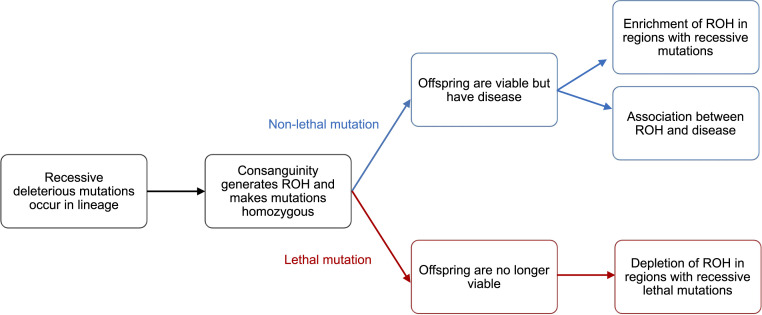
Potential mechanisms for associations between ROH and phenotypes that depend on recessive mutations. If a recessive deleterious mutation is nonlethal (blue), it may lead to ROH correlating with disease, while lethal (red) recessive mutations will cause a depletion of ROH.
Fig. 2.
Fig. 2.
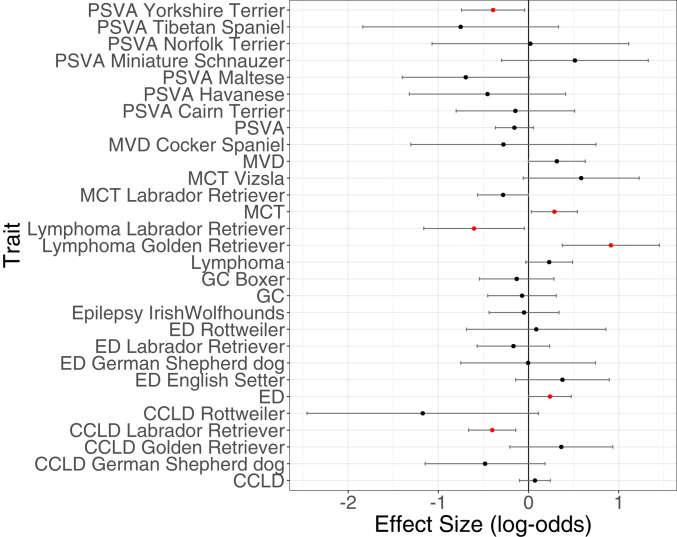
Association of ROH burden with eight quantitative traits. Results are presented both stratified by breed and across all breeds. A significant effect of ROH burden on a trait (nominal P < 0.05) is indicated with a red point. An effect size greater than 0 indicates an increase in ROH with the trait or disease status, and less than 0 represents the converse. Phenotype abbreviations are as follows: portosystemic vascular anomalies (PSVA); mitral valve degeneration (MVD); mast cell tumor (MCT); granulomatous colitis (GC); elbow dysplasia (ED); and cranial cruciate ligament disease (CCLD). These results use the SRBOUND correction for populations stratification (see Materials and Methods). Reference SI Appendix for additional information on P values. SI Appendix, Table S1 contains sample sizes, effect sizes, odds ratio, CI, and nominal P values. SI Appendix, Fig. S13 shows the uncorrected results as well as results using the genotype-relatedness matrix.
Fig. 3.
Fig. 3.
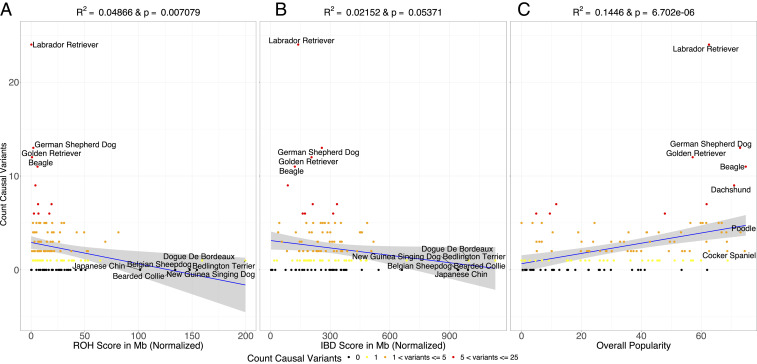
The correlation between the number of causal variants identified in each breed reported in OMIA and breed demographic characteristics. (A) Within-breed ROH and the total number of causal variants in OMIA. (B) Within-breed IBD and the total number of causal variants in OMIA. (C) Breed popularity over time and the total number of causal variants in OMIA. The shaded regions in each plot represent the CI on the regression line.
Fig. 4.
Fig. 4.
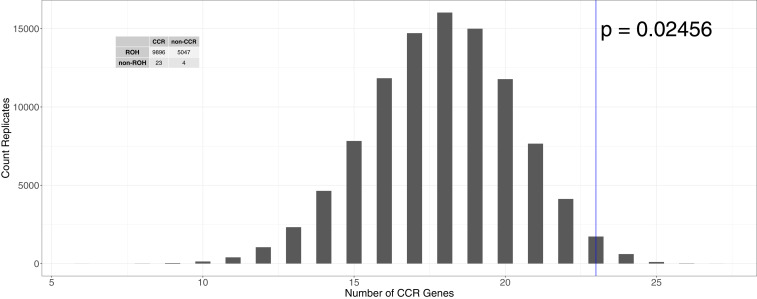
Histogram of the expected number of genes that fall into the top 10% CCRs over 100,000 randomly drawn sets of 27 genes. The empirical data are demarcated by the blue line (P = 0.025). The contingency table shows the count of genes classified as to whether all exons overlap an ROH (“ROH”) and whether any exons overlap a CCR (“CCR”). There is a 2.94-fold enrichment of genes with at least one exon without an ROH (“non-ROH” genes) in CCRs (P = 0.041) relative to genes where all exons overlap an ROH.

References

    1. Marsden C. D., et al., Bottlenecks and selective sweeps during domestication have increased deleterious genetic variation in dogs. Proc. Natl. Acad. Sci. U.S.A. 113, 152–157 (2016). - PMC - PubMed
    1. Boyko A. R., et al., A simple genetic architecture underlies morphological variation in dogs. PLoS Biol. 8, e1000451 (2010). - PMC - PubMed
    1. Freedman A. H., Lohmueller K. E., Wayne R. K., Evolutionary history, selective sweeps, and deleterious variation in the dog. Annu. Rev. Ecol. Evol. Syst. 47, 73–96 (2016).
    1. Boyko A. R., The domestic dog: Man’s best friend in the genomic era. Genome Biol. 12, 216 (2011). - PMC - PubMed
    1. Vonholdt B. M., et al., Genome-wide SNP and haplotype analyses reveal a rich history underlying dog domestication. Nature 464, 898–902 (2010). - PMC - PubMed

Publication types