. 2021 Apr 14;11(1):8191.
doi: 10.1038/s41598-021-86873-0.

A compartmental model that predicts the effect of social distancing and vaccination on controlling COVID-19

Affiliations

A compartmental model that predicts the effect of social distancing and vaccination on controlling COVID-19

Mohammadali Dashtbali et al. Sci Rep. .

Abstract

The understanding of the interaction between disease dynamics and human behavior is an important and essential point to control infectious. Disease outbreak can be influenced by social distancing and vaccination. In this study, we introduce two compartmental models to derive the epidemic curve and analyze the individual's behavior in spreading and controlling the COVID-19 epidemic. The first model includes Susceptible, Exposed, Infectious, Hospitalized, Recovered and Death compartments and in the second model, we added a new compartment namely, semi-susceptible individuals that are assumed to be more immune than the susceptible. A comparison of the two models shows that the second model provides a better fit to the daily infected cases from Egypt, Belgium, Japan, Nigeria, Italy, and Germany released by WHO. Finally, we added a vaccinated term to the model to predict how vaccination could control the epidemic. The model was applied on the record data from WHO.


Conflict of interest statement

The authors declare no competing interests.

Figures
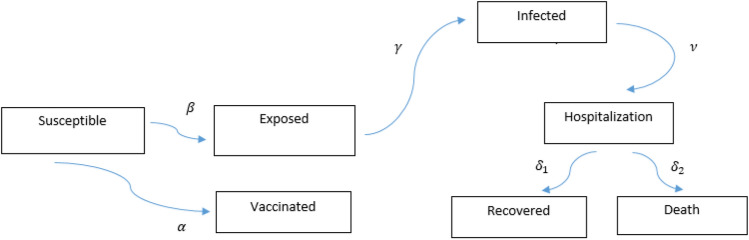
Figure 1
Figure 1
SEIHRDV model. The diagram for SEIHRDV model that S, E, I, H, R, D and V are the number of susceptible individuals, exposed individuals (persons in the incubation period after being infected by the disease pathogen), infected individuals, hospitalized individuals, recovered individuals, death individuals and vaccinated individuals, respectively.
Figure 2
Figure 2
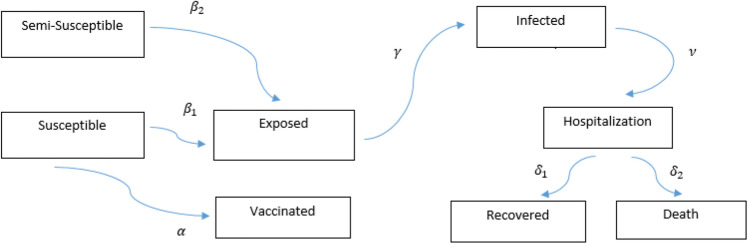
SMEIHRDV model. SMEIHRDV model that S, M, E, I, H, R, D and V are the number of susceptible, exposed, infected, semi-susceptible, hospitalized, recovered, death, and vaccinated individuals, respectively.
Figure 3
Figure 3
Fitting the models with real data. The number of infected individuals predicted by the “SEIHRDV” and the “SMEIHRDV” models for Japan (from 22th January to 23th June 2020), Italy (from 31th January to 23th June 2020), Belgium (from 4th February to 23th June 2020), Germany (from 27th January to 23th June 2020), Nigeria (from 28th February to 23th June 2020) and Egypt (from 14th February to 23th June 2020). The blue dots denote the reported infected cases and the black (or Less width) and blue lines present the results of the “SEIHRDV” and the “SMEIHRDV” models, respectively. The deSolve package version 1.28 in R software version 4.0.3 was used to generate the figure (http://desolve.r-forge.rproject.org/).
Figure 4
Figure 4
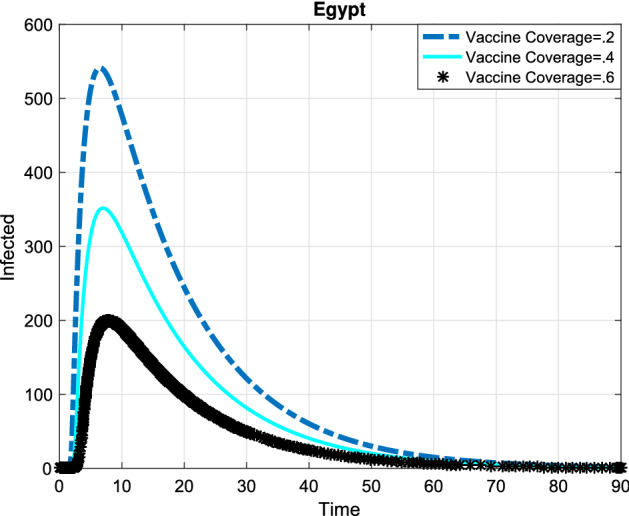
Simulation, the forecast of the epidemic process. The forecast of the epidemic growing tendency for infected cases through the SMEIHRDV model in Egypt. The results show that by increasing the vaccine coverage, the epidemic peak for infected cases decreases. The number of infected cases at the epidemic peak is approximately 540 in Egypt and it has reduced to 200 by the increasing vaccine coverage from 0.2 to 0.6. N=102,000,000.
Figure 5
Figure 5
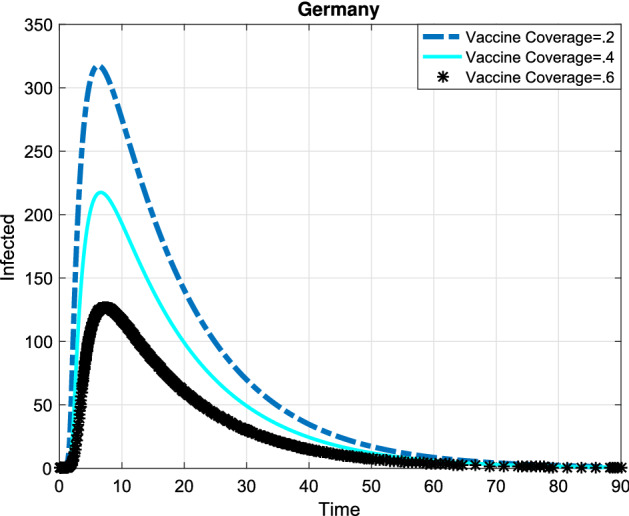
Simulation, the forecast of the epidemic process. Infected cases are predicted by the SMEIHRDV model in Germany. The results show that the number of infected cases at the epidemic peak is approximately 320 in Germany and it has reduced to 120 by the increasing vaccine coverage from 0.2 to 0.6. N=80,000,000.
Figure 6
Figure 6
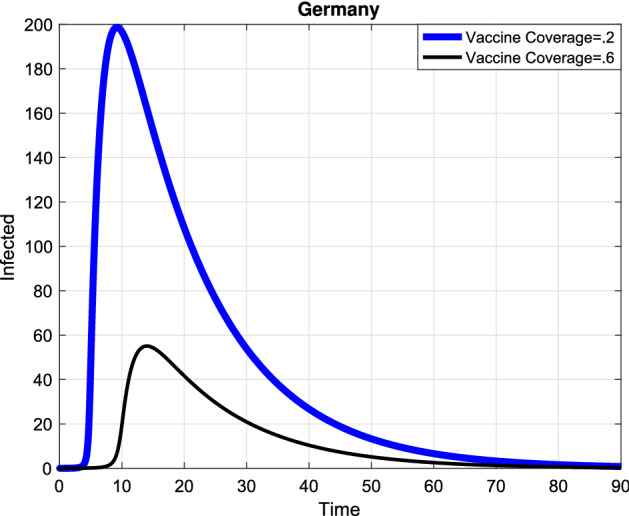
Simulation, the forecast of the epidemic process. The forecast of the epidemic growing tendency for infected cases through the SMEIHRDV model with the best investment strategy in social distancing. The results show that the best investment strategy in social distancing reduces the epidemic peak for infected cases and also by increasing the vaccine coverage, the epidemic peak for infected cases decreases. The number of infected cases at the epidemic peak is approximately 200 in Germany and it has reduced to 55 by the increasing vaccine coverage from 0.2 to 0.6. N=80,000,000.

References

    1. Dawood F, Jain S, Finelli L, Shaw M, Lindstrom S, et al. Emergence of a novel swine-origin influenza A (H1N1) virus in humans. N. Engl. J. Med. 2009;360:2605–15. doi: 10.1056/NEJMoa0903810. - DOI - PubMed
    1. Miao A, Zhang J, Zhang T, Pradeep BG. Threshold dynamics of a stochastic model with vertical transmission and vaccination. Comput. Math. Methods Med. 2017;20:2017. - PMC - PubMed
    1. Harapan H, Itoh N, Yufika A, Winardi W, Keam S, Te H, et al. Coronavirus disease 2019 (COVID-19): A literature review. J. Infect. Public Health. 2020;20:20. - PMC - PubMed
    1. Dhama K, et al. Coronavirus disease 2019-COVID-19. Clin. Microbiol. Rev. 2020;33:4. doi: 10.1128/CMR.00028-20. - DOI - PMC - PubMed
    1. Kermack WO, McKendrick AG. A contribution to the mathematical theory of epidemics. Proc. R. Soc. Lond. Ser. A Contain. Pap. Math. Phys. Charact. 1927;115(772):700–721.

Publication types

Substances