


Comparing conventional and high sensitivity troponin T measurements in identifying adverse cardiac events in patients admitted to an Asian emergency department chest pain observation unit
- PMID: 33855162
- PMCID: PMC8027767
- DOI: 10.1016/j.ijcha.2021.100758
Comparing conventional and high sensitivity troponin T measurements in identifying adverse cardiac events in patients admitted to an Asian emergency department chest pain observation unit
Abstract
Background: High sensitive cardiac troponin assays can be used for prediction of major adverse cardiac events (MACE) in patients with chest pain.
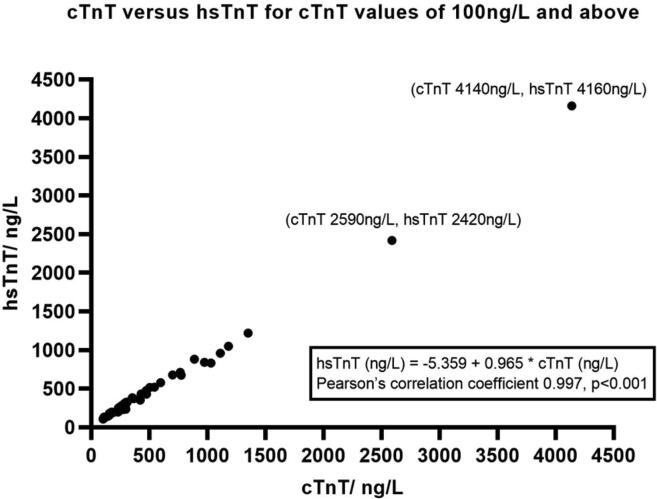
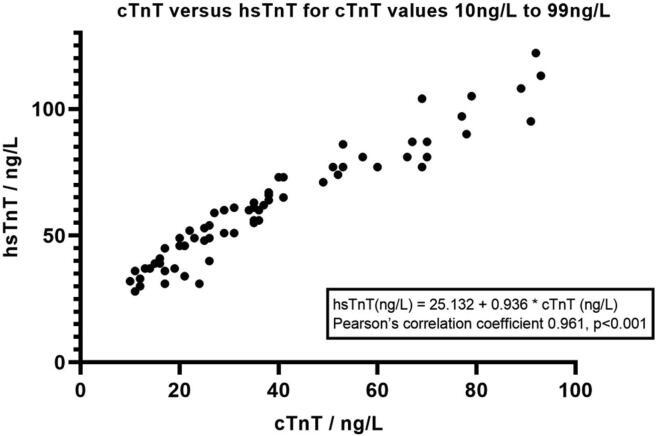
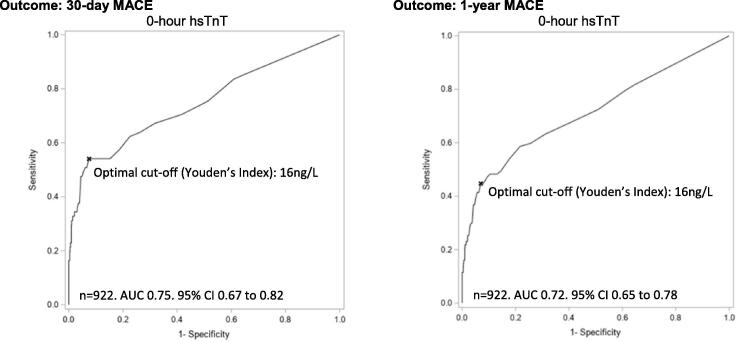
Methods: We included patients with symptoms suggestive of acute coronary syndrome in the emergency department observation unit. We compared the accuracy of conventional troponin T (cTnT) with high sensitive troponin T (hsTnT) at various ranges, as well as the utility of hsTnT and cTnT in prediction of 30-day and 1-year MACE.
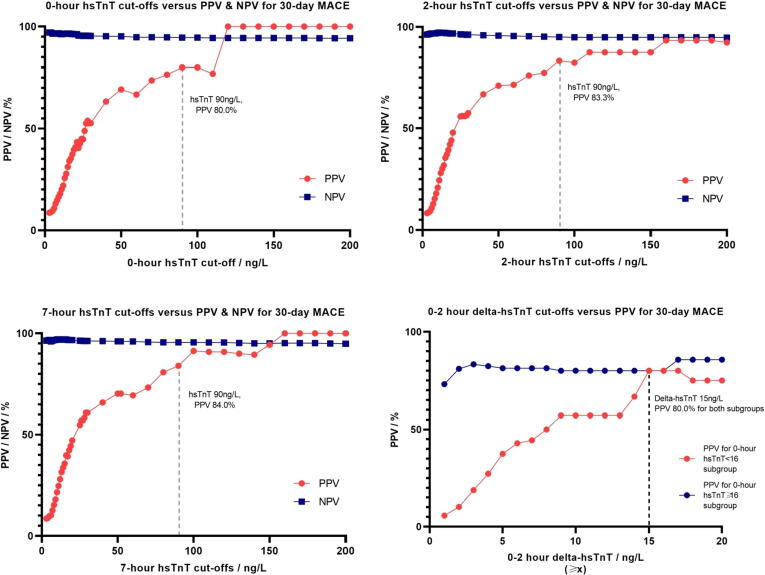
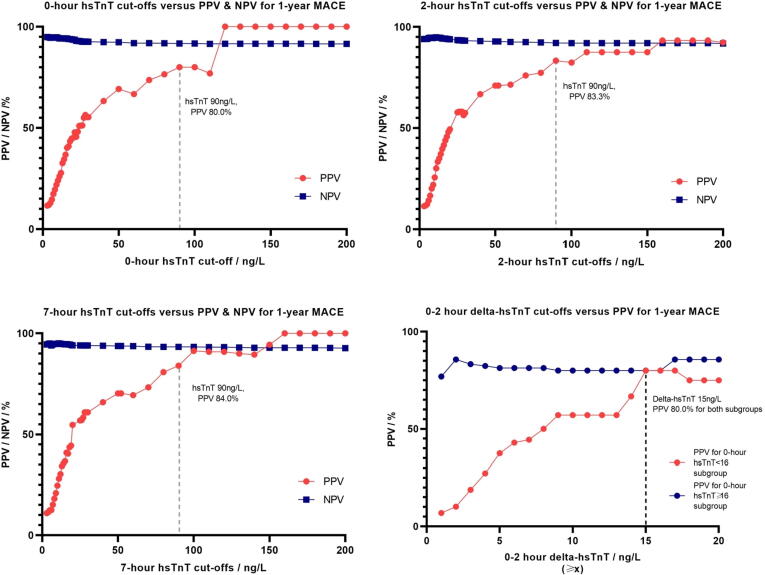
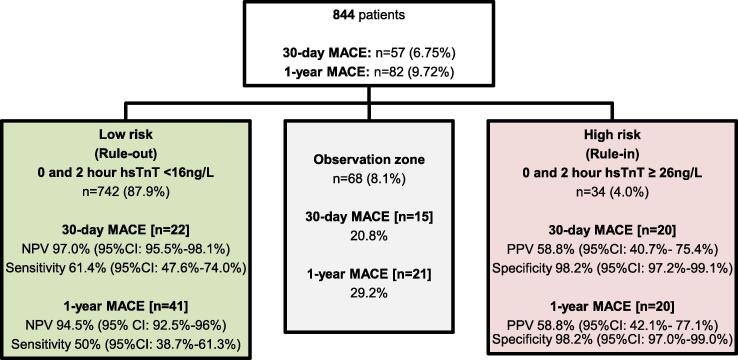
Results: 1023 patients were included (68.1% male, median age 56 years). There were 2712 hsTnT and cTnT values compared. hsTnT had a higher AUC than cTnT for 30-day and 1-year MACE. The optimal cut-off of 0-hour hsTnT for 30-day (PPV 34%, NPV 96.6%) and 1-year MACE (PPV 40.2%, NPV 94.2%) was 16 ng/L.For 844 patients who had values for both 0 and 2 h hsTnT, we proposed a rule-out cut-off of 0 and 2 h hsTnT < 16 ng/L (NPV 97.0%, 95%CI 95.5-98.1%) and a rule-in cut-off of 0 and 2 h hsTnT ≥ 26 ng/L (PPV 58.8%, 95%CI 40.7%-75.4%) for 30-day MACE. Negative 0-2 h delta-hsTnT had poor predictive discriminant capabilities on 30-day (PPV 8.2%) and 1-year MACE (PPV 12.3%).
Conclusion: The cut off values of hsTnT used in the 0 and 2-hour algorithm to rule-out (16 ng/L) and rule-in MACE (26 ng/L) are in the range that previous cTnT assays are unable to measure accurately. Risk scores can be used to further improve NPV of the rule-out group. A fall in hsTnT level acutely is not predictive of MACE.
Keywords: Acute coronary syndrome; Biomarkers; Chest pain; Major adverse cardiac events; Myocardial infarction; Troponin.
© 2021 The Authors. Published by Elsevier B.V.
Conflict of interest statement
Dr. Arthur M. Richards has received, in kind, support from the industry: assay provision by Roche Diagnostics and Abbott Laboratories; research grant from Roche Diagnostics; and speaker’s and advisory board fees from Roche Diagnostics and Novartis.
Figures
References
-
- Aldous S.J., Florkowski C.M., Crozier I.G., George P., Mackay R., Than M., Flaws D.F., Borowsky J. High sensitivity troponin outperforms contemporary assays in predicting major adverse cardiac events up to two years in patients with chest pain. Ann Clin Biochem. 2011;48:249–255. doi: 10.1258/acb.2010.010220. - DOI - PubMed
-
- Lipinski M.J., Baker N.C., Escarcega R.O., Torguson R., Chen F., Aldous S.J., Christ M., Collinson P.O., Goodacre S.W., Mair J., Inoue K., Lotze U., Sebbane M., Cristol J.P., Freund Y., Chenevier-Gobeaux C., Meune C., Eggers K.M., Pracon R., Schreiber D.H., Wu A.H., Ordonez-Llanos J., Jaffe A.S., Twerenbold R., Mueller C., Waksman R. Comparison of conventional and high-sensitivity troponin in patients with chest pain: a collaborative meta-analysis, Am. Hear. J. 2015;169:6–16 e6. doi: 10.1016/j.ahj.2014.10.007. - DOI - PubMed
-
- Reichlin T., Hochholzer W., Bassetti S., Steuer S., Stelzig C., Hartwiger S., Biedert S., Schaub N., Buerge C., Potocki M., Noveanu M., Breidthardt T., Twerenbold R., Winkler K., Bingisser R., Mueller C. Early diagnosis of myocardial infarction with sensitive cardiac troponin assays. N. Engl. J. Med. 2009;361:858–867. doi: 10.1056/NEJMoa0900428. - DOI - PubMed
-
- National Registry of Diseases Office Singapore Myocardial Infarction Registry Annual Report. 2017:2019.
LinkOut - more resources
Full Text Sources
Other Literature Sources
Research Materials
Miscellaneous
