


Interactions between serum FSH, inhibin B and antral follicle count in the decline of serum AMH during the menstrual cycle in late reproductive age
- PMID: 33855196
- PMCID: PMC8029535
- DOI: 10.1002/edm2.172
Interactions between serum FSH, inhibin B and antral follicle count in the decline of serum AMH during the menstrual cycle in late reproductive age
Abstract
Objective: To investigate the hormonal interrelationships during the menstrual cycle in women of late reproductive age with suppressed serum AMH and antral follicle count (AFC).
Methods: Serum hormones (AMH, FSH, LH, estradiol, progesterone, inhibin A, inhibin B), AFC (2-10 mm) and AMH/AFC ratio (an estimate of AMH/follicle) were assessed every 2-3 days across the menstrual cycle in 26 healthy ovulatory women aged 18-50 years.
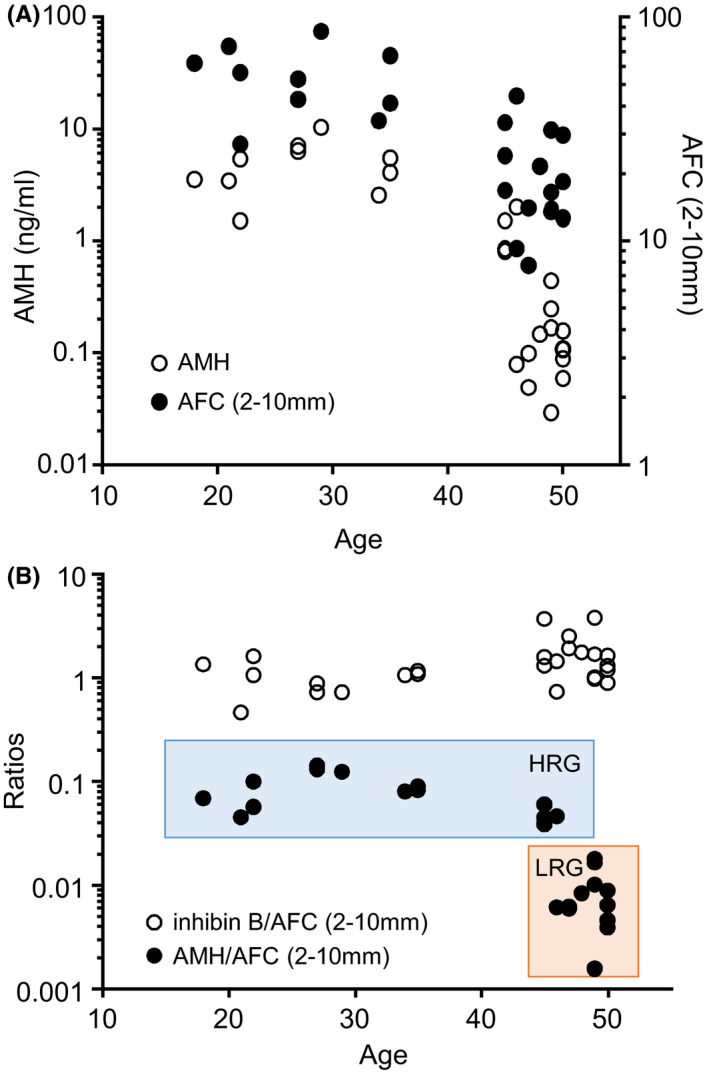
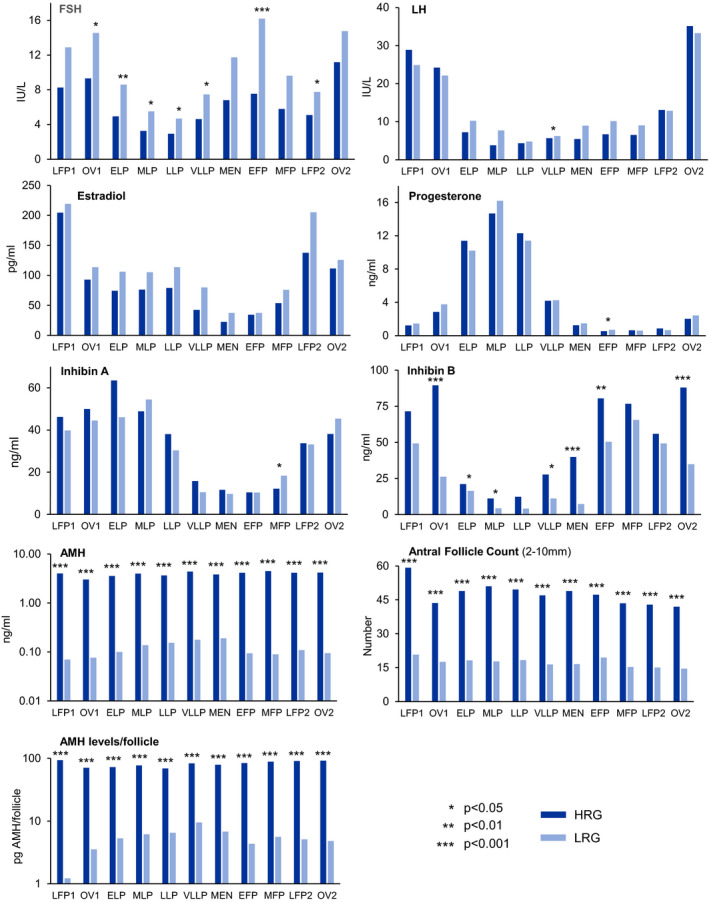
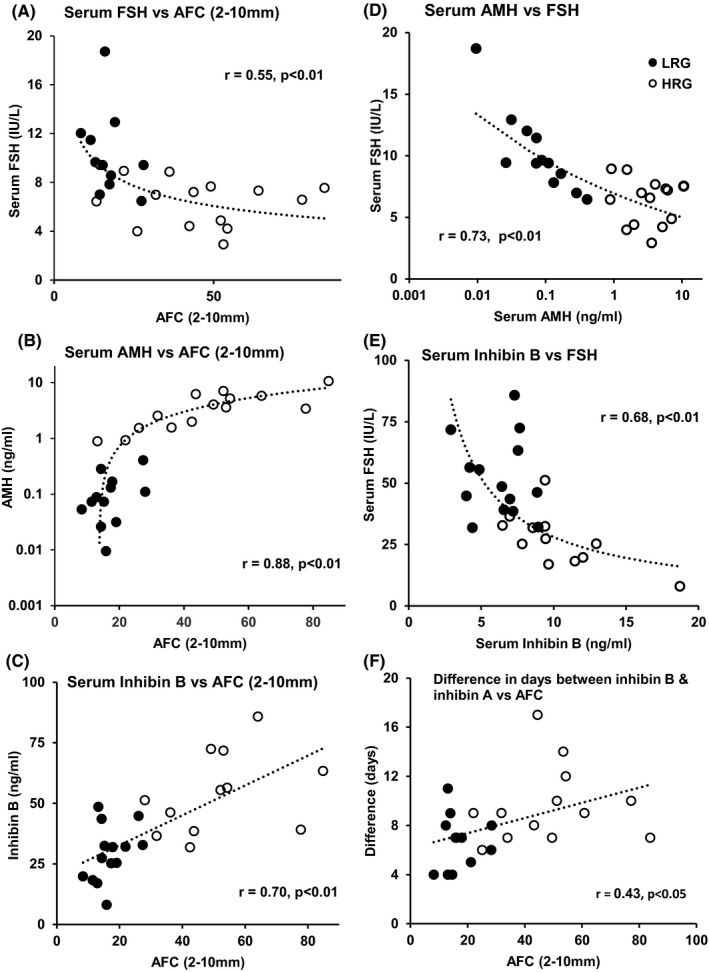
Results: An 11-fold fall in AMH/AFC was observed in women aged ≥45 years compared to those 18-45 years (P < .001). Although women ≥45 years exhibited normal menstrual cycle patterns of serum estradiol, progesterone, LH and inhibin A, FSH was elevated (P < .001) and inhibin B suppressed (P < .001) compared to the younger group. Overall FSH was inversely correlated (r = .55, P < .05) and AMH directly correlated (r = .88, P < .01) with AFC; however, these relationships were curvilinear and more pronounced when AFC was low. Inhibin B was directly linearly correlated (r = .70, P < .01) with AFC across both high and low AMH/follicle groups.
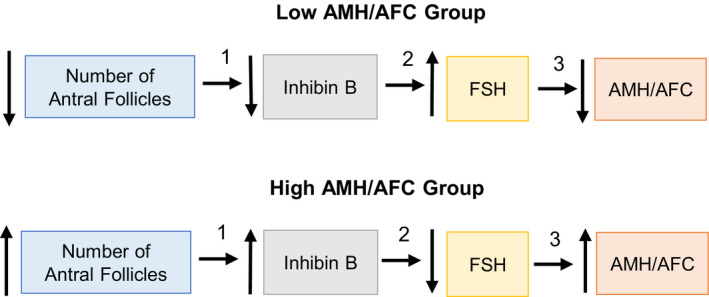
Conclusions: It is hypothesized that the marked fall in AMH/follicle in late reproductive age is attributed to the change in the hormonal interplay between the pituitary and ovary. The fall in AFC leads to a decrease in inhibin B and a concomitant increase in FSH by a recognized feedback mechanism. It is postulated the elevated FSH suppresses AMH either directly or indirectly through oocyte-specific growth factors leading to a marked fall in AMH/follicle. We propose that pituitary-ovarian and intra-ovarian regulatory systems underpin the accelerated fall in AMH/follicle during the transition to menopause.
Keywords: BMP15; GDF9; cumulin; estradiol; inhibin A; menopause; oocytes.
© 2020 The Authors. Endocrinology, Diabetes & Metabolism published by John Wiley & Sons Ltd.
Conflict of interest statement
The authors have nothing to disclose.
Figures
References
-
- Faddy MJ. Follicle dynamics during ovarian ageing. Mol Cell Endocrinol. 2000;163:43‐48. - PubMed
-
- Dewailly D, Andersen CY, Balen A, et al. The physiology and clinical utility of anti‐Mullerian hormone in women. Hum Reprod Update. 2014;20:370‐385. - PubMed
-
- Durlinger AL, Kramer P, Karels B, et al. Control of primordial follicle recruitment by anti‐Müllerian hormone in the mouse ovary. Endocrinology. 1999;140:5789‐5796. - PubMed
-
- Durlinger AL, Gruijters MJ, Kramer P, et al. Anti‐Müllerian hormone attenuates the effects of FSH on follicle development in the mouse ovary. Endocrinology. 2001;142:4891‐4899. - PubMed
Publication types
MeSH terms
Substances
Grants and funding
LinkOut - more resources
Full Text Sources
Medical
