


The prognostic value of resting-state EEG in acute post-traumatic unresponsive states
- PMID: 33855295
- PMCID: PMC8023635
- DOI: 10.1093/braincomms/fcab017
The prognostic value of resting-state EEG in acute post-traumatic unresponsive states
Abstract
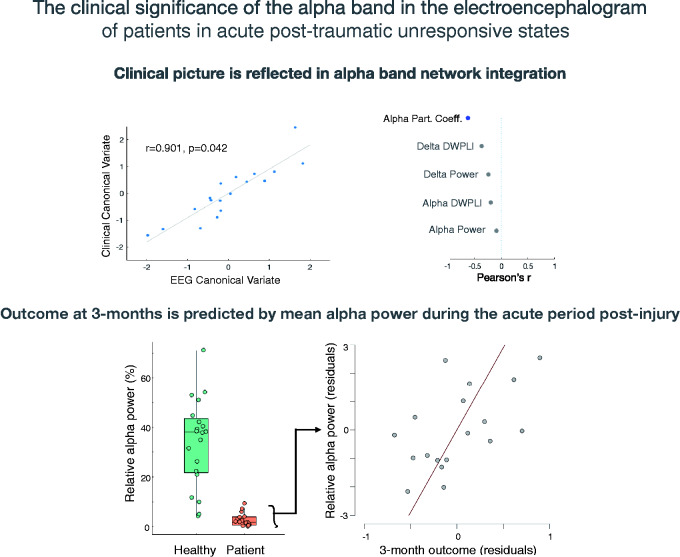
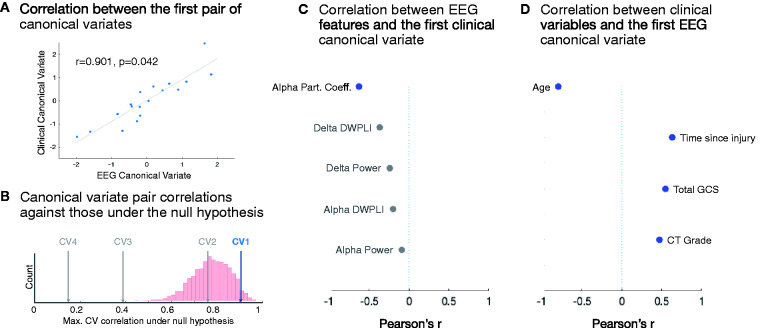
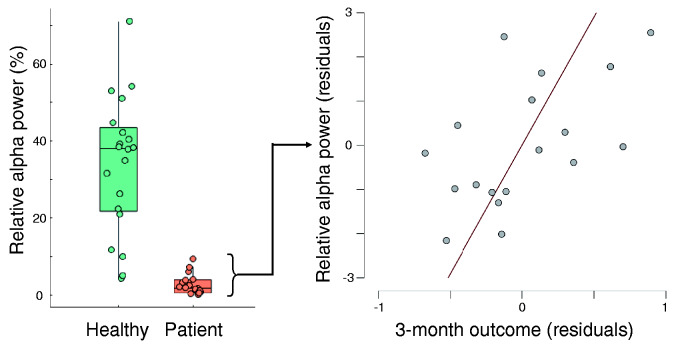
Accurate early prognostication is vital for appropriate long-term care decisions after traumatic brain injury. While measures of resting-state EEG oscillations and their network properties, derived from graph theory, have been shown to provide clinically useful information regarding diagnosis and recovery in patients with chronic disorders of consciousness, little is known about the value of these network measures when calculated from a standard clinical low-density EEG in the acute phase post-injury. To investigate this link, we first validated a set of measures of oscillatory network features between high-density and low-density resting-state EEG in healthy individuals, thus ensuring accurate estimation of underlying cortical function in clinical recordings from patients. Next, we investigated the relationship between these features and the clinical picture and outcome of a group of 18 patients in acute post-traumatic unresponsive states who were not following commands 2 days+ after sedation hold. While the complexity of the alpha network, as indexed by the standard deviation of the participation coefficients, was significantly related to the patients' clinical picture at the time of EEG, no network features were significantly related to outcome at 3 or 6 months post-injury. Rather, mean relative alpha power across all electrodes improved the accuracy of outcome prediction at 3 months relative to clinical features alone. These results highlight the link between the alpha rhythm and clinical signs of consciousness and suggest the potential for simple measures of resting-state EEG band power to provide a coarse snapshot of brain health for stratification of patients for rehabilitation, therapy and assessments of both covert and overt cognition.
Keywords: EEG; alpha; coma; prognosis; traumatic brain injury.
© The Author(s) (2021). Published by Oxford University Press on behalf of the Guarantors of Brain.
Figures
References
-
- Rosenfeld JV Maas AI Bragge P Morganti-Kossmann MC Manley GT Gruen RL. Early management of severe traumatic brain injury. Lancet. 2012;380(9847):1088–1098. - PubMed
-
- Royal College of Physicians. Prolonged disorders of consciousness following sudden onset brain injury: national clinical guidelines. RCP London. Published March 6, 2020. https://www.rcplondon.ac.uk/guidelines-policy/prolonged-disorders-consci.... Accessed 15 September 2020.
-
- Claassen J Doyle K Matory A, et al. Detection of brain activation in unresponsive patients with acute brain injury. N Engl J Med. 2019;380(26):2497–2505. - PubMed
-
- Wilson JTL Pettigrew LEL Teasdale GM. Structured interviews for the Glasgow outcome scale and the extended Glasgow outcome scale: guidelines for their use. J Neurotrauma. 1998;15(8):573–585. - PubMed
-
- Cruse D Chennu S Chatelle C, et al. Bedside detection of awareness in the vegetative state: a cohort study. Lancet. 2011;378(9809):2088–2094. - PubMed
Grants and funding
LinkOut - more resources
Full Text Sources
Other Literature Sources