


Machine learning methods in sport injury prediction and prevention: a systematic review
- PMID: 33855647
- PMCID: PMC8046881
- DOI: 10.1186/s40634-021-00346-x
Machine learning methods in sport injury prediction and prevention: a systematic review
Abstract
Purpose: Injuries are common in sports and can have significant physical, psychological and financial consequences. Machine learning (ML) methods could be used to improve injury prediction and allow proper approaches to injury prevention. The aim of our study was therefore to perform a systematic review of ML methods in sport injury prediction and prevention.
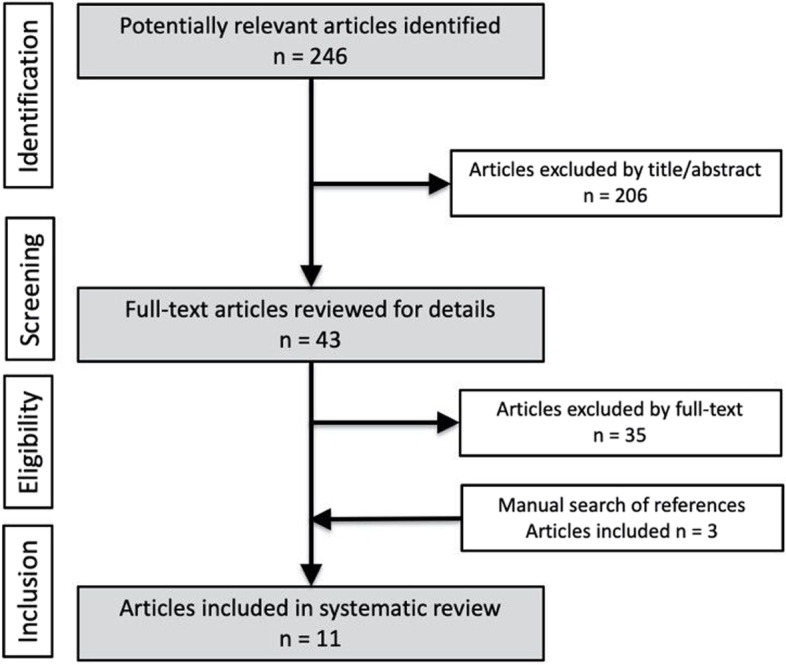
Methods: A search of the PubMed database was performed on March 24th 2020. Eligible articles included original studies investigating the role of ML for sport injury prediction and prevention. Two independent reviewers screened articles, assessed eligibility, risk of bias and extracted data. Methodological quality and risk of bias were determined by the Newcastle-Ottawa Scale. Study quality was evaluated using the GRADE working group methodology.
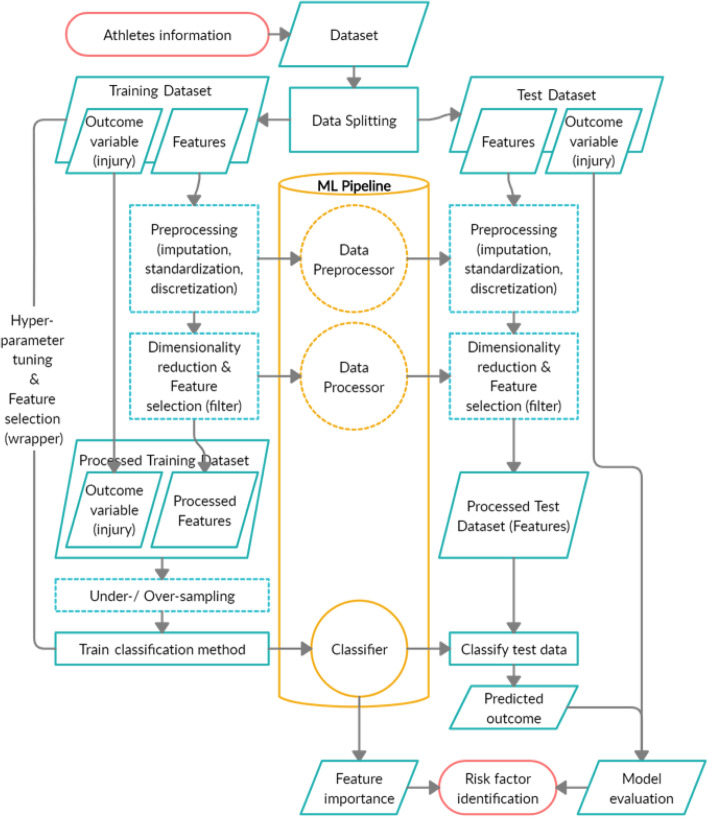
Results: Eleven out of 249 studies met inclusion/exclusion criteria. Different ML methods were used (tree-based ensemble methods (n = 9), Support Vector Machines (n = 4), Artificial Neural Networks (n = 2)). The classification methods were facilitated by preprocessing steps (n = 5) and optimized using over- and undersampling methods (n = 6), hyperparameter tuning (n = 4), feature selection (n = 3) and dimensionality reduction (n = 1). Injury predictive performance ranged from poor (Accuracy = 52%, AUC = 0.52) to strong (AUC = 0.87, f1-score = 85%).
Conclusions: Current ML methods can be used to identify athletes at high injury risk and be helpful to detect the most important injury risk factors. Methodological quality of the analyses was sufficient in general, but could be further improved. More effort should be put in the interpretation of the ML models.
Keywords: Injury prediction; Injury prevention; Machine Learning; Sport injury.
Conflict of interest statement
The authors declare that they have no competing interests.
Figures
References
-
- Adetiba E, Iweanya VC, Popoola SI, Adetiba JN, Menon C. Automated detection of heart defects in athletes based on electrocardiography and artificial neural network. Cogent Eng. 2017;4:1411220. doi: 10.1080/23311916.2017.1411220. - DOI
Publication types
LinkOut - more resources
Full Text Sources
Other Literature Sources
Miscellaneous
