


Four-factor Prothrombin Complex Concentrate for Reversal of Factor Xa Inhibitors versus Warfarin in Life-threatening Bleeding
- PMID: 33856296
- PMCID: PMC7972353
- DOI: 10.5811/westjem.2020.11.47931
Four-factor Prothrombin Complex Concentrate for Reversal of Factor Xa Inhibitors versus Warfarin in Life-threatening Bleeding
Abstract
Introduction: Factor Xa (fXa) inhibitor reversal for life-threatening bleeding is controversial due to a lack of high-quality evidence. The purpose of this study was to determine the hemostatic efficacy of four-factor prothrombin complex concentrate (4F-PCC) for the reversal of fXa inhibitors compared to warfarin for life-threatening bleeding.
Methods: This was a multicenter, retrospective cohort study at two academic medical centers between January 1, 2014-December 31, 2019, which included patients who presented to the emergency department with a life-threatening bleed necessitating anticoagulation reversal with 4F-PCC. The primary endpoint was achievement of hemostatic efficacy after 4F-PCC administration.
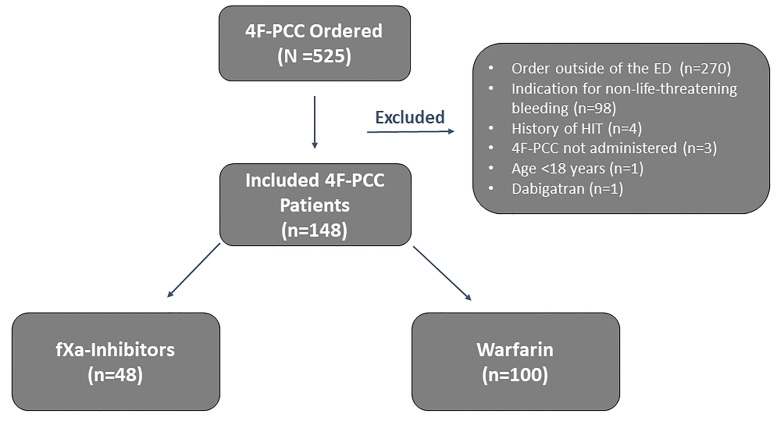
Results: Of the 525 patients who had an order for 4F-PCC during the study period, 148 patients met the criteria for inclusion (n = 48 fXa inhibitor group; n = 100 warfarin group). Apixaban (52.1%) and rivaroxaban (45.8%) were the most commonly used fXa inhibitors. Effective hemostasis was similar between groups (79.2% fXa inhibitor group vs 85% warfarin group, p = 0.38). This was consistent across all types of bleeding. Thrombotic events were rare in both groups (2% vs 3%).
Conclusion: This multicenter, retrospective cohort study demonstrated that using 4F-PCC for treatment of life-threatening bleeding produced effective hemostasis in patients on fXa inhibitors and warfarin.
Conflict of interest statement
Figures
Similar articles
-
Emergent reversal of oral factor Xa inhibitors with four-factor prothrombin complex concentrate.Am J Emerg Med. 2020 Dec;38(12):2641-2645. doi: 10.1016/j.ajem.2020.08.019. Epub 2020 Aug 19. Am J Emerg Med. 2020. PMID: 33041150
-
Safety, efficacy, and cost of four-factor prothrombin complex concentrate (4F-PCC) in patients with factor Xa inhibitor-related bleeding: a retrospective study.J Thromb Thrombolysis. 2019 Aug;48(2):250-255. doi: 10.1007/s11239-019-01846-5. J Thromb Thrombolysis. 2019. PMID: 30941571
-
Four-factor prothrombin complex concentrate for life-threatening bleeds or emergent surgery: A retrospective evaluation.J Crit Care. 2016 Dec;36:166-172. doi: 10.1016/j.jcrc.2016.06.024. Epub 2016 Jul 5. J Crit Care. 2016. PMID: 27546767
-
Roles of Four-Factor Prothrombin Complex Concentrate in the Management of Critical Bleeding.Transfus Med Rev. 2021 Oct;35(4):96-103. doi: 10.1016/j.tmrv.2021.06.007. Epub 2021 Aug 26. Transfus Med Rev. 2021. PMID: 34551881 Review.
-
Effect of low- versus high-dose 4-factor prothrombin complex concentrate in factor Xa inhibitor-associated bleeding: A qualitative systematic review.Am J Health Syst Pharm. 2024 May 24;81(11):e274-e282. doi: 10.1093/ajhp/zxae009. Am J Health Syst Pharm. 2024. PMID: 38430127
Cited by
-
Four-factor prothrombin complex concentrate for the treatment of oral factor Xa inhibitor-associated bleeding: a meta-analysis of fixed versus variable dosing.Res Pract Thromb Haemost. 2023 Mar 10;7(2):100107. doi: 10.1016/j.rpth.2023.100107. eCollection 2023 Feb. Res Pract Thromb Haemost. 2023. PMID: 37063756 Free PMC article.
-
Andexanet Alfa in Urgent Cardiac Surgery: A Case Report of Edoxaban Reversal for Acute Hemopericardium.Am J Case Rep. 2025 Mar 30;26:e945265. doi: 10.12659/AJCR.945265. Am J Case Rep. 2025. PMID: 40158195 Free PMC article.
-
Long-Term Safety of a Four-Factor Prothrombin Complex Concentrate (Kcentra®/Beriplex® P/N): An Updated Pharmacovigilance Review.Thromb Haemost. 2025 Jan;125(1):46-57. doi: 10.1055/s-0044-1788305. Epub 2024 Jul 29. Thromb Haemost. 2025. PMID: 39074810 Free PMC article. Review.
References
-
- Lip GYH, Banerjee A, Boriani G, et al. Antithrombotic therapy for atrial fibrillation: CHEST guideline and expert panel report. Chest. 2018;154(5):1121–201. - PubMed
-
- Hankey GJ, Stevens SR, Piccini JP, et al. Intracranial hemorrhage among patients with atrial fibrillation anticoagulated with warfarin or rivaroxaban: the rivaroxaban once daily, oral, direct factor Xa inhibition compared with vitamin K antagonism for prevention of stroke and embolism trial in atrial fibrillation. Stroke. 2014;45(5):1304–12. - PubMed
-
- Ruff CT, Giugliano RP, Braunwald E, et al. Comparison of the efficacy and safety of new oral anticoagulants with warfarin in patients with atrial fibrillation: a meta-analysis of randomised trials. Lancet. 2014;383(9921):955–62. - PubMed
MeSH terms
Substances
LinkOut - more resources
Full Text Sources
Other Literature Sources
Medical
Miscellaneous