


SeedQuant: a deep learning-based tool for assessing stimulant and inhibitor activity on root parasitic seeds
- PMID: 33856485
- PMCID: PMC8260127
- DOI: 10.1093/plphys/kiab173
SeedQuant: a deep learning-based tool for assessing stimulant and inhibitor activity on root parasitic seeds
Abstract
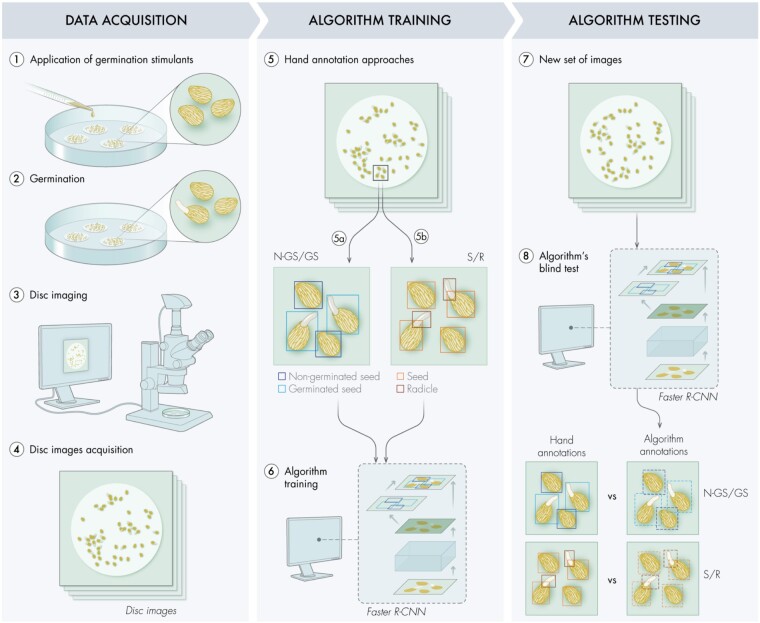
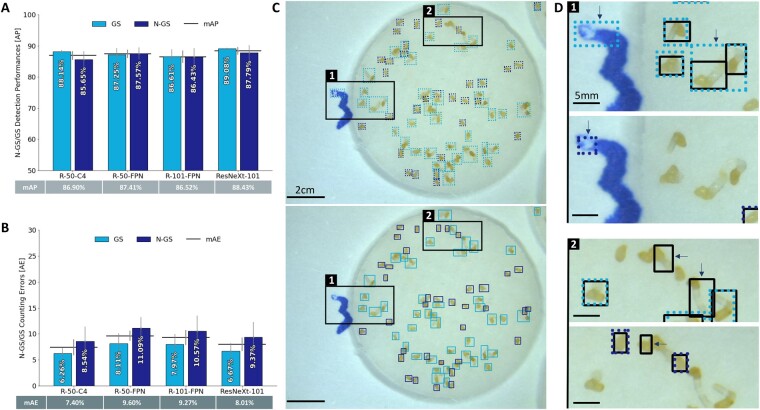
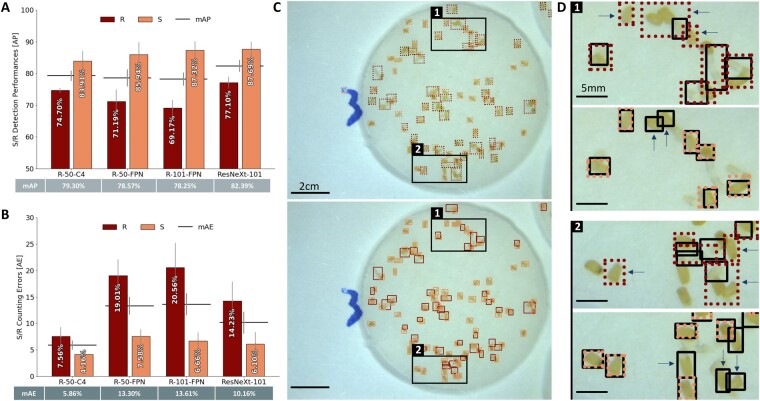
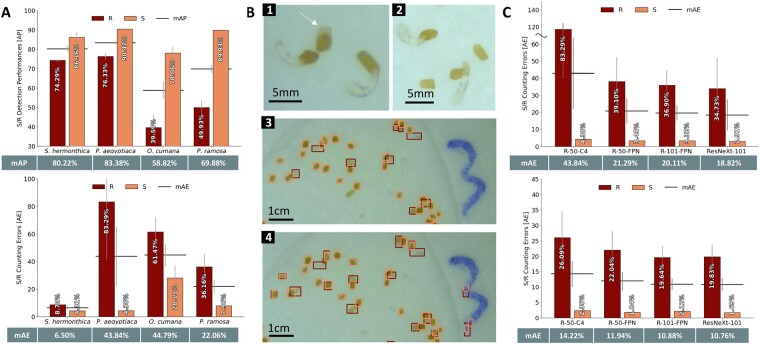
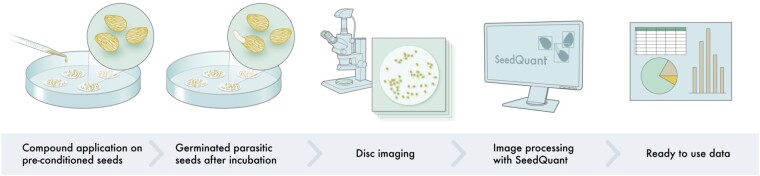
Witchweeds (Striga spp.) and broomrapes (Orobanchaceae and Phelipanche spp.) are root parasitic plants that infest many crops in warm and temperate zones, causing enormous yield losses and endangering global food security. Seeds of these obligate parasites require rhizospheric, host-released stimulants to germinate, which opens up possibilities for controlling them by applying specific germination inhibitors or synthetic stimulants that induce lethal germination in the host's absence. To determine their effect on germination, root exudates or synthetic stimulants/inhibitors are usually applied to parasitic seeds in in vitro bioassays, followed by assessment of germination ratios. Although these protocols are very sensitive, the germination recording process is laborious, representing a challenge for researchers and impeding high-throughput screens. Here, we developed an automatic seed census tool to count and discriminate germinated seeds (GS) from non-GS. We combined deep learning, a powerful data-driven framework that can accelerate the procedure and increase its accuracy, for object detection with computer vision latest development based on the Faster Region-based Convolutional Neural Network algorithm. Our method showed an accuracy of 94% in counting seeds of Striga hermonthica and reduced the required time from approximately 5 min to 5 s per image. Our proposed software, SeedQuant, will be of great help for seed germination bioassays and enable high-throughput screening for germination stimulants/inhibitors. SeedQuant is an open-source software that can be further trained to count different types of seeds for research purposes.
© The Author(s) 2021. Published by Oxford University Press on behalf of American Society of Plant Biologists.
Figures
References
-
- Aly R (2012) Advanced technologies for parasitic weed control. Weed Sci 60: 290–294
-
- Atera EA, Itoh K, Azuma T, Ishii T (2012) Farmers' perspectives on the biotic constraint of Striga hermonthica and its control in western Kenya. Weed Biol Manag 12: 53–62
-
- Bengio Y, Courville A, Vincent P (2013) Representation learning: a review and new perspectives. IEEE Trans Pattern Anal Mach Intell 35: 1798–1828 - PubMed
-
- Bouwmeester HJ, Matusova R, Sun ZK, Beale MH (2003) Secondary metabolite signaling in host-parasitic plant interactions. Curr Opin Plant Biol 6: 358–364 - PubMed
-
- Butler LG (1995) Chemical Communication Between the Parasitic Weed Striga and its Crop Host: A New Dimension in Allelochemistry. ACS Publications, Washington, DC
Publication types
MeSH terms
LinkOut - more resources
Full Text Sources
Other Literature Sources
Miscellaneous
