Cumulative Rates of Child Protection Involvement and Terminations of Parental Rights in a California Birth Cohort, 1999-2017
- PMID: 33856882
- PMCID: PMC8101595
- DOI: 10.2105/AJPH.2021.306214
Cumulative Rates of Child Protection Involvement and Terminations of Parental Rights in a California Birth Cohort, 1999-2017
Abstract
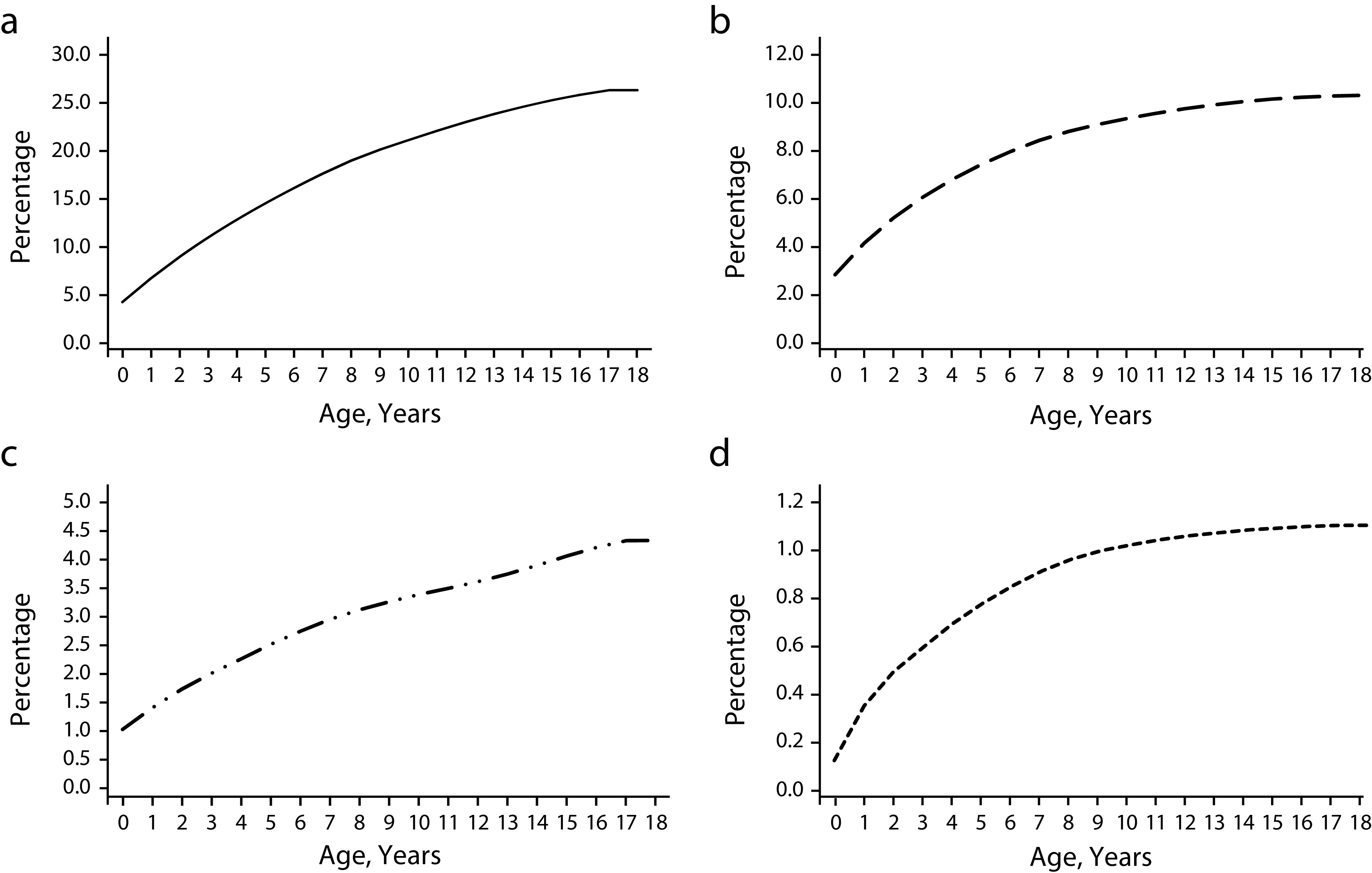
Objectives. To document the cumulative childhood risk of different levels of involvement with the child protection system (CPS), including terminations of parental rights (TPRs).Methods. We linked vital records for California's 1999 birth cohort (n = 519 248) to CPS records from 1999 to 2017. We used sociodemographic information captured at birth to estimate differences in the cumulative percentage of children investigated, substantiated, placed in foster care, and with a TPR.Results. Overall, 26.3% of children were investigated for maltreatment, 10.5% were substantiated, 4.3% were placed in foster care, and 1.1% experienced a TPR. Roughly 1 in 2 Black and Native American children were investigated during childhood. Children receiving public insurance experienced CPS involvement at more than twice the rate of children with private insurance.Conclusions. Findings provide a lower-bound estimate of CPS involvement and extend previous research by documenting demographic differences, including in TPRs.Public Health Implications. Conservatively, CPS investigates more than a quarter of children born in California for abuse or neglect. These data reinforce policy questions about the current scope and reach of our modern CPS.
Figures
Comment in
-
Making Meaning of Cumulative Child Welfare System Involvement.Am J Public Health. 2021 Jun;111(6):993-995. doi: 10.2105/AJPH.2021.306268. Am J Public Health. 2021. PMID: 33950724 Free PMC article. No abstract available.
-
Putnam-Hornstein et al. Respond.Am J Public Health. 2021 Dec;111(12):e2-e3. doi: 10.2105/AJPH.2021.306532. Am J Public Health. 2021. PMID: 34878883 Free PMC article. No abstract available.
-
Widespread Surveillance by the Child Protection System: Lasting Effects on Families.Am J Public Health. 2021 Dec;111(12):e1-e2. doi: 10.2105/AJPH.2021.306530. Am J Public Health. 2021. PMID: 34878885 Free PMC article. No abstract available.
References
-
- US Department of Health & Human Services. Children’s Bureau. AFCARS report #26. October 24, 2019. Available at: https://www.acf.hhs.gov/cb/report/afcars-report-26. Accessed March 15, 2021. - PubMed
-
- Child Welfare Information Gateway. Grounds for involuntary termination of parental rights. 2017. Available at: https://www.childwelfare.gov/topics/systemwide/laws-policies/statutes/gr.... Accessed June 14, 2020.
-
- Meyer AS, McWey LM, McKendrick W, Henderson TL. Substance using parents, foster care, and termination of parental rights: the importance of risk factors for legal outcomes. Child Youth Serv Rev. 2010;32(5):639–649. doi: 10.1016/j.childyouth.2009.12.011. - DOI
Publication types
MeSH terms
Grants and funding
LinkOut - more resources
Full Text Sources
Other Literature Sources
Medical