. 2021 Jun 7;31(11):2455-2468.e18.
doi: 10.1016/j.cub.2021.03.050. Epub 2021 Apr 14.

Variable kinship patterns in Neolithic Anatolia revealed by ancient genomes

Affiliations

Variable kinship patterns in Neolithic Anatolia revealed by ancient genomes

Reyhan Yaka et al. Curr Biol. .

Abstract

The social organization of the first fully sedentary societies that emerged during the Neolithic period in Southwest Asia remains enigmatic,1 mainly because material culture studies provide limited insight into this issue. However, because Neolithic Anatolian communities often buried their dead beneath domestic buildings,2 household composition and social structure can be studied through these human remains. Here, we describe genetic relatedness among co-burials associated with domestic buildings in Neolithic Anatolia using 59 ancient genomes, including 22 new genomes from Aşıklı Höyük and Çatalhöyük. We infer pedigree relationships by simultaneously analyzing multiple types of information, including autosomal and X chromosome kinship coefficients, maternal markers, and radiocarbon dating. In two early Neolithic villages dating to the 9th and 8th millennia BCE, Aşıklı Höyük and Boncuklu, we discover that siblings and parent-offspring pairings were frequent within domestic structures, which provides the first direct indication of close genetic relationships among co-burials. In contrast, in the 7th millennium BCE sites of Çatalhöyük and Barcın, where we study subadults interred within and around houses, we find close genetic relatives to be rare. Hence, genetic relatedness may not have played a major role in the choice of burial location at these latter two sites, at least for subadults. This supports the hypothesis that in Çatalhöyük,3-5 and possibly in some other Neolithic communities, domestic structures may have served as burial location for social units incorporating biologically unrelated individuals. Our results underscore the diversity of kin structures in Neolithic communities during this important phase of sociocultural development.

Keywords: Anatolia; Neolithic transition; household composition; identity by descent; intramural burial; kinship; paleogenomics; relatedness.


Conflict of interest statement

Declaration of interests The authors declare no competing interests.

Figures
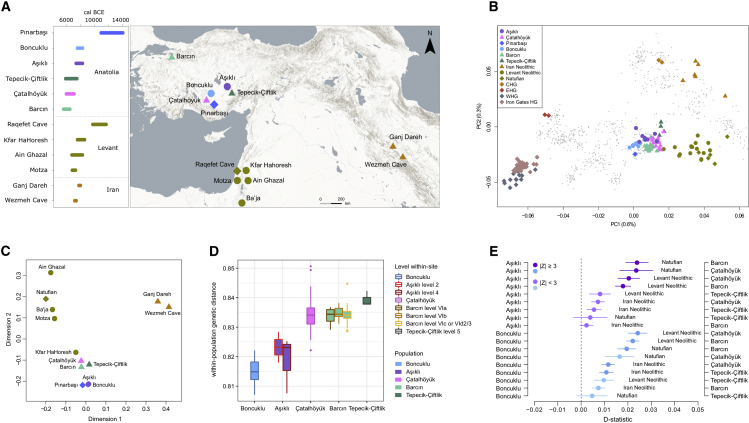
Figure 1
Figure 1
Population relationships in Neolithic Anatolia (A) Geographic map of early Holocene SW Asian settlements with genome data used in the study (Table Z3). The map was created using ArcGIS Pro® 2.4.0 (ArcGIS Pro® is the intellectual property of Esri and is used herein under license. For more information about Esri® software, please visit www.esri.com. Map sources: Esri, USGS, NOAA). (B) Principal components analysis (PCA) plot describing the genetic affinities among ancient populations studied. The genotype of each ancient individual was projected upon the first two PCs calculated using present-day West Eurasians. Colored dots represent ancient individuals. Figure S3B lists population labels of present-day individuals (gray dots). (C) Multidimensional scaling plot summarizing f3-statistic-based genetic distances between Anatolian populations (goodness of fit r2 = 0.92). (D) Boxplots showing within-population genetic distances (i.e., diversity) calculated using roughly contemporaneous individuals from each settlement (STAR Methods). Boxplot whiskers extend <1.5 times the interquartile range. (E) Population level D-statistics calculated as D(Yoruba, X; Aceramic, Ceramic), where Aceramic indicates Aşıklı and Boncuklu shown on the left-hand y axis, and Ceramic indicates Çatalhöyük, Barcın, or Tepecik-Çiftlik shown on the right-hand y axis, and X stands for ancient populations from the Levant and Iran, shown in the middle. Negative or positive D values indicate higher genetic affinity between X and Aceramic or Ceramic Neolithic Anatolians, respectively. Darker colors show nominally significant D-statistics with |Z| ≥3, and lighter colors show non-significant values. Error bars show ± 1 standard error. See also Figures S2 and S3 and Tables Z1–Z5, Z8–Z9.
Figure 2
Figure 2
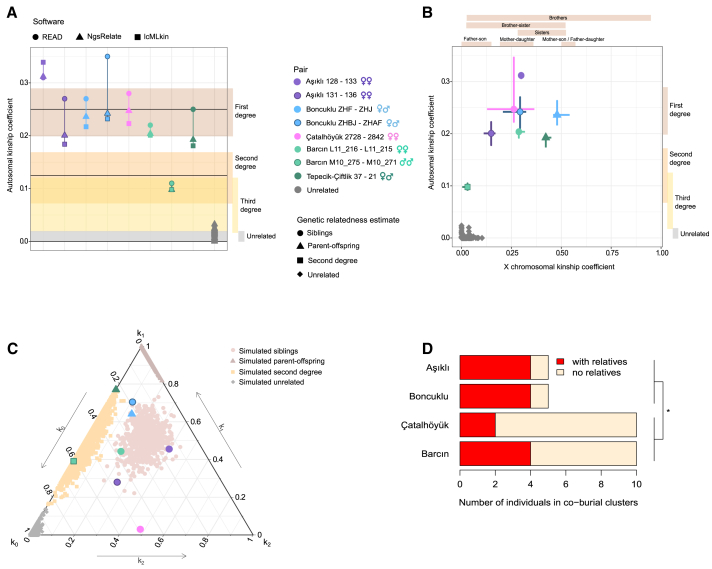
Genetic relatedness estimation among co-buried individuals using genomic data (A) Autosomal kinship coefficients (θ) between pairs of individuals calculated using three different software programs. The horizontal black lines indicate expected autosomal θ values for first- and second-degree related and unrelated pairs. The high estimates for the Aşıklı 128–133 pair may be influenced by inbreeding (STAR Methods). The horizontal colored bars indicate expected θ ranges for different degrees of relatedness estimated using simulations with 5,000 SNPs (95% confidence interval). Figure S4B presents the same results, where simulations were performed using the same SNP numbers per pair. (B) Autosomal versus X chromosomal kinship coefficients (θ) between pairs calculated with NgsRelate. The vertical bars on the right indicate expected θ ranges for different degrees of relatedness estimated using simulations with 5,000 autosomal SNPs, while the horizontal bars on the top indicate expected θ ranges for different types of relatedness estimated using simulations with 800 X chromosome SNPs (empirical 95% bootstrap confidence interval). The horizontal and vertical point-bars describe uncertainty in autosomal and X chromosomal θ estimates, respectively, calculated by bootstrapping SNPs 100 times (Table Z12). (C) Probabilities of sharing 0, 1, or 2 autosomal alleles identical-by-descent (Cotterman coefficients; k0, k1, k2) between pairs of individuals calculated with NgsRelate. The gray dots indicate expected values based on simulation. The estimated pedigree relationships reflect joint evaluation of different information (e.g., age at death) in addition to Cotterman coefficients (Table S3). (D) Frequencies of individuals found in co-burial clusters with or without close relatives identified (Figure 3), among all co-buried individuals tested genetically in a site. () indicates p < 0.05. Including the Tepecik-Çiftlik data in the Aceramic period versus Ceramic period comparison yields an odds ratio = 6.6 and p = 0.054. See also Figures S1 and S4 and Tables S1–S3, Z11, Z12, Z16–Z19.
Figure 3
Figure 3
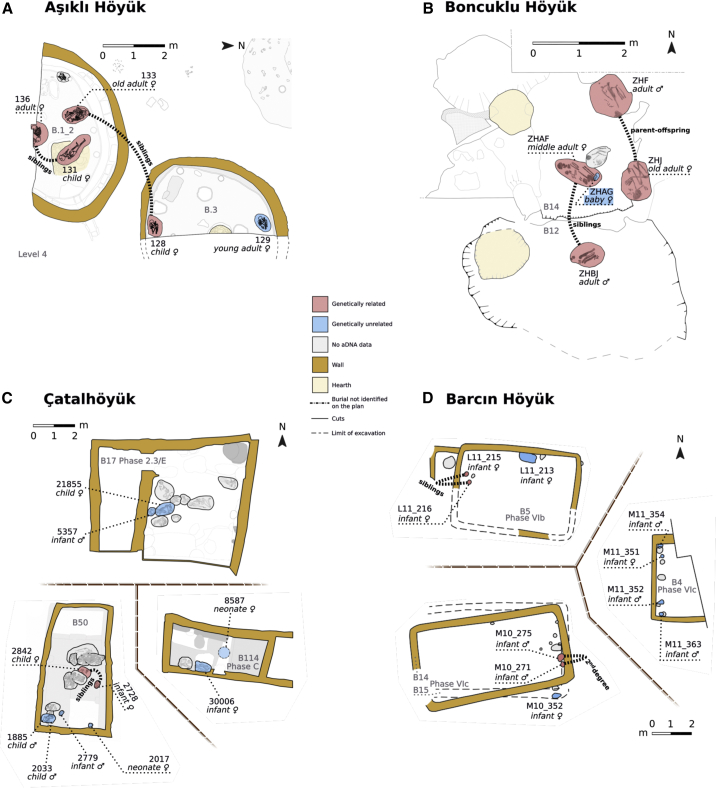
Relatedness among co-buried individuals in (A) Aşıklı Höyük, (B) Boncuklu Höyük, (C) Çatalhöyük, (D) Barcın Höyük The plans show buildings where burials with identified close relatives are shown in red, burials with no identified relatives in blue, and burials for which no DNA data was available, in gray. Building numbers are shown starting with “B.” The figure indicates the most likely inferred relationships, described in Table S3. See also Figure S4 and Tables S1–S3, Z11, and Z12.

References

    1. Kuijt I. People and Space in Early Agricultural Villages: Exploring Daily Lives, Community Size, and Architecture in the Late Pre-Pottery Neolithic. J. Anthropol. Archaeol. 2000;19:75–102. doi: 10.1006/jaar.1999.0352. - DOI
    1. Boz B., Hager L.D. Living above the Dead: Intramural Burial practices at Çatalhöyük. In: Hodder I., editor. Humans and Landscapes of Çatalhöyük: Reports from the 2000-2008 Seasons. Cotsen Institute of Archaeology; 2013. pp. 413–440.
    1. Pilloud M.A., Larsen C.S. “Official” and “practical” kin: Inferring social and community structure from dental phenotype at Neolithic Çatalhöyük, Turkey. Am. J. Phys. Anthropol. 2011;145:519–530. doi: 10.1002/ajpa.21520. - DOI - PubMed
    1. Larsen C.S., Knüsel C.J., Haddow S.D., Pilloud M.A., Milella M., Sadvari J.W., Pearson J., Ruff C.B., Garofalo E.M., Bocaege E. Bioarchaeology of Neolithic Çatalhöyük reveals fundamental transitions in health, mobility, and lifestyle in early farmers. Proc. Natl. Acad. Sci. USA. 2019;116:12615–12623. doi: 10.1073/pnas.1904345116. - DOI - PMC - PubMed
    1. Chyleński M., Ehler E., Somel M., Yaka R., Krzewińska M., Dabert M., Juras A., Marciniak A. Ancient mitochondrial genomes reveal the absence of maternal kinship in the burials of Çatalhöyük people and their genetic affinities. Genes (Basel) 2019;10:207. doi: 10.3390/genes10030207. - DOI - PMC - PubMed

Publication types

LinkOut - more resources