. 2021 Apr 15;21(1):353.
doi: 10.1186/s12879-021-06015-9.

Bronchoalveolar lavage fluid characteristics and outcomes of invasively mechanically ventilated patients with COVID-19 pneumonia in Genoa, Italy

Affiliations

Bronchoalveolar lavage fluid characteristics and outcomes of invasively mechanically ventilated patients with COVID-19 pneumonia in Genoa, Italy

Chiara Dentone et al. BMC Infect Dis. .

Abstract

Background: The primary objective of the study is to describe the cellular characteristics of bronchoalveolar lavage fluid (BALF) of COVID-19 patients requiring invasive mechanical ventilation; the secondary outcome is to describe BALF findings between survivors vs non-survivors.

Materials and methods: Patients positive for SARS-CoV-2 RT PCR, admitted to ICU between March and April 2020 were enrolled. At ICU admission, BALF were analyzed by flow cytometry. Univariate, multivariate and Spearman correlation analyses were performed.

Results: Sixty-four patients were enrolled, median age of 64 years (IQR 58-69). The majority cells in the BALF were neutrophils (70%, IQR 37.5-90.5) and macrophages (27%, IQR 7-49) while a minority were lymphocytes, 1%, TCD3+ 92% (IQR 82-95). The ICU mortality was 32.8%. Non-survivors had a significantly older age (p = 0.033) and peripheral lymphocytes (p = 0.012) were lower compared to the survivors. At multivariate analysis the percentage of macrophages in the BALF correlated with poor outcome (OR 1.336, CI95% 1.014-1.759, p = 0.039).

Conclusions: In critically ill patients, BALF cellularity is mainly composed of neutrophils and macrophages. The macrophages percentage in the BALF at ICU admittance correlated with higher ICU mortality. The lack of lymphocytes in BALF could partly explain a reduced anti-viral response.

Keywords: Bronchoalveolar lavage fluid; COVID-19; Lymphocytes; Macrophages.


Conflict of interest statement

The authors declare that they have no known competing financial interests or personal relationships that could have appeared to influence the work reported in this paper.

Figures
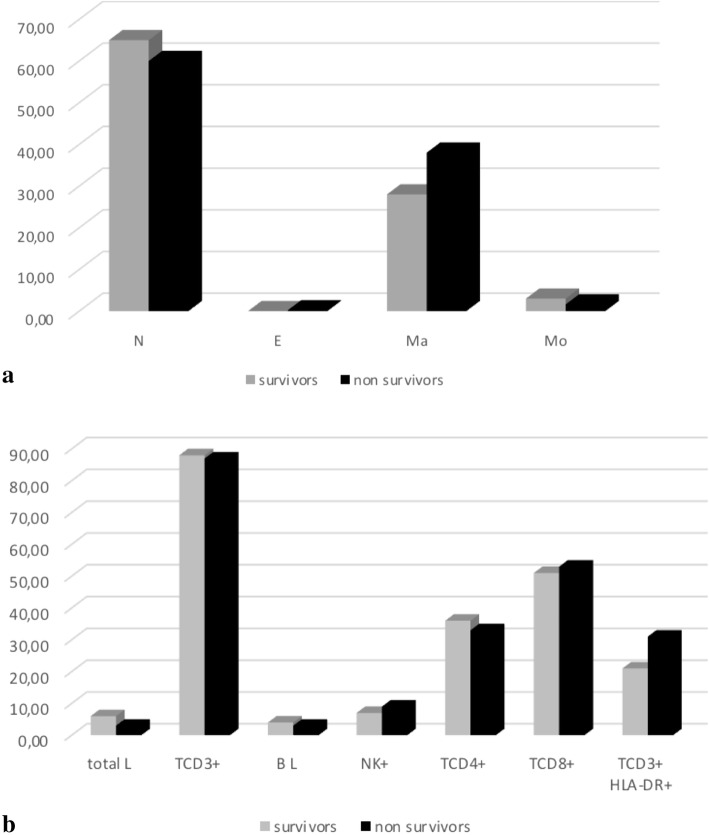
Fig. 1
Fig. 1
The comparison of percentage of different types of cells in bronchoalveolar lavage fluid in survivors and non-survivors. a (neutrophils, eosinophils, macrophages, monocytes). The survivors are represented in grey and non-survivors in black. All values are expressed as percentage. N: neutrophils, E: eosinophils, Ma: macrophages, Mo: monocytes. b (total lymphocytes, T CD3+, B, natural killer, T CD4+, TCD8+ and TCD3 + HLA-DR+). The survivors are represented in grey and non-survivors in black. All values are expressed as percentage. L: lymphocytes, TCD3+: lymphocytes T CD3+, B L: B lymphocytes, NK+: natural killer cells, TCD4+: lymphocytes TCD4+, TCD8+: lymphocytes TCD8+, TCD3 + HLA-DR+: activated lymphocytes. In the bronchoalveolar lavage fluid of non-survivors, the median value of macrophage percentages was higher (35%) than in survivors (20%); the TCD4+/TCD8+ ratio was lower (0.5 vs 0.6), and activated lymphocytes (TCD3 + HLA-DR+) were higher in the non-survivors (23% vs 20%) compared to survivors. All the differences are not statistically significant

References

    1. Zhang W, Zhang Y, Zhang F, et al. The use of anti-inflammatory drugs in the treatment of people with severe coronavirus disease 2019 (COVID-19): the perspectives of clinical immunologists from China. Clin Immunol. 2020;214:108393. doi: 10.1016/j.clim.2020.108393. - DOI - PMC - PubMed
    1. Merad M, Martin JC. Pathological inflammation in patients with COVID-19: a key role for monocytes and macrophages. Nat Rev Immunol. 2020;20(6):355–362. doi: 10.1038/s41577-020-0331-4. - DOI - PMC - PubMed
    1. Rello J, Storti E, Belliato M, Serrano R. Clinical phenotypes of SARS- CoV-2: implications for clinicians and researchers. Eur Respir J. 2020;55(5):2001028. doi: 10.1183/13993003.01028-2020. - DOI - PMC - PubMed
    1. Channappanavar R, Perlman S. Pathogenic human coronavirus infections: causes and consequences of cytokine storm and immunopathology. Semin Immunopathol. 2017;39(5):529–539. doi: 10.1007/s00281-017-0629-x. - DOI - PMC - PubMed
    1. Mehta P, Mc Auley DF, Brown M, et al. COVID-19: consider cytokine storm syndromes and immunosuppression. Lancet. 2020;395(10229):1033–1034. doi: 10.1016/S0140-6736(20)30628-0. - DOI - PMC - PubMed

MeSH terms
