


Endocarditis with spondylodiscitis: clinical characteristics and prognosis
- PMID: 33858337
- PMCID: PMC8051097
- DOI: 10.1186/s12872-021-01991-x
Endocarditis with spondylodiscitis: clinical characteristics and prognosis
Abstract
Background: The association of infective endocarditis (IE) with spondylodiscitis (SD) was first reported in 1965, but few data are available about this issue. This study aimed to evaluate the prevalence of SD in patients with IE, and to determine the clinical features and the prognostic impact of this association.
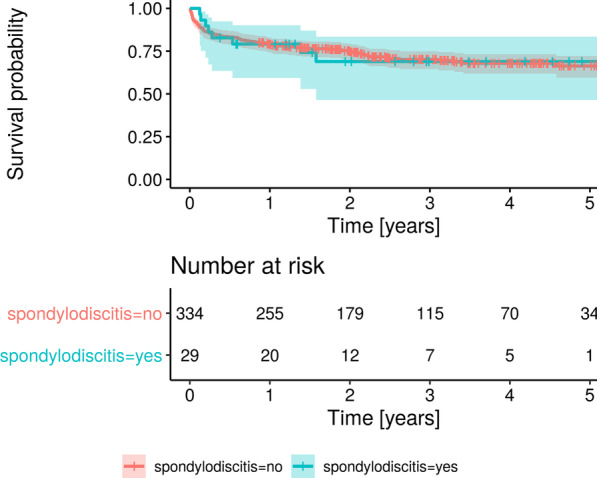
Methods: We retrospectively analysed 363 consecutive patients admitted to our Department with non-device-related IE. Radiologically confirmed SD was revealed in 29 patients (8%). Long-term follow-up (average: 3 years) was obtained by structured telephone interviews; in 95 cases (13 of whom had been affected by SD), follow-up echocardiographic evaluation was also available.
Results: At univariable analysis, the combination of IE with SD was associated with male gender (p = 0.017), diabetes (p = 0.028), drug abuse (p = 0.009), Streptococcus Viridans (p = 0.009) and Enterococcus (p = 0.015) infections. At multivariable analysis, all these factors independently correlated with presence of SD in patients with IE. Mortality was similar in patients with and without SD. IE relapses at 3 years were associated with the presence of SD (p = 0.003), Staphylococcus aureus infection (p < 0.001), and drug abuse (p < 0.001) but, at multivariable analysis, only drug abuse was an independent predictor of IE relapses (p < 0.001; HR 6.8, 95% CI 1.6-29). At echocardiographic follow-up, SD was not associated with worsening left ventricular systolic function or valvular dysfunction.
Conclusions: The association of IE with SD is not rare. Hence, patients with IE should be screened for metastatic infection of the vertebral column, especially if they have risk factors for it. However, SD does not appear to worsen the prognosis of patients with IE, either in-hospital or long-term.
Conflict of interest statement
The authors declare that they have no competing interests.
Figures
References
-
- Habib G, Erba PA, Iung B, Donal E, Cosyns B, Laroche C, Popescu BA, Prendergast B, Tornos P, Sadeghpour A, Oliver L, Vaskelyte JJ, Sow R, Axler O, Maggioni AP, Lancellotti P, EURO-ENDO Investigators Clinical presentation, aetiology and outcome of infective endocarditis. Results of the ESC-EORP EURO-ENDO (European infective endocarditis) registry: a prospective cohort study. Eur Heart J. 2019;40:3222–3232. doi: 10.1093/eurheartj/ehz620. - DOI - PubMed
-
- Habib G, Lancellotti P, Antunes MJ, Bongiorni MG, Casalta JP, Del Zotti F, Dulgheru R, El Khoury G, Erba PA, Iung B, Miro JM, Mulder BJ, Plonska-Gosciniak E, Price S, Roos-Hesselink J, Snygg-Martin U, Thuny F, Mas PT, Vilacosta I, Zamorano JL. for the ESC Scientific Document Group, 2015 ESC Guidelines for the management of infective endocarditis: The Task Force for the Management of Infective Endocarditis of the European Society of Cardiology (ESC) Endorsed by: European Association for Cardio-Thoracic Surgery (EACTS), the European Association of Nuclear Medicine (EANM) Eur Heart J. 2015;36:3075–3128. doi: 10.1093/eurheartj/ehv319. - DOI - PubMed
-
- Zoghbi WA, Adams D, Bonow RO, Enriquez-Sarano M, Foster E, Grayburn PA, Hahn RT, Han Y, Hung J, Lang RM, Little SH, Shah DJ, Shernan S, Thavendiranathan P, Thomas JD, Weissman NJ. Recommendations for noninvasive evaluation of native valvular regurgitation: a report from the American Society of Echocardiography developed in collaboration with the Society for Cardiovascular Magnetic Resonance. J Am Soc Echocardiogr. 2017;30:303–371. doi: 10.1016/j.echo.2017.01.007. - DOI - PubMed
Publication types
MeSH terms
LinkOut - more resources
Full Text Sources
Other Literature Sources
Medical
