


Precarious Employment and Stress: The Biomedical Embodiment of Social Factors. PRESSED Project Study Protocol
- PMID: 33859972
- PMCID: PMC8042135
- DOI: 10.3389/fpubh.2021.649447
Precarious Employment and Stress: The Biomedical Embodiment of Social Factors. PRESSED Project Study Protocol
Abstract
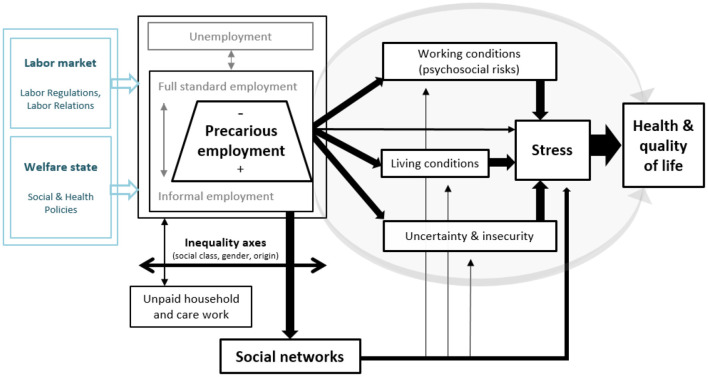
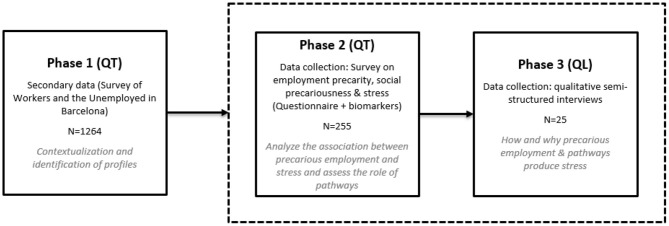
The PRESSED project aims to explain the links between a multidimensional measure of precarious employment and stress and health. Studies on social epidemiology have found a clear positive association between precarious employment and health, but the pathways and mechanisms to explain such a relationship are not well-understood. This project aims to fill this gap from an interdisciplinary perspective, integrating the social and biomedical standpoints to comprehensively address the complex web of consequences of precarious employment and its effects on workers' stress, health and well-being, including health inequalities. The project objectives are: (1) to analyze the association between multidimensional precarious employment and chronic stress among salaried workers in Barcelona, measured both subjectively and using biological indicators; (2) to improve our understanding of the pathways and mechanisms linking precarious employment with stress, health and well-being; and (3) to analyze health inequalities by gender, social class and place of origin for the first two objectives. The study follows a sequential mixed design. First, secondary data from the 2017 Survey on Workers and the Unemployed of Barcelona is analyzed (N = 1,264), yielding a social map of precarious employment in Barcelona that allows the contextualization of the scope and characteristics of this phenomenon. Drawing on these results, a second survey on a smaller sample (N = 255) on precarious employment, social precariousness and stress is envisaged. This study population is also asked to provide a hair sample to have their levels of cortisol and its related components, biomarkers of chronic stress, analyzed. Third, a sub-sample of the latter survey (n = 25) is selected to perform qualitative semi-structured interviews. This allows going into greater depth into how and why the experience of uncertainty, the precarization of living conditions, and the degradation of working conditions go hand-in-hand with precarious employment and have an impact on stress, as well as to explore the potential role of social support networks in mitigating these effects.
Keywords: health inequalities; in-work poverty; insecurity; precarious employment; psychosocial risks; social support networks; stress; stress biomarkers.
Copyright © 2021 Bolibar, Belvis, Jódar, Vives, Méndez, Bartoll-Roca, Pozo, Gomez-Gomez, Padrosa, Benach and Julià.
Conflict of interest statement
The authors declare that the research was conducted in the absence of any commercial or financial relationships that could be construed as a potential conflict of interest.
Figures
References
-
- World Health Organization- Commission on Social Determinants of Health . Closing the Gap in a Generation: Health Equity Through Action on the Social Determinants of Health. Final report of the Commission on Social Determinants of Health. World Health Organization; (Executive Summary- 27 August 2008). Available online at: https://www.who.int/publications/i/item/WHO-IER-CSDH-08.1 (accessed on February 19, 2020).
-
- Benach J, Muntaner C, Santana V. Employment, Work, and Health Inequalities: A Global Perspective. Barcelona: (2013).
-
- Buchholz S, Hofäcker D, Mills M, Blossfeld H-P, Kurz K, Hofmeister H. Life courses in the globalization process: the development of social inequalities in modern societies. Eur Sociol Rev. (2009) 25:53–71. 10.1093/esr/jcn033 - DOI
-
- Monastiriotis V. Employment Flexibility and UK Regional Unemployment: Persistence and Macroeconomic Shocks. London: Department of Trade and Industry; (2006).
-
- Miguélez F, Prieto C. Transformaciones del empleo, flexibilidad y relaciones laborales en Europa. Política y Soc. (2009) 46:275–87.
Publication types
MeSH terms
LinkOut - more resources
Full Text Sources
Other Literature Sources
Miscellaneous
