


Discriminative Stimulus Effects of Substituted Tryptamines in Rats
- PMID: 33860176
- PMCID: PMC8033599
- DOI: 10.1021/acsptsci.0c00173
Discriminative Stimulus Effects of Substituted Tryptamines in Rats
Abstract
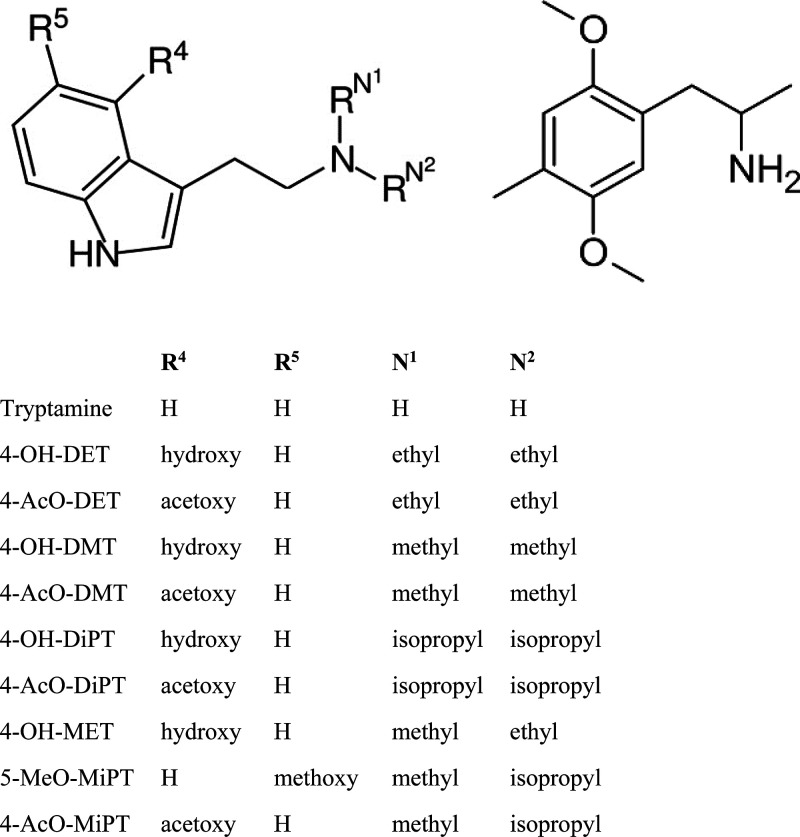
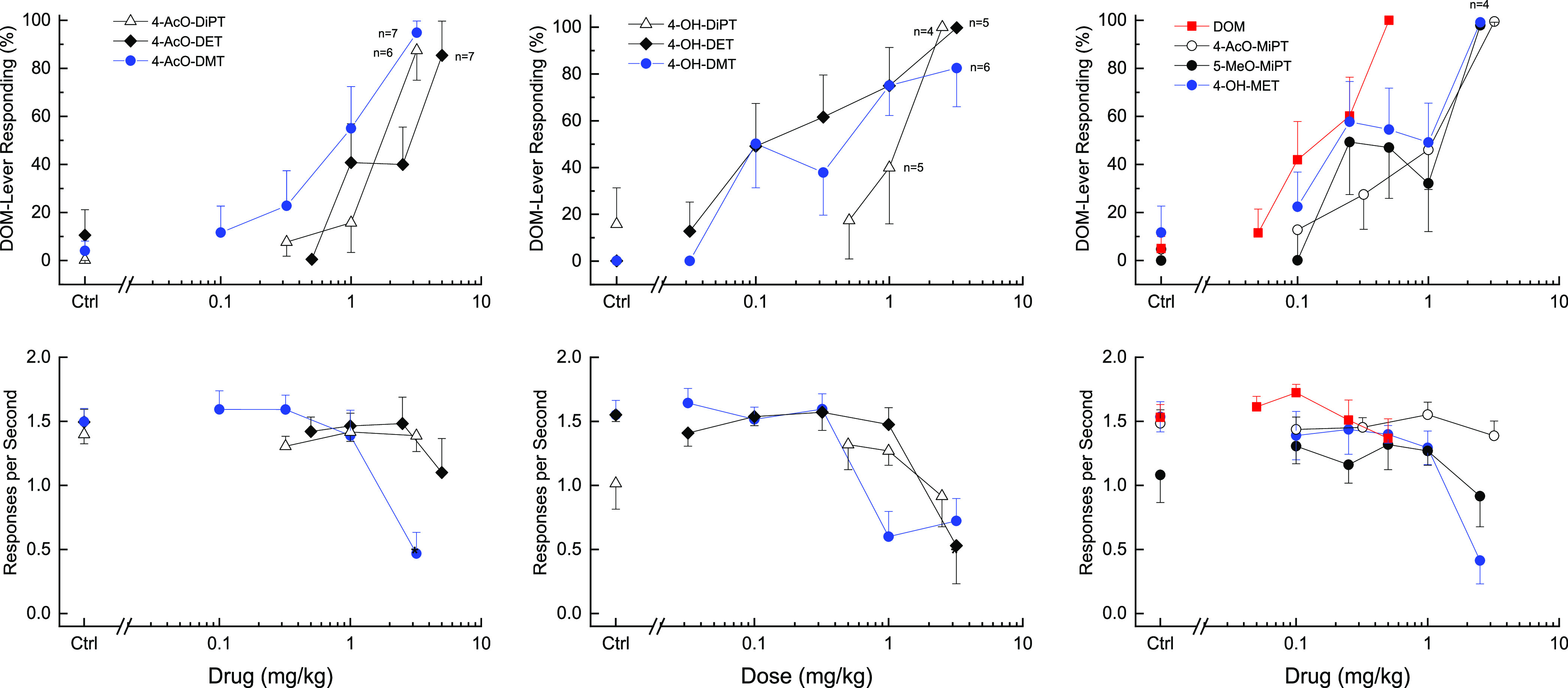
Novel synthetic compounds have been available for decades as quasi-legal alternatives to controlled substances. The hallucinogen-like effects of eight novel substituted tryptamines were evaluated to determine their potential abuse liability. Male Sprague-Dawley rats were trained to discriminate 2,5-dimethoxy-4-methylamphetamine (DOM, 0.5 mg/kg, i.p., 30 min) from saline. 4-Acetoxy-N,N-diethyltryptamine (4-AcO-DET), 4-hydroxy-N-methyl-N-ethyltryptamine (4-OH-MET), 4-hydroxy-N,N-diethyltryptamine (4-OH-DET), 4-acetoxy-N-methyl-N-isopropyltryptamine (4-AcO-MiPT), 4-acetoxy-N,N-dimethyltryptamine (4-AcO-DMT), 4-hydroxy-N,N-dimethyltryptamine (4-OH-DMT, psilocin), 5-methoxy-N-methyl-N-isopropyltryptamine (5-MeO-MiPT), 4-acetoxy-N,N-diisopropyltryptamine (4-AcO-DiPT), and 4-hydroxy-N,N-diisopropyltryptamine (4-OH-DiPT) were tested for their ability to substitute for the discriminative stimulus effects of DOM. All test compounds fully substituted for DOM with potencies less than or equal to that of DOM. 4-OH-MET, 4-OH-DET, 4-OH-DMT, and 4-AcO-DMT decreased response rate at doses that fully substituted. Because the test compounds produced DOM-like discriminative stimulus effects, they may have similar abuse liability as DOM. 4-Acetoxy substituted compounds were less potent than 4-hydroxy substituted compounds, and the N,N-diisopropyl compounds were less potent than the dimethyl, diethyl, N-methyl-N-ethyl, and N-methyl-N-isopropyl compounds.
© 2020 American Chemical Society.
Conflict of interest statement
The authors declare no competing financial interest.
Figures
References
-
- Guzmán G. (2008) Hallucinogenic mushrooms in Mexico: An overview. Econ. Bot. 62, 404–412. 10.1007/s12231-008-9033-8. - DOI
-
- Griffiths R. R.; Johnson M. W.; Carducci M. A.; Umbricht A.; Richards W. A.; Richards B. D.; Cosimano M. P.; Klinedinst M. A. (2016) Psilocybin produces substantial and sustained decreases in depression and anxiety in patients with life-threatening cancer: A randomized double-blind trial. J. Psychopharmacol. 30, 1181–1197. 10.1177/0269881116675513. - DOI - PMC - PubMed
- Shulgin A., and Shulgin A. (1997) TIHKAL: The Continuation. Transform Press, Berkeley, CA.
-
- Carbonaro T. M.; Johnson M. W.; Griffiths R. R. (2020) Subjective features of the psilocybin experience that may account for its self-administration by humans: a double-blind comparison of psilocybin and dextromethorphan. Psychopharmacology (Berl) 237 (8), 2293–2304. 10.1007/s00213-020-05533-9. - DOI - PMC - PubMed
LinkOut - more resources
Full Text Sources
Other Literature Sources
Miscellaneous