


Investigation of the Structure-Activity Relationships of Psilocybin Analogues
- PMID: 33860183
- PMCID: PMC8033608
- DOI: 10.1021/acsptsci.0c00176
Investigation of the Structure-Activity Relationships of Psilocybin Analogues
Abstract
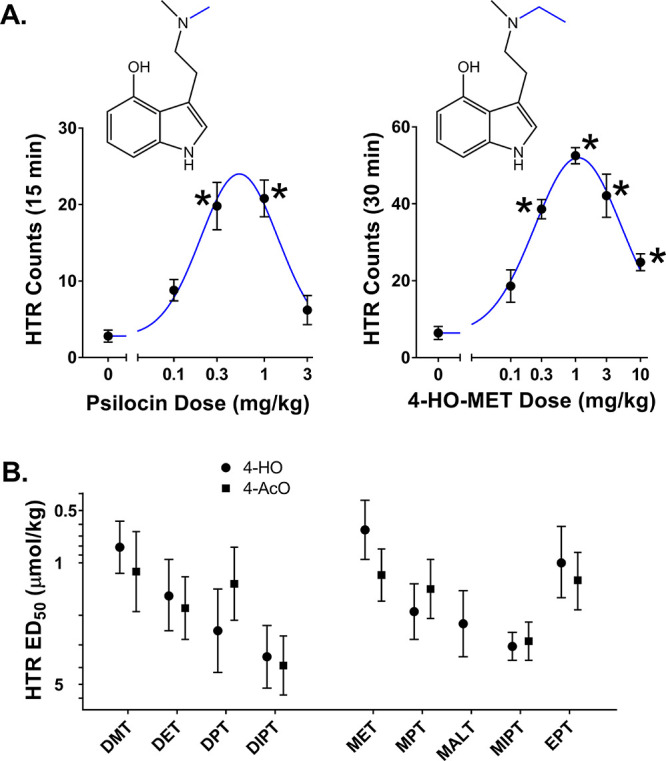
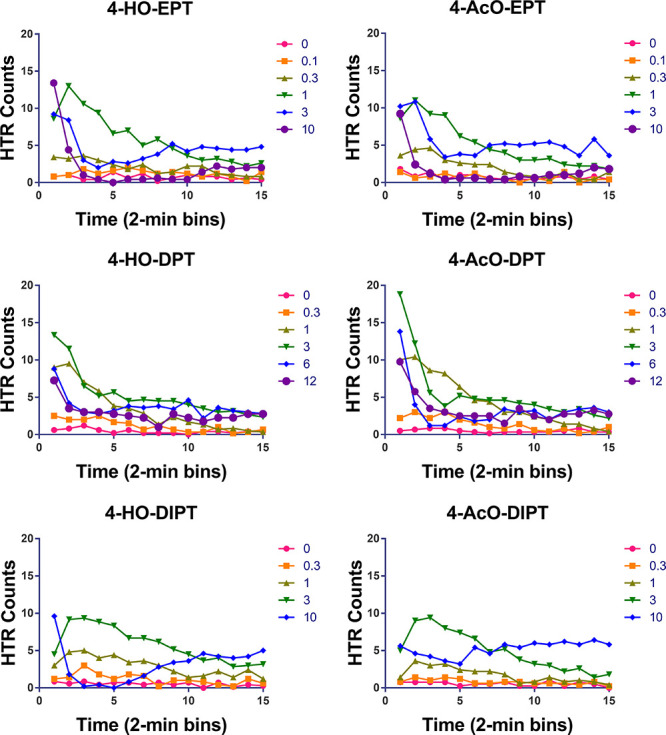
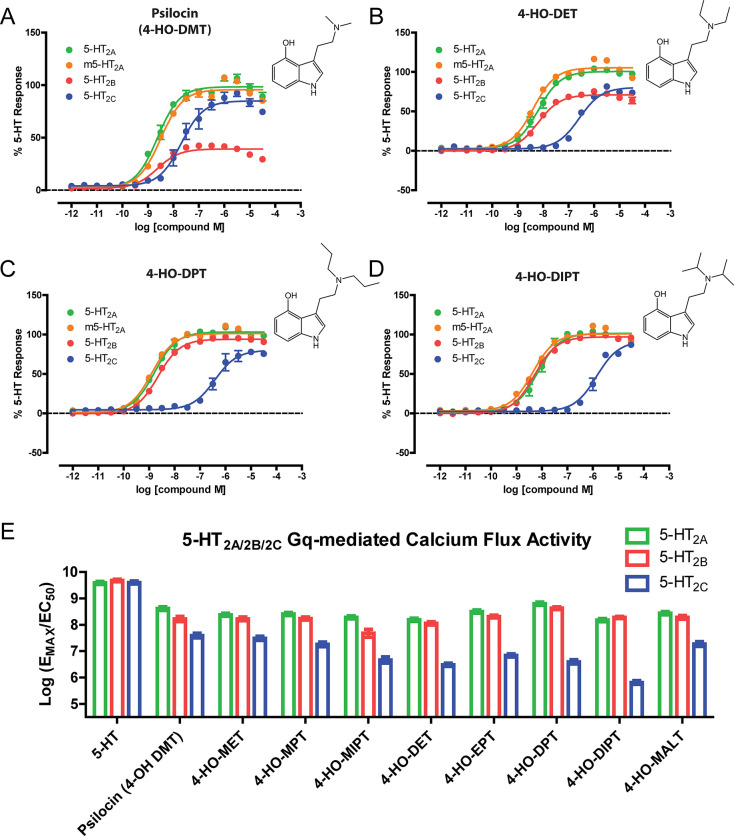
The 5-HT2A receptor is thought to be the primary target for psilocybin (4-phosphoryloxy-N,N-dimethyltryptamine) and other serotonergic hallucinogens (psychedelic drugs). Although a large amount of experimental work has been conducted to characterize the pharmacology of psilocybin and its dephosphorylated metabolite psilocin (4-hydroxy-N,N-dimethyltryptamine), there has been little systematic investigation of the structure-activity relationships (SAR) of 4-substituted tryptamine derivatives. In addition, structural analogs of psilocybin containing a 4-acetoxy group, such as 4-acetoxy-N,N-dimethyltryptamine (4-AcO-DMT), have appeared as new designer drugs, but almost nothing is known about their pharmacological effects. To address the gap of information, studies were conducted with 17 tryptamines containing a variety of symmetrical and asymmetrical N,N-dialkyl substituents and either a 4-hydroxy or 4-acetoxy group. Calcium mobilization assays were conducted to assess functional activity at human and mouse 5-HT2 subtypes. Head-twitch response (HTR) studies were conducted in C57BL/6J mice to assess 5-HT2A activation in vivo. All of the compounds acted as full or partial agonists at 5-HT2 subtypes, displaying similar potencies at 5-HT2A and 5-HT2B receptors, but some tryptamines with bulkier N-alkyl groups had lower potency at 5-HT2C receptors and higher 5-HT2B receptor efficacy. In addition, O-acetylation reduced the in vitro 5-HT2A potency of 4-hydroxy-N,N-dialkyltryptamines by about 10- to 20-fold but did not alter agonist efficacy. All of the compounds induce head twitches in mice, consistent with an LSD-like behavioral profile. In contrast to the functional data, acetylation of the 4-hydroxy group had little effect on HTR potency, suggesting that O-acetylated tryptamines may be deacetylated in vivo, acting as prodrugs. In summary, the tryptamine derivatives have psilocybin-like pharmacological properties, supporting their classification as psychedelic drugs.
© 2020 American Chemical Society.
Conflict of interest statement
The authors declare no competing financial interest.
Figures
References
-
- Eivindvik K.; Rasmussen K. E.; Sund R. B. (1989) Handling of psilocybin and psilocin by everted sacs of rat jejunum and colon. Acta. Pharm. Nord. 1, 295–302. - PubMed
-
- Hasler F.; Bourquin D.; Brenneisen R.; Bar T.; Vollenweider F. X. (1997) Determination of psilocin and 4-hydroxyindole-3-acetic acid in plasma by HPLC-ECD and pharmacokinetic profiles of oral and intravenous psilocybin in man. Pharm. Acta Helv. 72, 175–184. 10.1016/S0031-6865(97)00014-9. - DOI - PubMed
Grants and funding
LinkOut - more resources
Full Text Sources
Other Literature Sources
Miscellaneous