


Prevalence of Dirofilaria immitis in mosquitoes (Diptera) - systematic review and meta-analysis
- PMID: 33860239
- PMCID: PMC8039976
- DOI: 10.21307/jofnem-2021-012
Prevalence of Dirofilaria immitis in mosquitoes (Diptera) - systematic review and meta-analysis
Abstract
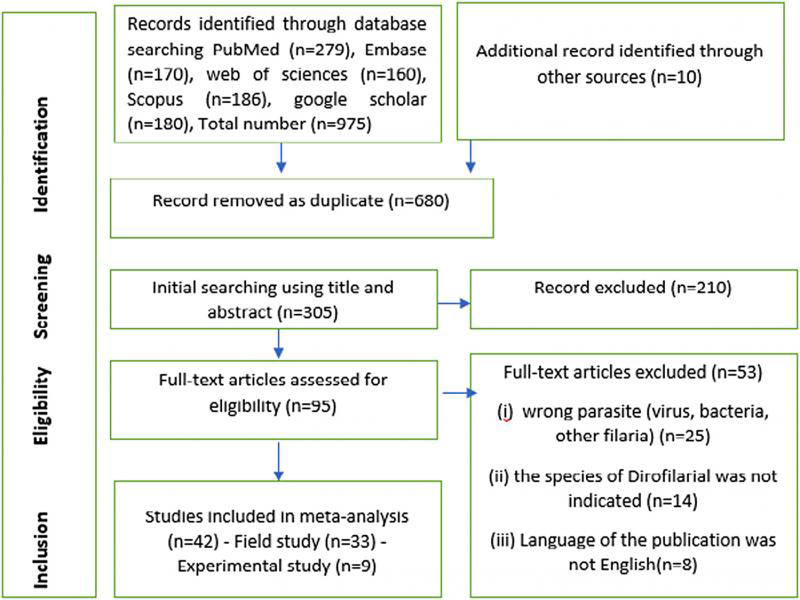
Knowledge of the vectors of dirofilariasis in the world beside the treatment of infected dog is crucial to establish mosquito vector-based control programs. The current systematic review and meta-analysis were conducted on published studies, documenting the prevalence of Dirofilaria immitis infected/infective mosquitoes from field surveys and laboratory experiments under controlled conditions. Articles up through 2019 from Scopus, PubMed, Embase, Web of Science, Google Scholar were screened systematically. The overall prevalence of D. immitis infected/infective mosquitoes was estimated using a random effect model. Meta-regression was used to identify factors related to high dirofilariasis prevalence in the vectors. In these studies, the detection method was not identified as a heterogeneity and the overall prevalence in both subgroups had overlap (7.9-34.9 and 1.5-48.5). The overall prevalence of infective stage was 2.6 (95% CI: 0.97-4.77 per 1,000) and 84.7 per 1000 (95% CI: 20.5-183.8 per 1,000) for the field survey/laboratory experiment, respectively. The higher overall prevalence of D. immitis infected/infective mosquitoes were reported across studies in which take place in Eastern Mediterranean Region office (EMRO), longitude: 80 to 110, latitude: 20 to 40, annual rainfall: 250 to 1000, sea level: 26 to 100 and <1,000, humidity: 66 to 70, during 2000 to 2005 by dissection methods. Our review determined that mosquito species within the genus Anopheles and to a less extent Culex were the main vectors of dirofilariasis.
Keywords: Culicidae; Diagnostic methods; Dirofilariasis; Meta-analysis; Systematic review.
© 2021 Authors.
Figures
References
-
- Ahid, S. M. M., Vasconcelos, P. S. D. S. and Lourenço-de-Oliveira, R.. 2000. Vector competence of Culex quinquefasciatus Say from different regions of Brazil to Dirofilaria immitis. Memórias do Instituto Oswaldo Cruz 95:769–775. - PubMed
-
- Azari-Hamidian, S., Yaghoobi-Ershadi, M., Javadian, E., Mobedi, I. and Abai, M.. 2007. Review of dirofilariasis in Iran. Journal of Guilan University of Medical Sciences 15:102–114.
- Azari-Hamidian, S., Yaghoobi-Ershadi, M., Javadian, E., Abai, M., Mobedi, I., Linton, Y. M. and Harbach, R. 2009. Distribution and ecology of mosquitoes in a focus of dirofilariasis in northwestern Iran, with the first finding of filarial larvae in naturally infected local mosquitoes. Medical and Veterinary Entomology 23:111–. - PubMed
-
- Azari‐Hamidian, S., Yaghoobi‐Ershadi, M., Javadian, E., Abai, M., Mobedi, I., Linton, Y. M. and Harbach, R.. 2009. Distribution and ecology of mosquitoes in a focus of dirofilariasis in northwestern Iran, with the first finding of filarial larvae in naturally infected local mosquitoes. Medical and Veterinary Entomology 23:111–121. - PubMed
-
- Bayoh, M. N. and Lindsay, S. W.. 2004. Temperature-related duration of aquatic stages of the Afrotropical malaria vector mosquito Anopheles gambiae in the laboratory. Medical and Veterinary Entomology 18:174–179. - PubMed
-
- Bışkın, Z., Düzlü, O., Yildirim, A. and Incı, A.. 2010. The molecular diagnosis of Dirofilaria immitis in vector mosquitoes in Felahiye district of Kayseri. Turkiye parazitolojii dergisi 34:200–205. - PubMed
LinkOut - more resources
Full Text Sources
Other Literature Sources