


Mobile Apps to Support Family Caregivers of People With Alzheimer Disease and Related Dementias in Managing Disruptive Behaviors: Qualitative Study With Users Embedded in a Scoping Review
- PMID: 33861207
- PMCID: PMC8087965
- DOI: 10.2196/21808
Mobile Apps to Support Family Caregivers of People With Alzheimer Disease and Related Dementias in Managing Disruptive Behaviors: Qualitative Study With Users Embedded in a Scoping Review
Abstract
Background: People with Alzheimer disease and related dementias often display disruptive behaviors (eg, aggression, wandering, and restlessness), which increase family caregivers' burden of care. However, there are few tools currently available to help these caregivers manage disruptive behaviors. Mobile apps could meet this need, but to date little is known about them.
Objective: The aims of our study were to identify existing mobile apps designed to support family caregivers of people with Alzheimer disease and related dementias in managing disruptive behaviors; explore whether family caregivers view these mobile apps as relevant to meeting their needs and as useful in managing disruptive behaviors; and document the types of mobile apps that are of interest and appeal to most family caregivers (with regard to format, ergonomics, and clarity).
Methods: A review of mobile apps initially conducted in February 2018 was updated in March 2019 with 2 platforms (App Store [Apple Inc.] and Google Play [Google]). The selected apps were first analyzed independently by 3 raters (2 students and 1 researcher) for each of the platforms. A focus group discussion was then held with 4 family caregivers to explore their perceptions of the apps according to their needs and interests. The content of the discussion was analyzed.
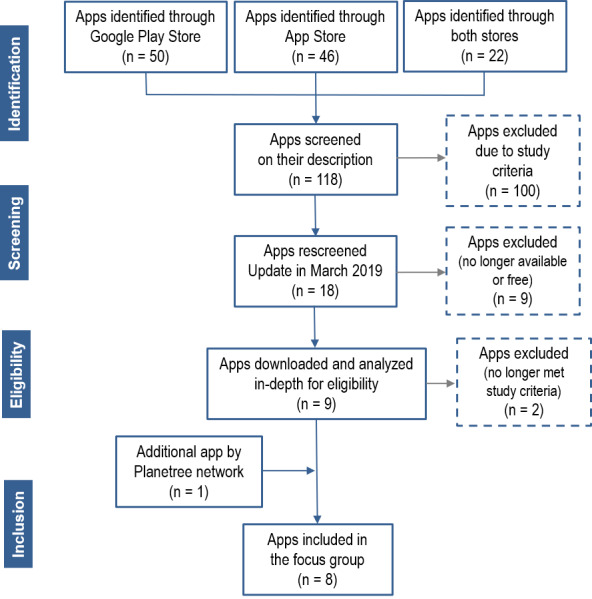
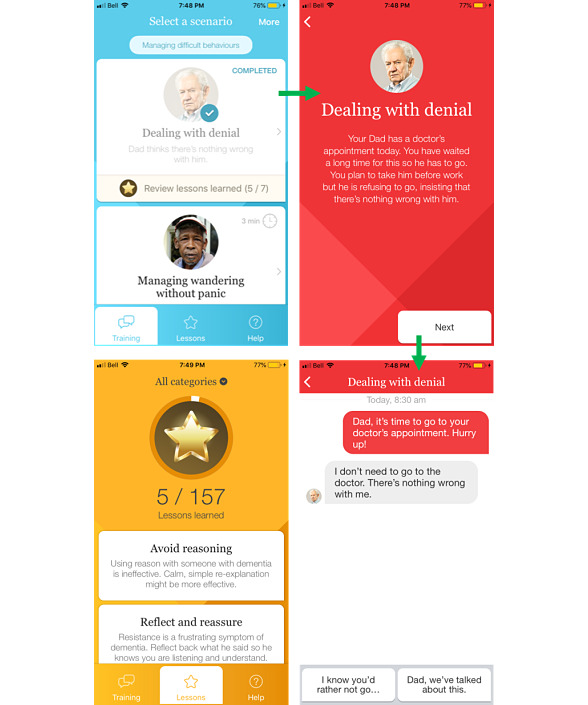
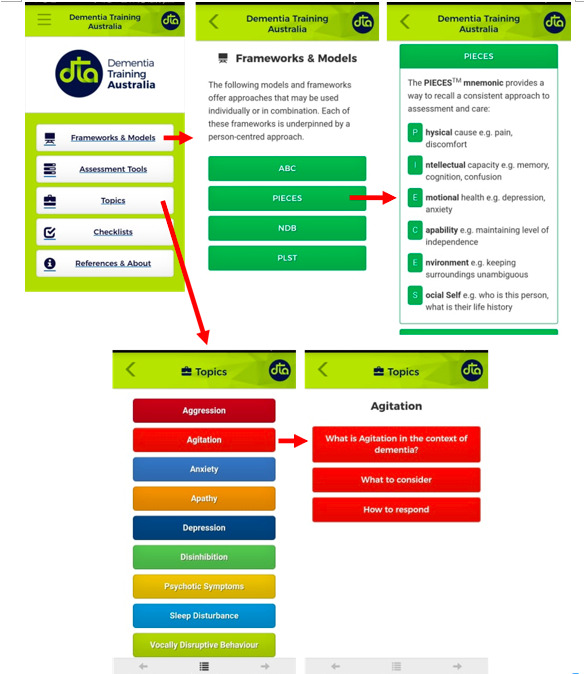
Results: Initially, 7 of 118 apps identified met the inclusion criteria. An eighth app, recommended by one of the knowledge users, was added later. Four family caregivers (women aged between 58 and 78 years) participated in the discussion. Participants expressed a preference for easy-to-understand apps that provide concrete intervention strategies. They reported being most inclined to use two apps, Dementia Advisor and DTA Behaviours.
Conclusions: Few mobile apps on the market meet the needs of family caregivers in terms of content and usability. Our results could help to address this gap by identifying what family caregivers deem relevant in a mobile app to help them manage disruptive behaviors.
Keywords: app; caregivers; dementia; disruptive behaviors management; focus group; mHealth; mobile phone; neurocognitive disorder; scoping review.
©Marjorie Désormeaux-Moreau, Charlie-Maude Michel, Mélanie Vallières, Maryse Racine, Myriame Poulin-Paquet, Delphine Lacasse, Pascale Gionet, Melissa Genereux, Wael Lachiheb, Véronique Provencher. Originally published in JMIR Aging (http://aging.jmir.org), 16.04.2021.
Conflict of interest statement
Conflicts of Interest: None declared.
Figures
References
-
- Norton S, Matthews FE, Brayne C. A commentary on studies presenting projections of the future prevalence of dementia. BMC Public Health. 2013 Jan 02;13:1. doi: 10.1186/1471-2458-13-1. https://bmcpublichealth.biomedcentral.com/articles/10.1186/1471-2458-13-1 - DOI - PMC - PubMed
-
- Manuel DG, Garner R, Finès P, Bancej C, Flanagan W, Tu K, Reimer K, Chambers LW, Bernier J. Alzheimer's and other dementias in Canada, 2011 to 2031: a microsimulation Population Health Modeling (POHEM) study of projected prevalence, health burden, health services, and caregiving use. Popul Health Metr. 2016;14:37. doi: 10.1186/s12963-016-0107-z. https://pophealthmetrics.biomedcentral.com/articles/10.1186/s12963-016-0... - DOI - PMC - PubMed
-
- Martinková J, Kabátová O, Puteková S. Influence of gender on the prevalence of behavioral symptoms in patients with Alzheimer's dementia. Kontakt. 2019 Mar 27;21(1):74–79. doi: 10.32725/kont.2019.013. - DOI
-
- Brown C, Stoffel V, Munoz J. Occupational therapy in mental health: A vision for participation. In: Schaber P, editor. Occupational Therapy in Mental Health. Philadelphia: FA Davis Co; 2011. pp. 225–237.
Publication types
LinkOut - more resources
Full Text Sources
Miscellaneous
