


Prevalence of overuse of short-acting beta-2 agonists (SABA) and associated factors among patients with asthma in Germany
- PMID: 33863317
- PMCID: PMC8051057
- DOI: 10.1186/s12931-021-01701-3
Prevalence of overuse of short-acting beta-2 agonists (SABA) and associated factors among patients with asthma in Germany
Abstract
Background: Overuse of short-acting beta-2 agonists (SABA), which do not treat the underlying inflammation of asthma, is linked to poor clinical outcomes such as increased exacerbation risk. This study, as part of the SABINA program, estimated the prevalence of SABA overuse and associated variables in outpatients in Germany.
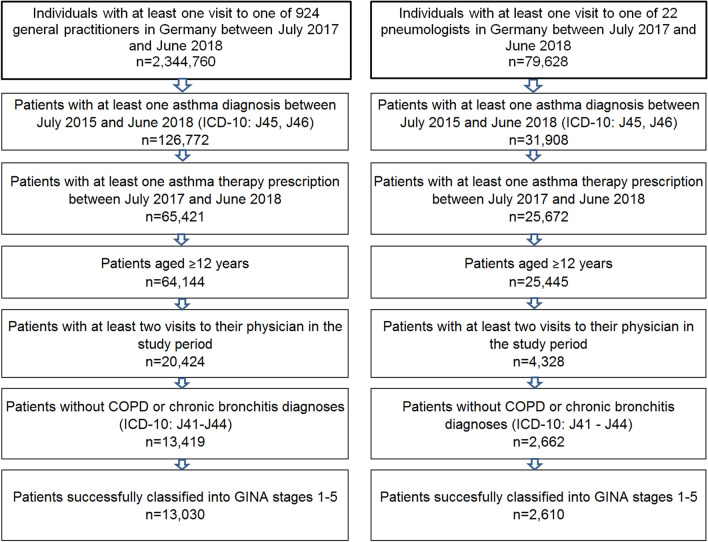
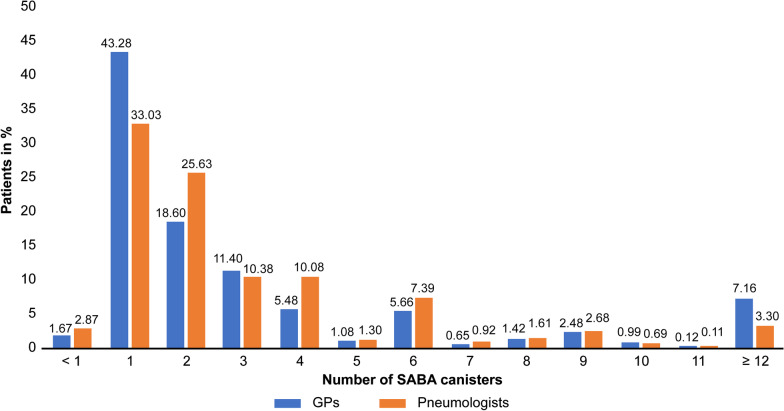
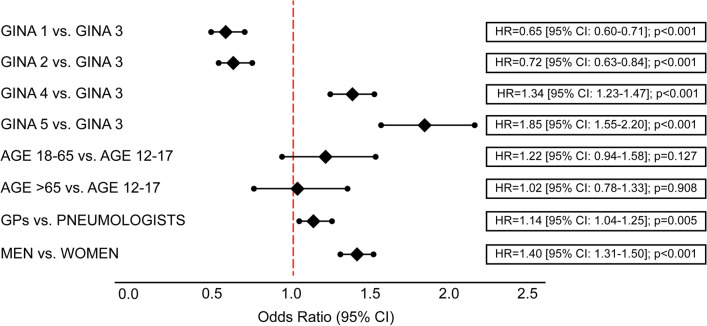
Methods: This retrospective study used anonymized electronic healthcare data from the Disease Analyzer database (IQVIA). A total of 15,640 patients aged ≥ 12 years with asthma who received ≥ 1 SABA prescription(s) between July 2017 and June 2018 in 924 general physician and 22 pneumologist (PN) practices were included. SABA overuse was defined as ≥ 3 prescribed inhalers (~ 200 puffs each) during the study period. The associations between SABA overuse and physician specialty, Global Initiative for Asthma (GINA) steps (based on asthma medications), age, sex, and inhaled corticosteroid (ICS)/long-acting beta agonist (LABA) use were estimated using multivariable regression for patients with probable moderate (GINA step 2) and probable severe (GINA steps 3-5) asthma.
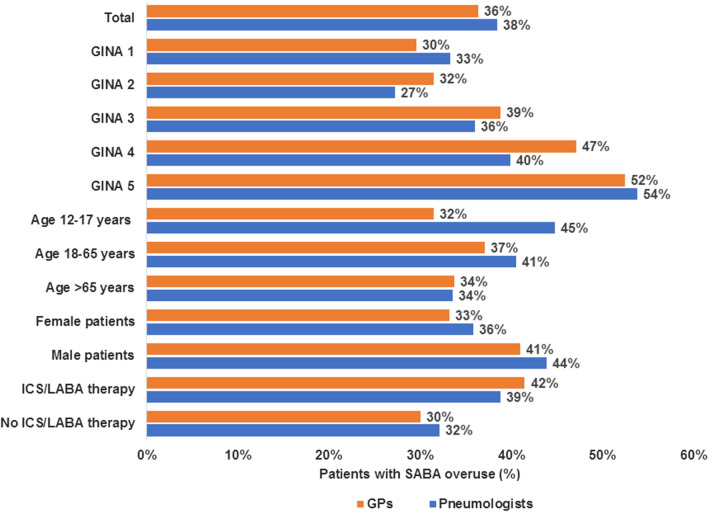
Results: Annually, 36% of all patients (GINA steps 1-5) in general and 38% in PN practices received ≥ 3 SABA inhalers. The risk of SABA overuse was 14% higher in patients treated by a general practitioner vs. a PN; 34% and 85% higher in GINA steps 4 and 5, respectively, vs. GINA step 3; and 40% higher in male vs. female patients.
Conclusions: SABA overuse is prevalent among patients with asthma across all GINA steps in Germany, which may indicate suboptimal asthma control. Further studies are needed to investigate the reasons behind SABA overuse.
Keywords: Asthma; GINA; Germany; Overuse; Risk factors; Short-acting beta agonists.
Conflict of interest statement
IM and AS are employees of AstraZeneca. E-MB and KK are employees of IQVIA. PK reports personal fees from Novartis, AstraZeneca, Boehringer Ingelheim, Chiesi, GlaxoSmithKline, Menarini, and Takeda, all of which are outside the submitted work. CFV reports personal fees from Almirall, Cipla, Berlin-Chemie/Menarini, CSL Behring, and Teva, grants and personal fees from AstraZeneca, Boehringer Ingelheim, Chiesi, GlaxoSmithKline, Grifols, Mundipharma, Novartis, and Takeda, and grants from the German Federal Ministry of Education and Research (BMBF) Competence Network Asthma and COPD (AsCoNet), Bayer Schering Pharma AG, MSD, and Pfizer, all of which are outside the submitted work. HW reports personal fees from AstraZeneca, Boehringer Ingelheim, Chiesi, GlaxoSmithKline, Klosterfrau, Menarini, Novartis, Omron, and Takeda, all of which are outside the submitted work. C-PC reports personal fees from AstraZeneca, Boehringer Ingelheim, Chiesi, GlaxoSmithKline, Klosterfrau, Menarini, Novartis, Omron, Sanofi, and Takeda, all of which are outside the submitted work.
Figures
References
Publication types
MeSH terms
Substances
LinkOut - more resources
Full Text Sources
Other Literature Sources
Medical
