. 2021 Apr 16;13(1):60.
doi: 10.1186/s13073-021-00874-2.

Human breast microbiome correlates with prognostic features and immunological signatures in breast cancer

Affiliations

Human breast microbiome correlates with prognostic features and immunological signatures in breast cancer

Alice Tzeng et al. Genome Med. .

Abstract

Background: Currently, over half of breast cancer cases are unrelated to known risk factors, highlighting the importance of discovering other cancer-promoting factors. Since crosstalk between gut microbes and host immunity contributes to many diseases, we hypothesized that similar interactions could occur between the recently described breast microbiome and local immune responses to influence breast cancer pathogenesis.

Methods: Using 16S rRNA gene sequencing, we characterized the microbiome of human breast tissue in a total of 221 patients with breast cancer, 18 individuals predisposed to breast cancer, and 69 controls. We performed bioinformatic analyses using a DADA2-based pipeline and applied linear models with White's t or Kruskal-Wallis H-tests with Benjamini-Hochberg multiple testing correction to identify taxonomic groups associated with prognostic clinicopathologic features. We then used network analysis based on Spearman coefficients to correlate specific bacterial taxa with immunological data from NanoString gene expression and 65-plex cytokine assays.

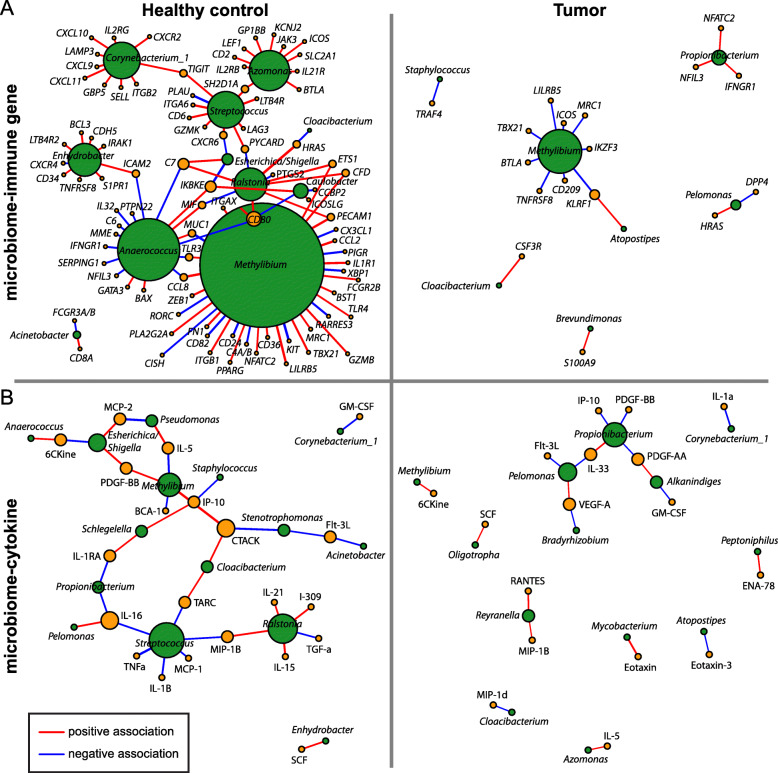
Results: Multiple bacterial genera exhibited significant differences in relative abundance when stratifying by breast tissue type (tumor, tumor adjacent normal, high-risk, healthy control), cancer stage, grade, histologic subtype, receptor status, lymphovascular invasion, or node-positive status, even after adjusting for confounding variables. Microbiome-immune networks within the breast tended to be bacteria-centric, with sparse structure in tumors and more interconnected structure in benign tissues. Notably, Anaerococcus, Caulobacter, and Streptococcus, which were major bacterial hubs in benign tissue networks, were absent from cancer-associated tissue networks. In addition, Propionibacterium and Staphylococcus, which were depleted in tumors, showed negative associations with oncogenic immune features; Streptococcus and Propionibacterium also correlated positively with T-cell activation-related genes.

Conclusions: This study, the largest to date comparing healthy versus cancer-associated breast microbiomes using fresh-frozen surgical specimens and immune correlates, provides insight into microbial profiles that correspond with prognostic clinicopathologic features in breast cancer. It additionally presents evidence for local microbial-immune interplay in breast cancer that merits further investigation and has preventative, diagnostic, and therapeutic potential.

Keywords: Biomarkers; Host microbial interactions; Mammary carcinoma; Microbiota; Tumor microenvironment.


Conflict of interest statement

The authors declare that they have no competing interests.

Figures
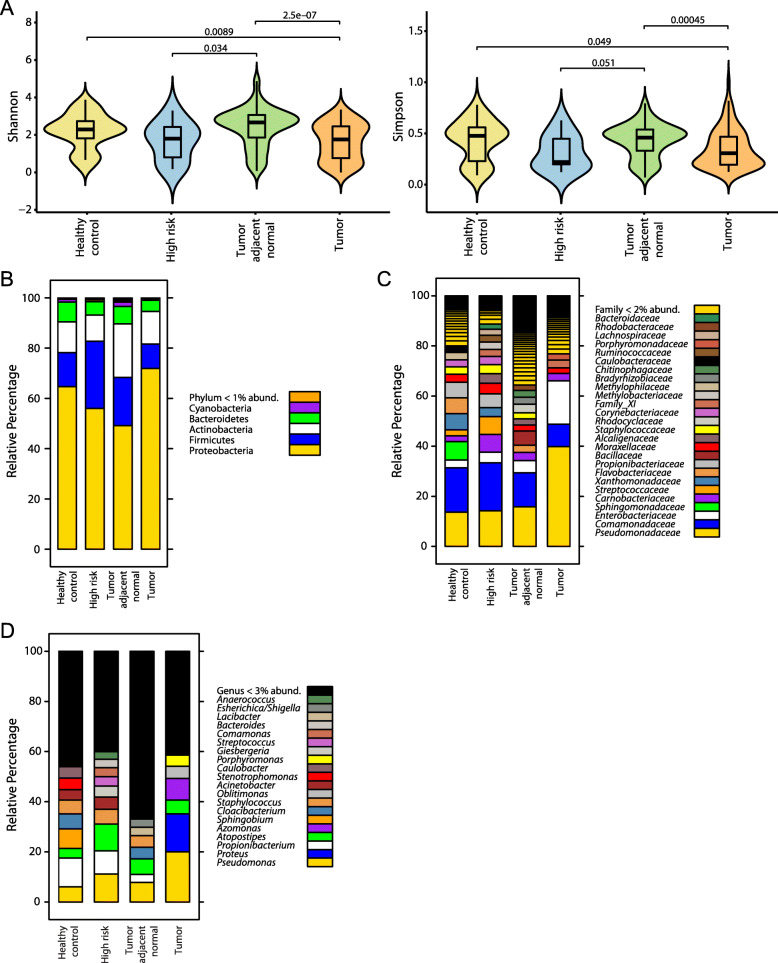
Fig. 1
Fig. 1
Breast bacterial community composition varies by patient breast cancer status and tissue type. a Bacterial α-diversity as measured by Shannon and Simpson diversity indices within breast tissue from patients with (tumor, tumor adjacent normal) versus without (healthy control, high-risk) breast cancer. Violin plots show median and interquartile range. p-values result from one-way ANOVA tests. Taxonomic composition of the breast microbiome, depicted as average relative abundances at the phylum (b), family (c), and genus (d) levels for each tissue type
Fig. 2
Fig. 2
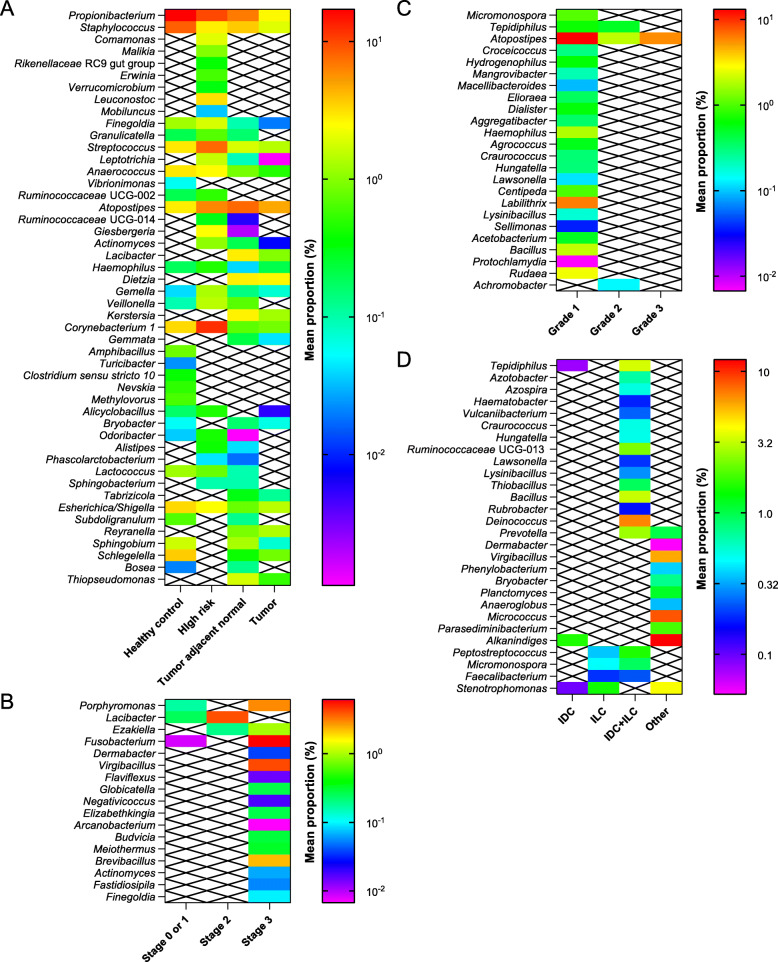
Specific bacterial genera correlate with clinicopathologic features. Mean relative abundances (proportions) of bacterial genera that were differentially present in distinct breast tissue types (a) and in breast tumors stratified by cancer stage (b), histologic grade (c), and histologic subtype (d). Stages 0 and 1 were combined for analysis due to the very small number of samples classified as stage 0. Crossed-out boxes indicate samples for which specific genera were not detected. Color bars vary on a logarithmic scale. All genera shown had FDR-corrected p-value < 0.05 by Kruskal–Wallis H-test after adjustments for age, race, and hospital
Fig. 3
Fig. 3
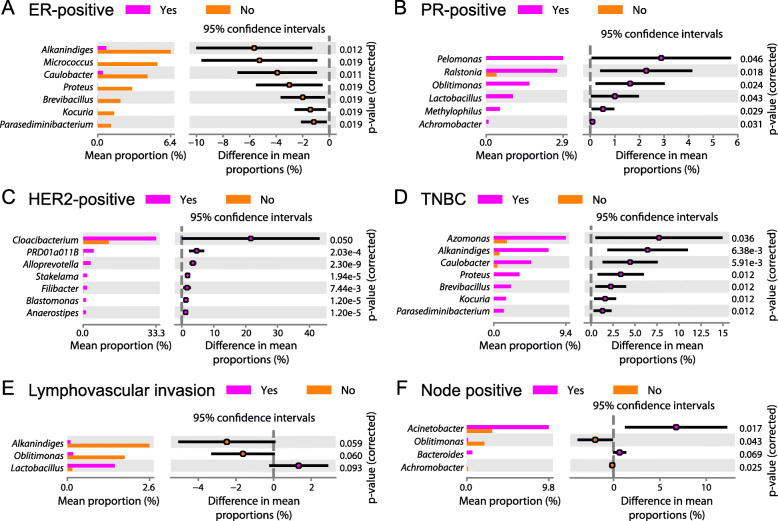
Specific bacterial genera correlate with breast tumor receptor status and metastatic potential. Mean relative abundances (proportions) of bacterial genera that were differentially present in ER positive versus negative (a), PR positive versus negative (b), HER2 positive versus negative (c), and TNBC versus non-TNBC (d) breast tumors, and in breast tumors with versus without lymphovascular invasion (e) and with versus without positive lymph nodes (f). All genera shown had FDR-corrected p-value < 0.1 by White’s t test after adjustments for age, race, and hospital
Fig. 4
Fig. 4
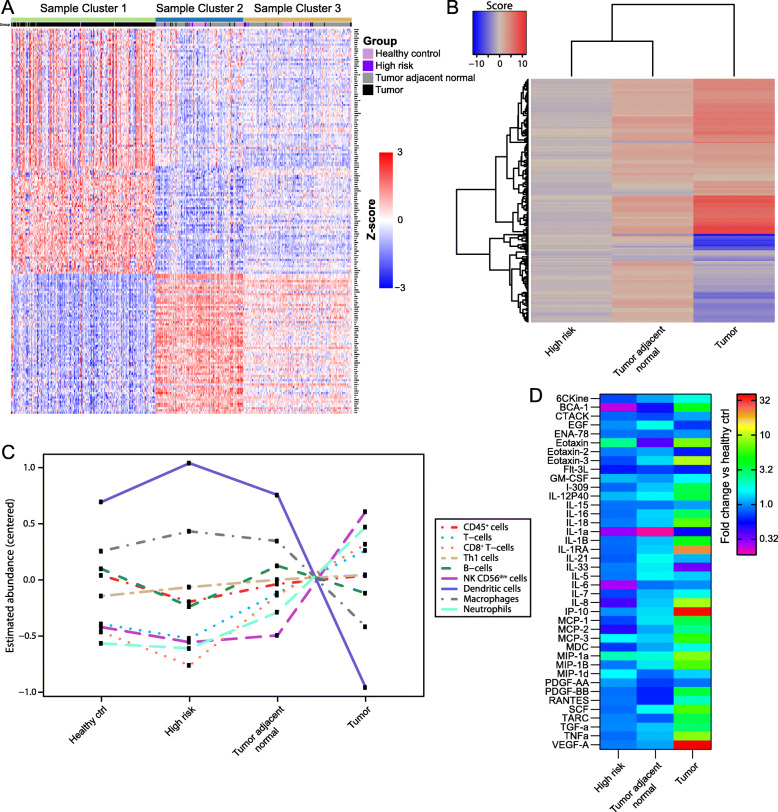
Breast tumor tissue exhibits a distinct immunological signature. a K-means clustering (k = 3) of 443 breast tissue samples by expression levels of immune-related genes as measured by NanoString. Genes with the greatest differential expression between tumor and healthy controls are shown (|fold change| > 2 and FDR < 0.05; n = 179 genes). Rows represent individual genes (log2 count normalized to standard deviations from the mean), and columns represent individual tissue samples. Cluster 1 is strongly enriched for tumor tissue. b Heatmap of directed global significance scores based on NanoString data showing 164 cellular pathways whose genes were overexpressed (red) or underexpressed (blue) in the indicated tissue type relative to healthy control tissue. c Estimated abundance of immune cell subsets in each tissue type based on stably expressed, specific marker genes present in the NanoString CodeSet. Abundance estimates are reported as the average log2 counts of marker genes for each cell subset that has been centered to have mean value 0; each unit increase corresponds to a doubling in abundance. d Cytokines present at significantly different levels in the indicated tissue types relative to healthy control tissue as measured by Milliplex assay (p < 0.05 by 2-way ANOVA with posthoc Tukey test; n = 40 cytokines). Color bar varies on a logarithmic scale
Fig. 5
Fig. 5
Network analyses reveal microbiome–immune associations in healthy control and tumor breast tissues. Visualization of significant microbiome associations with immune gene (a) and cytokine (b) expression based on Spearman coefficients (p < 0.05 for all associations shown). Each node corresponds to a single microbial (green) or immune (gold) feature, with node size proportional to the number of connections with other nodes. Edges (lines) between nodes depict positive (red) or negative (blue) associations, with edge width proportional to the magnitude of association

References

    1. Madigan MP, Ziegler RG, Benichou J, Byrne C, Hoover RN. Proportion of breast cancer cases in the United States explained by well-established risk factors. J Natl Cancer Inst. 1995;87(22):1681–1685. doi: 10.1093/jnci/87.22.1681. - DOI - PubMed
    1. Peterson CT, Sharma V, Elmen L, Peterson SN. Immune homeostasis, dysbiosis and therapeutic modulation of the gut microbiota. Clin Exp Immunol. 2015;179(3):363–377. doi: 10.1111/cei.12474. - DOI - PMC - PubMed
    1. Belkaid Y, Naik S. Compartmentalized and systemic control of tissue immunity by commensals. Nat Immunol. 2013;14(7):646–653. doi: 10.1038/ni.2604. - DOI - PMC - PubMed
    1. Wang H, Altemus J, Niazi F, Green H, Calhoun BC, Sturgis C, Grobmyer SR, Eng C. Breast tissue, oral and urinary microbiomes in breast cancer. Oncotarget. 2017;8(50):88122–88138. doi: 10.18632/oncotarget.21490. - DOI - PMC - PubMed
    1. Urbaniak C, Gloor GB, Brackstone M, Scott L, Tangney M, Reid G. The microbiota of breast tissue and its association with tumours. Appl Environ Microbiol. 2016;82(16):5039–5048. doi: 10.1128/AEM.01235-16. - DOI - PMC - PubMed

Publication types

Substances