. 2021 Apr 16;22(1):111.
doi: 10.1186/s13059-021-02316-z.

A verified genomic reference sample for assessing performance of cancer panels detecting small variants of low allele frequency

Wendell Jones  1 Binsheng Gong  2 Natalia Novoradovskaya  3 Dan Li  2 Rebecca Kusko  4 Todd A Richmond  5 Donald J Johann Jr  6 Halil Bisgin  7 Sayed Mohammad Ebrahim Sahraeian  8 Pierre R Bushel  9 Mehdi Pirooznia  10 Katherine Wilkins  11 Marco Chierici  12 Wenjun Bao  13 Lee Scott Basehore  3 Anne Bergstrom Lucas  11 Daniel Burgess  14 Daniel J Butler  15 Simon Cawley  16 Chia-Jung Chang  17 Guangchun Chen  18 Tao Chen  19 Yun-Ching Chen  10 Daniel J Craig  20 Angela Del Pozo  21 Jonathan Foox  15 Margherita Francescatto  12 Yutao Fu  22 Cesare Furlanello  12 Kristina Giorda  23 Kira P Grist  24 Meijian Guan  13 Yingyi Hao  25 Scott Happe  26 Gunjan Hariani  24 Nathan Haseley  27 Jeff Jasper  24 Giuseppe Jurman  12 David Philip Kreil  28 Paweł Łabaj  29   30 Kevin Lai  31 Jianying Li  32 Quan-Zhen Li  18 Yulong Li  33 Zhiguang Li  33 Zhichao Liu  2 Mario Solís López  21   34 Kelci Miclaus  13 Raymond Miller  11 Vinay K Mittal  22 Marghoob Mohiyuddin  8 Carlos Pabón-Peña  11 Barbara L Parsons  35 Fujun Qiu  36 Andreas Scherer  34   37 Tieliu Shi  38 Suzy Stiegelmeyer  39 Chen Suo  40 Nikola Tom  34   41 Dong Wang  2 Zhining Wen  25 Leihong Wu  2 Wenzhong Xiao  17   42 Chang Xu  43 Ying Yu  44 Jiyang Zhang  44 Yifan Zhang  45 Zhihong Zhang  36 Yuanting Zheng  2   44 Christopher E Mason  15 James C Willey  46 Weida Tong  2 Leming Shi  44   47   48 Joshua Xu  49
Affiliations

A verified genomic reference sample for assessing performance of cancer panels detecting small variants of low allele frequency

Wendell Jones et al. Genome Biol. .

Abstract

Background: Oncopanel genomic testing, which identifies important somatic variants, is increasingly common in medical practice and especially in clinical trials. Currently, there is a paucity of reliable genomic reference samples having a suitably large number of pre-identified variants for properly assessing oncopanel assay analytical quality and performance. The FDA-led Sequencing and Quality Control Phase 2 (SEQC2) consortium analyze ten diverse cancer cell lines individually and their pool, termed Sample A, to develop a reference sample with suitably large numbers of coding positions with known (variant) positives and negatives for properly evaluating oncopanel analytical performance.

Results: In reference Sample A, we identify more than 40,000 variants down to 1% allele frequency with more than 25,000 variants having less than 20% allele frequency with 1653 variants in COSMIC-related genes. This is 5-100× more than existing commercially available samples. We also identify an unprecedented number of negative positions in coding regions, allowing statistical rigor in assessing limit-of-detection, sensitivity, and precision. Over 300 loci are randomly selected and independently verified via droplet digital PCR with 100% concordance. Agilent normal reference Sample B can be admixed with Sample A to create new samples with a similar number of known variants at much lower allele frequency than what exists in Sample A natively, including known variants having allele frequency of 0.02%, a range suitable for assessing liquid biopsy panels.

Conclusion: These new reference samples and their admixtures provide superior capability for performing oncopanel quality control, analytical accuracy, and validation for small to large oncopanels and liquid biopsy assays.


Conflict of interest statement

The authors declare the following potential competing financial interests:

Natalia Novoradovskaya, Katherine Wilkins, Anne Lucas, Raymond Miller, and Carlos Pabon are all employees of Agilent Technologies, Inc. Agilent Sample B DNA reference sample is a current product and Sample A DNA is a potential product of Agilent Technologies, Inc.

Figures
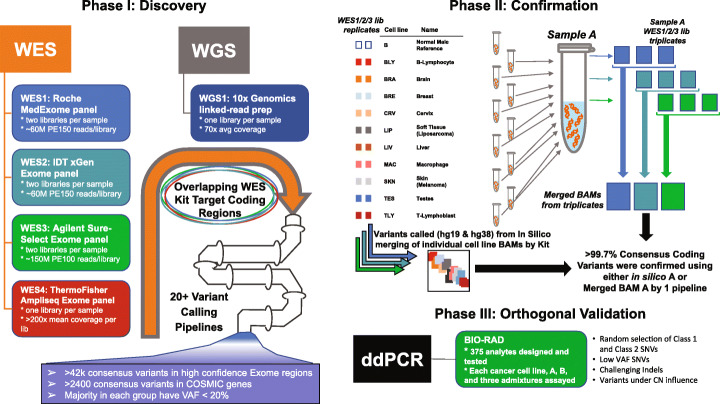
Fig. 1
Fig. 1
Overall flow diagram of process/method. Discovery of Class 1 variants came from consensus analysis of WES1/2/3/4 runs on overlapping WES kit target regions having high confidence. Additional Class 2 variants were discovered after analyzing WGS1 with WES results. Variants were confirmed by analyzing in silico A results where we combined individual BAMs from each cell line replicate and by analyzing merged-BAM Sample A from pooled Sample A individual replicate BAMs. Finally, a subset of these variants was orthogonally validated with ddPCR
Fig. 2
Fig. 2
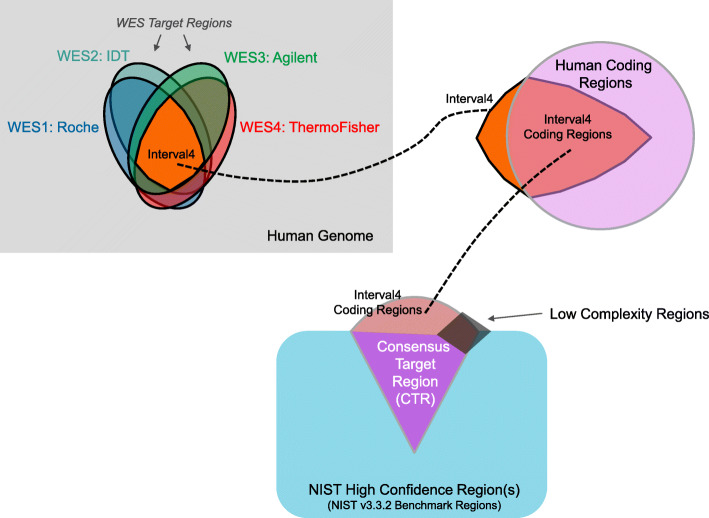
Defining the consensus target region (CTR). The regions shown are not to scale. Most of these regions and their sizes are provided in Additional file 1: Table S2. The low complexity regions are excluded from the CTR. Importantly, the size of the CTR is ~ 22.7 Mb for hg19
Fig. 3
Fig. 3
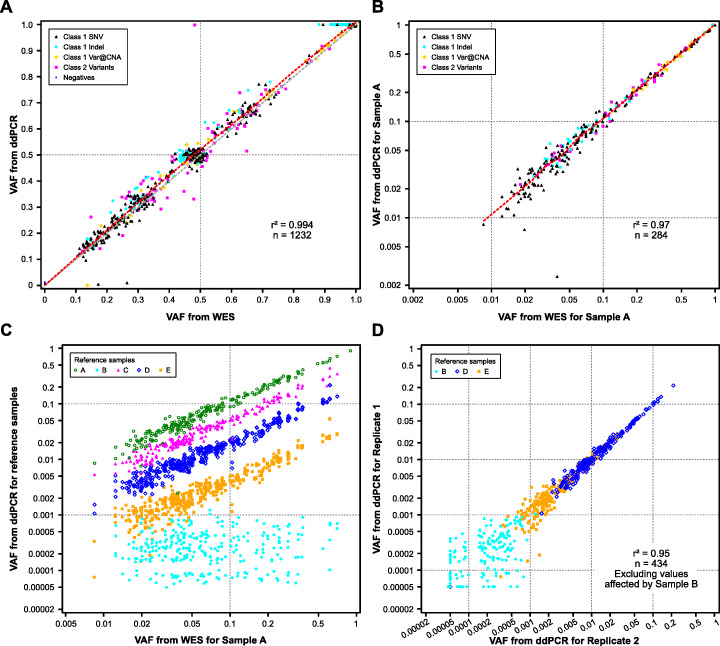
ddPCR and WES concordance: a VAF concordance of individual cell line WES consensus results with ddPCR assays of that cell line. b Concordance (log10 scale) of Sample A VAF between ddPCR and WES for positives only. c Various dilutions (C, D, E) of Sample A into B achieve the expected reduction in VAF as seen in the ddPCR results. It also shows the potential noise for measuring ddPCR variants below 0.1% (10− 3) in the distribution of Sample B variants. d Concordance of replicate ddPCR assays (on log10 scale) is very high (r2 = .95) in diluted target Samples D and E. Putative VAF values from Sample B are also shown for comparison
Fig. 4
Fig. 4
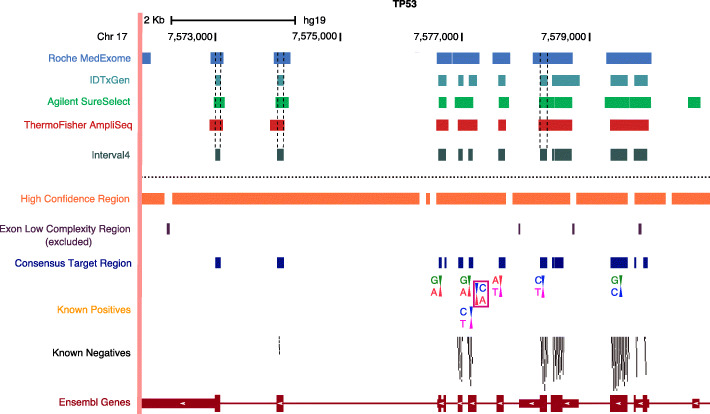
Illustration of considerations for determining positives and negatives within the reference material. Each WES kit coverage is shown relative to their intersection with coding regions (Interval4), the high confidence region, and the low complexity region. Also shown are known positive variant positions in Sample A (mostly Class 1 variants SNVs) including one identified by a violet box that is outside the Interval4 and CTR regions (Class 2 variant). Other positions shown include known negative positions
Fig. 5
Fig. 5
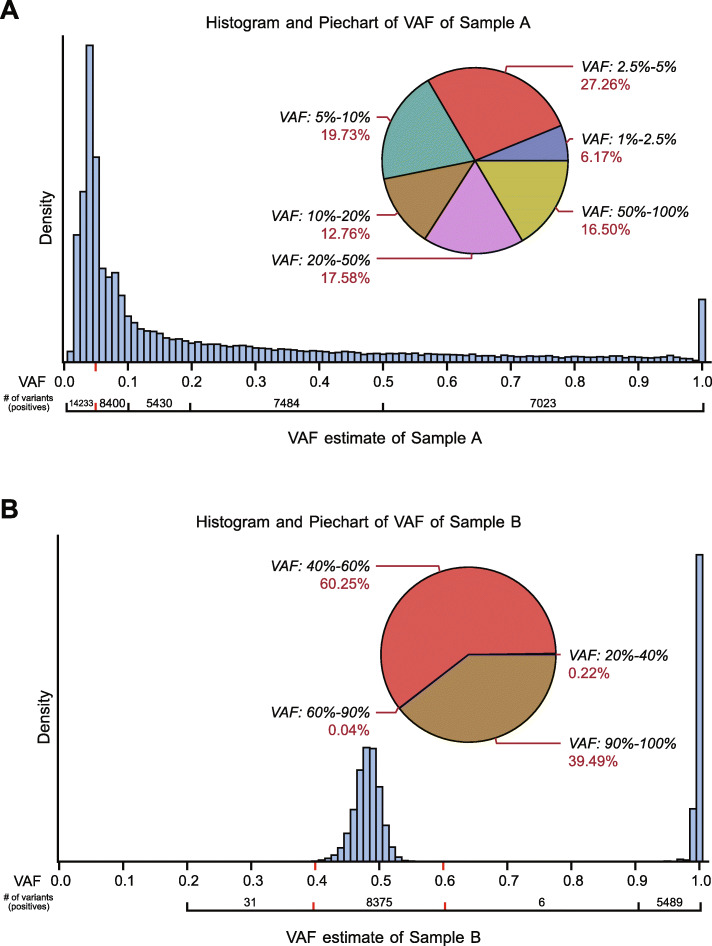
a VAF histogram of Sample A variants (Class 1 and Class2) with the obvious large numbers of variants in the low VAF range from 0.01 to 0.10. b VAF histogram of normal Sample B which can be used to dilute variants from Sample A

References

    1. MAQC consortium. MicroArray/Sequencing Quality Control (MAQC/SEQC). U.S. Food and Drug Administration. 2019. https://www.fda.gov/science-research/bioinformatics-tools/microarraysequ.... Accessed 24 Feb 2020.
    1. Zook JM, Catoe D, McDaniel J, Vang L, Spies N, Sidow A, Weng Z, Liu Y, Mason CE, Alexander N, Henaff E, McIntyre ABR, Chandramohan D, Chen F, Jaeger E, Moshrefi A, Pham K, Stedman W, Liang T, Saghbini M, Dzakula Z, Hastie A, Cao H, Deikus G, Schadt E, Sebra R, Bashir A, Truty RM, Chang CC, Gulbahce N, Zhao K, Ghosh S, Hyland F, Fu Y, Chaisson M, Xiao C, Trow J, Sherry ST, Zaranek AW, Ball M, Bobe J, Estep P, Church GM, Marks P, Kyriazopoulou-Panagiotopoulou S, Zheng GXY, Schnall-Levin M, Ordonez HS, Mudivarti PA, Giorda K, Sheng Y, Rypdal KB, Salit M. Extensive sequencing of seven human genomes to characterize benchmark reference materials. Sci Data. 2016;3(1):160025. doi: 10.1038/sdata.2016.25. - DOI - PMC - PubMed
    1. Suzuki T, Tsukumo Y, Furihata C, Naito M, Kohara A. Preparation of the standard cell lines for reference mutations in cancer gene-panels by genome editing in HEK 293 T/17 cells. Genes and Environ. 2020;42:8. 10.1186/s41021-020-0147-2. - PMC - PubMed
    1. Craig DW, Nasser S, Corbett R, Chan SK, Murray L, Legendre C, Tembe W, Adkins J, Kim N, Wong S, Baker A, Enriquez D, Pond S, Pleasance E, Mungall AJ, Moore RA, McDaniel T, Ma Y, Jones SJM, Marra MA, Carpten JD, Liang WS. A somatic reference standard for cancer genome sequencing. Sci Rep. 2016;6(1):24607. doi: 10.1038/srep24607. - DOI - PMC - PubMed
    1. Kim J, Kim D, Lim JS, Maeng JH, Son H, Kang H-C, Nam H, Lee JH, Kim S. The use of technical replication for detection of low-level somatic mutations in next-generation sequencing. Nat Commun. 2019;10(1):1047. doi: 10.1038/s41467-019-09026-y. - DOI - PMC - PubMed

Publication types

Substances