


Phylogenomic and morphological relationships among the botryllid ascidians (Subphylum Tunicata, Class Ascidiacea, Family Styelidae)
- PMID: 33863944
- PMCID: PMC8052435
- DOI: 10.1038/s41598-021-87255-2
Phylogenomic and morphological relationships among the botryllid ascidians (Subphylum Tunicata, Class Ascidiacea, Family Styelidae)
Abstract
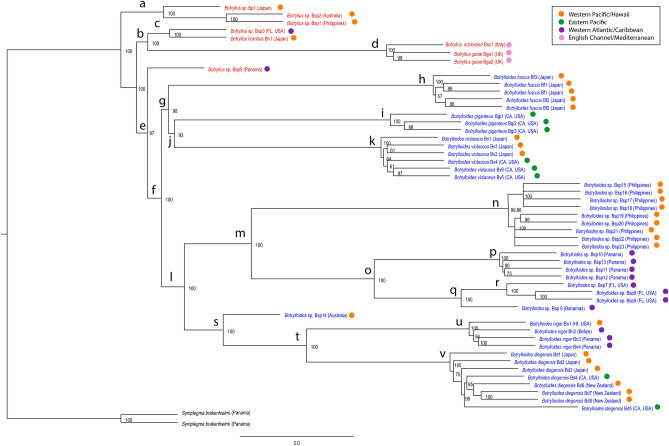
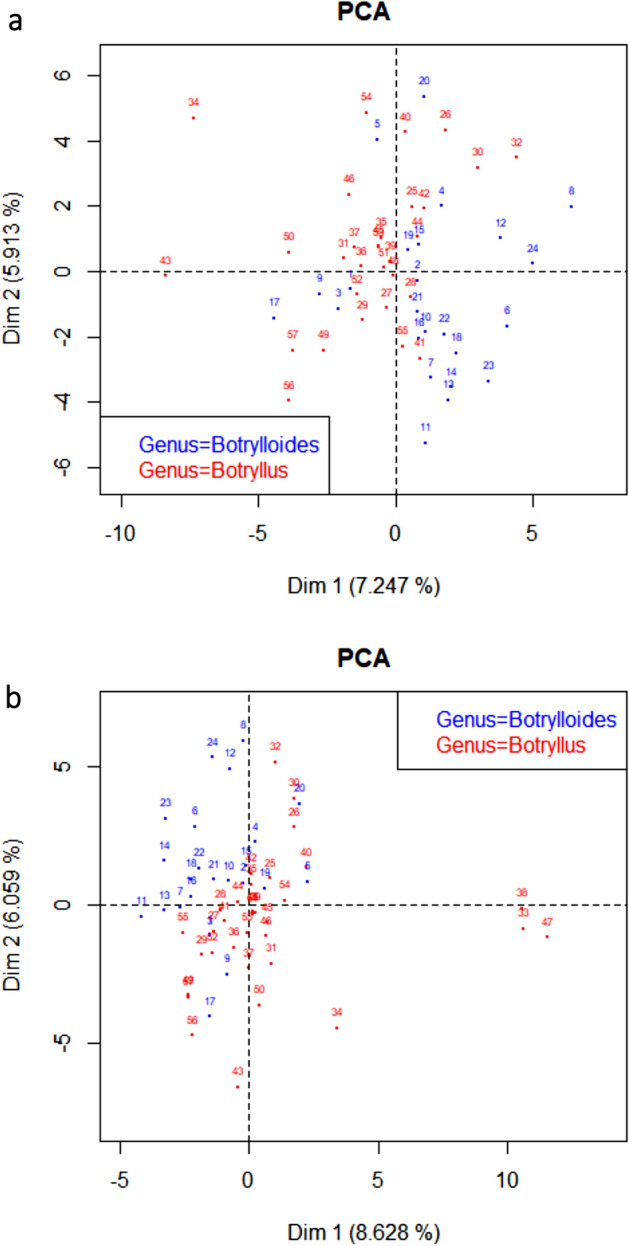
Ascidians (Phylum Chordata, Class Ascidiacea) are a large group of invertebrates which occupy a central role in the ecology of marine benthic communities. Many ascidian species have become successfully introduced around the world via anthropogenic vectors. The botryllid ascidians (Order Stolidobranchia, Family Styelidae) are a group of 53 colonial species, several of which are widespread throughout temperate or tropical and subtropical waters. However, the systematics and biology of this group of ascidians is not well-understood. To provide a systematic framework for this group, we have constructed a well-resolved phylogenomic tree using 200 novel loci and 55 specimens. A Principal Components Analysis of all species described in the literature using 31 taxonomic characteristics revealed that some species occupy a unique morphological space and can be easily identified using characteristics of adult colonies. For other species, additional information such as larval or life history characteristics may be required for taxonomic discrimination. Molecular barcodes are critical for guiding the delineation of morphologically similar species in this group.
Conflict of interest statement
The authors declare no competing interests.
Figures
Similar articles
-
DNA bar coding of Aplousobranchiata and Phlebobranchiata Ascidians (Phylum:Chordata) inferred from mitochondrial cytochrome oxidase subunit I (COI) gene sequence approach in Andaman and Nicobar Islands, India: a first report.Mitochondrial DNA A DNA Mapp Seq Anal. 2020 Oct;31(7):285-297. doi: 10.1080/24701394.2020.1798417. Epub 2020 Jul 30. Mitochondrial DNA A DNA Mapp Seq Anal. 2020. PMID: 32729766
-
An elongated COI fragment to discriminate botryllid species and as an improved ascidian DNA barcode.Sci Rep. 2021 Feb 18;11(1):4078. doi: 10.1038/s41598-021-83127-x. Sci Rep. 2021. PMID: 33603059 Free PMC article.
-
Ambiguities in the taxonomic assignment and species delineation of botryllid ascidians from the Israeli Mediterranean and other coastlines.Mitochondrial DNA A DNA Mapp Seq Anal. 2018 Oct;29(7):1073-1080. doi: 10.1080/24701394.2017.1404047. Epub 2017 Nov 22. Mitochondrial DNA A DNA Mapp Seq Anal. 2018. PMID: 29166817
-
Biological function of unique sulfated glycosaminoglycans in primitive chordates.Glycoconj J. 2017 Jun;34(3):277-283. doi: 10.1007/s10719-016-9728-5. Epub 2016 Sep 10. Glycoconj J. 2017. PMID: 27614617 Review.
-
Global diversity of Ascidiacea.PLoS One. 2011;6(6):e20657. doi: 10.1371/journal.pone.0020657. Epub 2011 Jun 20. PLoS One. 2011. PMID: 21701684 Free PMC article. Review.
Cited by
-
The Onset of Whole-Body Regeneration in Botryllus schlosseri: Morphological and Molecular Characterization.Front Cell Dev Biol. 2022 Feb 14;10:843775. doi: 10.3389/fcell.2022.843775. eCollection 2022. Front Cell Dev Biol. 2022. PMID: 35237607 Free PMC article.
-
Evolution of Allorecognition in the Tunicata.Biology (Basel). 2020 Jun 16;9(6):129. doi: 10.3390/biology9060129. Biology (Basel). 2020. PMID: 32560112 Free PMC article. Review.
-
Whole body regeneration and developmental competition in two botryllid ascidians.Evodevo. 2021 Dec 15;12(1):15. doi: 10.1186/s13227-021-00185-y. Evodevo. 2021. PMID: 34911568 Free PMC article.
References
-
- Lambert G. Ecology and natural history of the protochordates. Can. J. Zool. 2005;83:34–50. doi: 10.1139/z04-156. - DOI
-
- Zhan A, Briski E, Bock DG, Ghabooli S, MacIsaac HJ. Ascidians as models for studying invasion success. Mar. Biol. 2015;162:2449–2470. doi: 10.1007/s00227-015-2734-5. - DOI
-
- Lambert CC, Lambert G. Persistence and differential distribution of nonindigenous ascidians in harbors of the Southern California Bight. Mar. Ecol. Prog. Ser. 2003;259:145–161. doi: 10.3354/meps259145. - DOI
-
- Bullard SG, et al. The colonial ascidian Didemnum sp. A: Current distribution, basic biology and potential threat to marine communities of the northeast and west coasts of North America. J. Exp. Mar. Biol. Ecol. 2007;342:99–108. doi: 10.1016/j.jembe.2006.10.020. - DOI
Publication types
MeSH terms
Associated data
LinkOut - more resources
Full Text Sources
Other Literature Sources
