


The effect of body mass index on the outcomes of cementless medial mobile-bearing unicompartmental knee replacements
- PMID: 33864470
- PMCID: PMC9898366
- DOI: 10.1007/s00167-021-06549-0
The effect of body mass index on the outcomes of cementless medial mobile-bearing unicompartmental knee replacements
Abstract
Purpose: Given an increasingly overweight population, unicompartmental knee replacements (UKRs) are being performed in patients with higher body mass indices (BMIs). There are concerns that cemented fixation will not last. Cementless fixation may offer a solution, but the long term results in different BMI groups has not been assessed. We studied the effect of BMI on the outcomes of cementless UKRs.
Methods: A prospective cohort of 1000 medial cementless mobile-bearing UKR with a mean follow up of 6.6 years (SD 2.7) were analysed. UKRs were categorised into four BMI groups: (1) ≥ 18.5 to < 25 kg/m2 (normal), (2) 25 to < 30 kg/m2 (overweight), (3) 30 to < 35 kg/m2 (obese class 1) and (4) ≥ 35 kg/m2 (obese class 2). Implant survival was assessed using endpoints reoperation and revision. Functional outcomes were assessed.
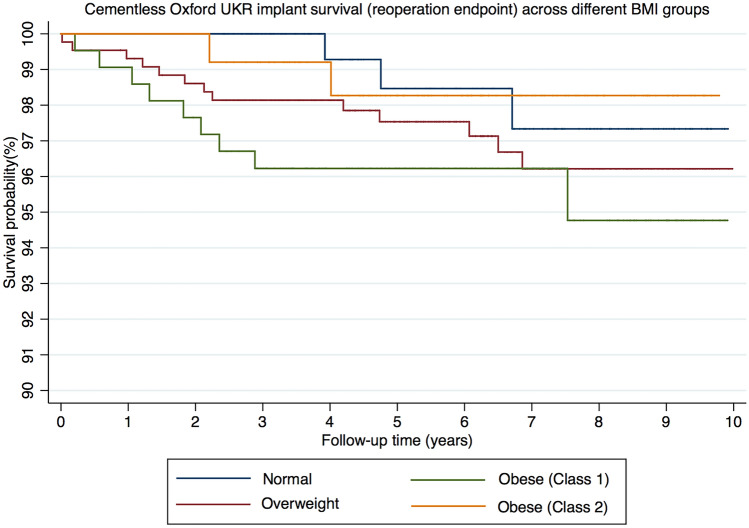
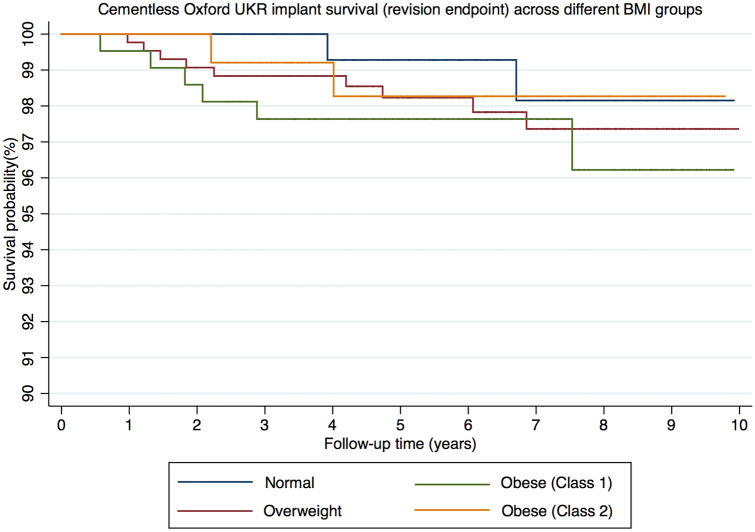
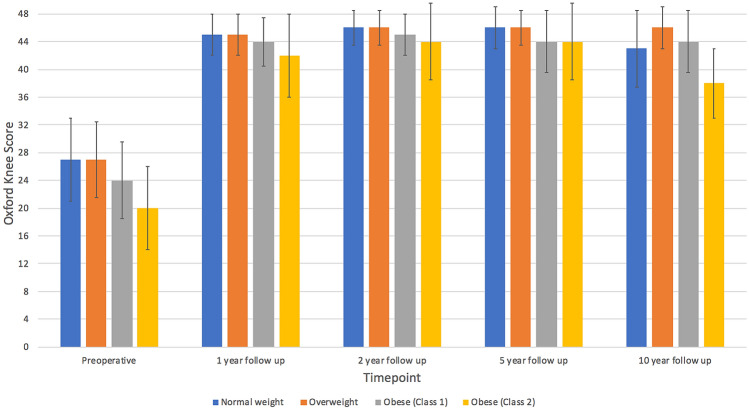
Results: Ten-year cumulative revision rate for the normal (n = 186), overweight (n = 434), obese class 1 (n = 213) and obese class 2 (n = 127) groups were 1.8% (CI 0.4-7.4), 2.6% (CI 1.3-5.1), 3.8% (CI 1.5-9.2) and 1.7% (CI 0.4-6.8) with no significant differences between groups (p = 0.79). The 10-year cumulative reoperation rates were 2.7% (CI 0.8-8.2), 3.8% (CI 2.2-6.6), 5.2% (CI 2.5-10.7) and 1.7% (CI 0.4-6.8) with no significant differences between groups (p = 0.44). The 10-year median Oxford Knee Score were 43.0, 46.0, 44.0 and 38.0 respectively.
Conclusion: Cementless mobile-bearing UKR has low 10-year reoperation and revision rates across in all BMI groups, and there are no significant differences between the groups. Although higher BMI groups had slightly worse functional outcomes, the improvement in function compared to preoperatively tended to be better. This study suggests that BMI should not be considered a contraindication for the cementless mobile-bearing UKR.
Keywords: Body mass index; Cementless fixation; Mid-long term outcomes; Unicondylar knee replacement.
© 2021. The Author(s).
Conflict of interest statement
The author or one or more of the authors have received or will receive benefits for personal or professional use from a commercial party related directly or indirectly to the subject of this article. In addition, benefits have been or will be directed to a research fund, foundation, educational institution, or other non-profit organisation with which one or more of the authors are associated.
Figures
References
-
- Abdel MP, Bonadurer GF, III, Jennings MT, Hanssen AD. Increased aseptic tibial failures in patients with a BMI ≥ 35 and well-aligned total knee arthroplasties. J Arthroplasty. 2015;30:2181–2184. - PubMed
-
- Amin A, Clayton R, Patton J, Gaston M, Cook R, Brenkel I. Total knee replacement in morbidly obese patients: results of a prospective, matched study. Bone Joint J. 2006;88:1321–1326. - PubMed
-
- Anandacoomarasamy A, Caterson I, Sambrook P, Fransen M, March L. The impact of obesity on the musculoskeletal system. Int J Obes (Lond) 2008;32:211–222. - PubMed
-
- Australian Orthopaedic Association . Australian Orthopaedic Association National Joint Replacement Registry (AOANJRR). Hip knee & shoulder arthroplasty. Australian Orthopaedic Association; 2018.
-
- Bonutti PM, Goddard MS, Zywiel MG, Khanuja HS, Johnson AJ, Mont MA. Outcomes of unicompartmental knee arthroplasty stratified by body mass index. J Arthroplasty. 2011;26:1149–1153. - PubMed
MeSH terms
LinkOut - more resources
Full Text Sources
Other Literature Sources
