


Femoral artery access site closure with perclose suture mediated device in coronary interventions
- PMID: 33865515
- PMCID: PMC8065371
- DOI: 10.1016/j.ihj.2020.12.014
Femoral artery access site closure with perclose suture mediated device in coronary interventions
Abstract
Objective: To compare the outcome of suture mediated vascular closure device Perclose Proglide (PP) with manual compression (MC) following transfemoral access for coronary interventions (CI).
Methods: It is a retrospective, observational, single centre study from January 2018 to September 2019. Consecutive patients undergoing interventions through transfemoral access were divided into PP and MC groups. Those with less than 3 months follow up were excluded. Two groups were compared for baseline characteristics and various complications at 24 h and at 30 days.
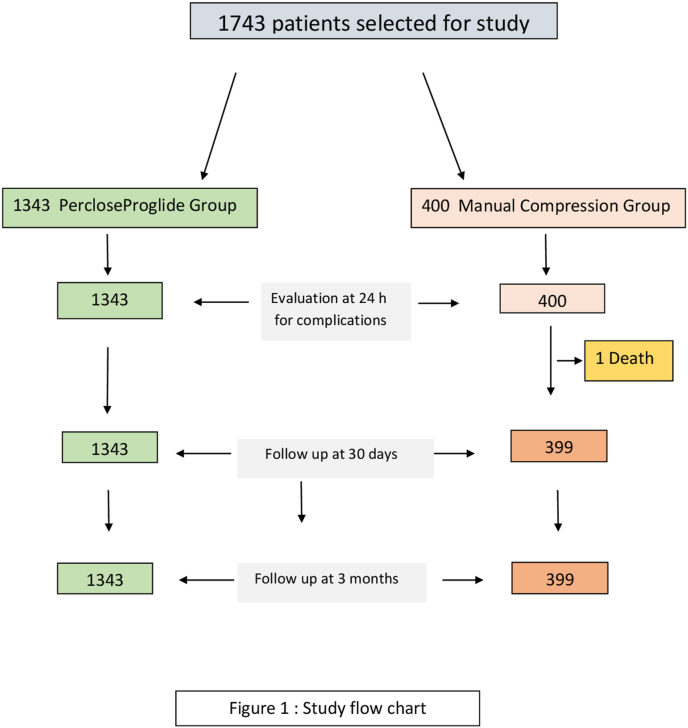
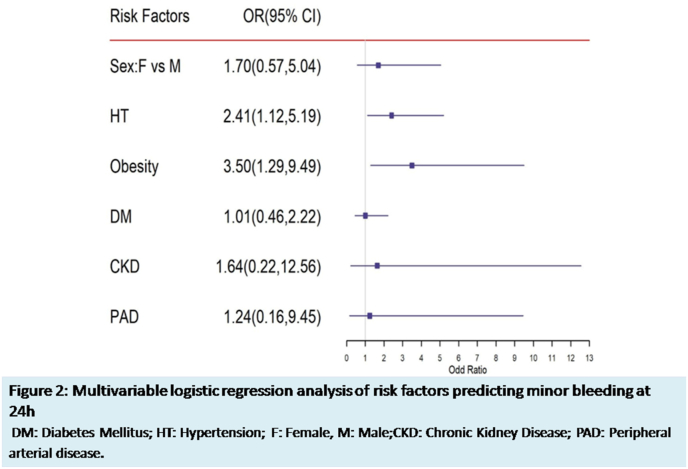
Results: Out of 1743 patients studied, PP group included 1343 and MC group, 400 patients. Both groups were comparable in baseline characteristics, sheath size and use of antiplatelets and anticoagulation. PP group had significantly less minor bleeding (P = .01, CI 0.34-4.03) and hematoma (P = .0007, CI 0.95-5.10) at 24 h. At 30 days, minor bleeding (P < .0001, CI 0.97-4.25), hematoma (P = .0002, CI 1.05-4.93) and pseudo-aneurysm (P = .0095, CI 0.03-1.18) were also significantly less in PP group. Obesity (OR 3.5, CI 1.29-9.49) and hypertension (OR 2.41, CI 1.12-5.19) were associated with increased minor bleeding at 24 h. Device failure rate was 2.38%.
Conclusions: PP device is safe, effective and is associated with fewer complications than MC in CI. Device failure rate is low. Obesity and hypertension are associated with increased minor bleeding in both groups.
Keywords: Coronary intervention; Femoral access site complication; Manual compression; Percutaneous coronary intervention; Suture mediated vascular closure device.
Copyright © 2020 Cardiological Society of India. Published by Elsevier B.V. All rights reserved.
Conflict of interest statement
Declaration of competing interest Nil.
Figures
References
-
- Gu D., Qu J., Zhang H. Revascularization for coronary artery disease: principle and challenges. Adv Exp Med Biol. 2020;1177:75–100. - PubMed
-
- Alkatiri A.A., Firman D., Haryono N. Comparison between radial versus femoral percutaneous coronary intervention access in Indonesian hospitals, 2017-2018: a prospective observational study of a national registry. Int J Cardiol Heart Vasc. 2020;27:100488. doi: 10.1016/j.ijcha.2020.100488. - DOI - PMC - PubMed
-
- Ferrante G., Rao S.V., Jüni P. Radial versus femoral access for coronary interventions across the entire spectrum of patients with coronary artery disease: a meta-analysis of randomized trials. JACC Cardiovasc Interv. 2016;9:1419–1434. - PubMed
MeSH terms
LinkOut - more resources
Full Text Sources
Miscellaneous
