


The Effect of Donor Graft Cryopreservation on Allogeneic Hematopoietic Cell Transplantation Outcomes: A Center for International Blood and Marrow Transplant Research Analysis. Implications during the COVID-19 Pandemic
- PMID: 33865804
- PMCID: PMC8217124
- DOI: 10.1016/j.jtct.2021.03.015
The Effect of Donor Graft Cryopreservation on Allogeneic Hematopoietic Cell Transplantation Outcomes: A Center for International Blood and Marrow Transplant Research Analysis. Implications during the COVID-19 Pandemic
Abstract
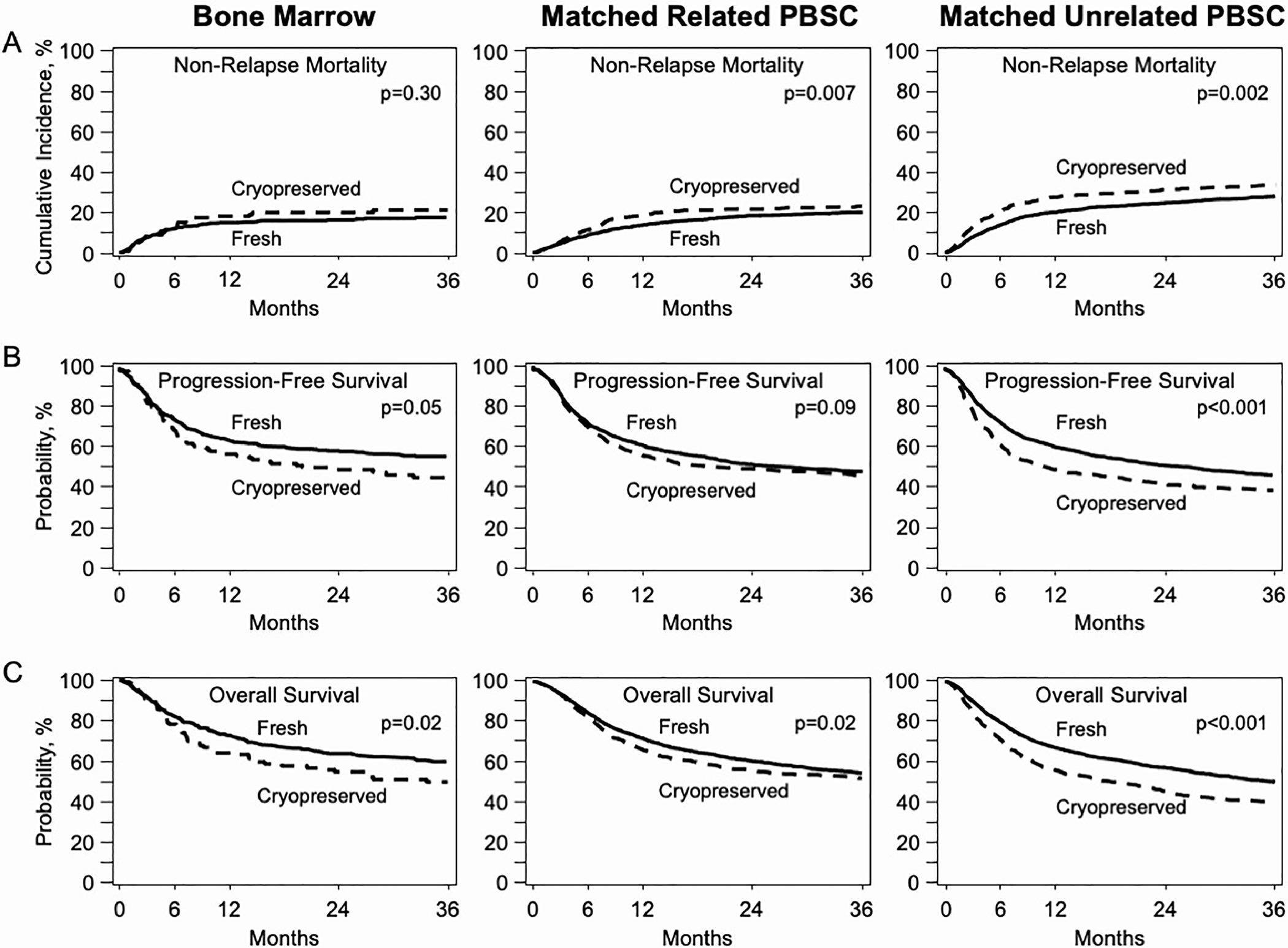
The COVID-19 pandemic has resulted in the increased use of cryopreserved grafts for allogeneic hematopoietic cell transplantation (HCT). However, information about the effect of cryopreservation on outcomes for patients receiving allogeneic donor grafts is limited. We evaluated outcomes of HCT recipients who received either fresh or cryopreserved allogeneic bone marrow (BM) or peripheral blood stem cell (PBSC) grafts reported to the Center for International Blood and Marrow Transplant Research. A total of 7397 patients were included in the analysis. Recipients of cryopreserved graft were divided into 3 cohorts based on graft source: HLA-matched related PBSC donors (n = 1051), matched unrelated PBSC donors (n = 678), and matched related or unrelated BM donors (n = 154). These patients were propensity score matched with 5514 patients who received fresh allografts. The primary endpoint was engraftment. Multivariate analyses showed no significant increased risk of delayed engraftment, relapse, nonrelapse mortality (NRM), or survival with cryopreservation of BM grafts. In contrast, cryopreservation of related donor PBSC grafts was associated with decreased platelet recovery (hazard ratio [HR], 0.73; 95% confidence interval [CI], 0.68 to 0.78; P < .001) and an increased risk of grade II-IV (HR, 1.27; 95% CI, 1.09 to 1.48; P = .002) and grade III-IV (HR, 1.48; 95% CI, 1.19 to 1.84; P < .001) acute graft-versus-host disease. Cryopreservation of unrelated PBSC grafts was associated with delayed engraftment of neutrophils (HR, 0.77; 95% CI, 0.71 to 0.84; P < .001) and platelets (HR, 0.61; 95% CI, 0.56 to 0.66; P < .001) as well as an increased risk of NRM (HR, 1.4; 95% CI, 1.18 to 1.66; P < .001) and relapse (HR, 1.32; 95% CI, 1.11 to 1.58; P = .002) and decreased progression-free survival (HR, 1.36; 95% CI, 1.20 to 1.55; P < .001) and overall survival (OS) (HR, 1.38; 95% CI, 1.22 to 1.58; P < .001). Reasons for cryopreservation were not routinely collected; however, in a subset of unrelated donor HCT recipients, the reason was typically a change in patient condition. Products cryopreserved for patient reasons were significantly associated with inferior OS in multivariate analysis (HR, 0.65; 95% CI, 0.44 to 0.96; P = .029). We conclude that cryopreservation is associated with slower engraftment of PBSC grafts, which may be associated with inferior transplantation outcomes in some patient populations. However, the small numbers in the cryopreserved BM cohort and the lack of information on the reason for cryopreservation in all patients suggests that these data should be interpreted with caution, particularly in the context of the risks associated with unexpected loss of a graft during the pandemic. Future analyses addressing outcomes when cryopreservation is universally applied are urgently required.
Keywords: Bone marrow graft; Cryopreservation; Peripheral blood stem cell graft.
Copyright © 2021 The American Society for Transplantation and Cellular Therapy. Published by Elsevier Inc. All rights reserved.
Figures
References
-
- Frey NV, Lazarus HM, Goldstein SC. Has allogeneic stem cell cryopreservation been given the “cold shoulder”? An analysis of the pros and cons of using frozen versus fresh stem cell products in allogeneic stem cell transplantation. Bone Marrow Transplant. 2006;38(6):399–405. - PubMed
-
- Attarian H, Feng Z, Buckner CD, MacLeod B, Rowley SD. Long-term cryopreservation of bone marrow for autologous transplantation. Bone Marrow Transplant. 1996;17(3):425–430. - PubMed
-
- Akkök ÇA, Liseth K, Melve GK, et al. Is there a scientific basis for a recommended standardization of collection and cryopreservation of peripheral blood stem cell grafts? Cytotherapy. 2011;13(8):1013–1024. - PubMed
-
- Eckardt JR, Roodman GD, Boldt DH, et al. Comparison of engraftment and acute GVHD in patients undergoing cryopreserved or fresh allogeneic BMT. Bone Marrow Transplant. 1993;11(2):125–131. - PubMed
-
- Stockschläder M, Krüger W, Kroschke G, et al. Use of cryopreserved bone marrow in allogeneic bone marrow transplantation. Bone Marrow Transplant. 1995;15(4):569–572. - PubMed
Publication types
MeSH terms
Grants and funding
LinkOut - more resources
Full Text Sources
Other Literature Sources
Medical
Research Materials
