


Tumor-Nipple Distance of ≥ 1 cm Predicts Negative Nipple Pathology After Neoadjuvant Chemotherapy
- PMID: 33866472
- PMCID: PMC9401087
- DOI: 10.1245/s10434-021-09902-2
Tumor-Nipple Distance of ≥ 1 cm Predicts Negative Nipple Pathology After Neoadjuvant Chemotherapy
Abstract
Background: As neoadjuvant chemotherapy (NAC) for breast cancer has become more widely used, so has nipple-sparing mastectomy. A common criterion for eligibility is a 1 cm tumor-to-nipple distance (TND), but its suitability after NAC is unclear. In this study, we examined factors predictive of negative nipple pathologic status (NS-) in women undergoing total mastectomy after NAC.
Methods: Women with invasive breast cancer treated with NAC and total mastectomy from August 2014 to April 2018 at our institution were retrospectively identified. Following review of pre- and post-NAC magnetic resonance imaging (MRI) and mammograms, the association of clinicopathologic and imaging variables with NS- was examined and the accuracy of 1 cm TND on imaging for predicting NS- was determined.
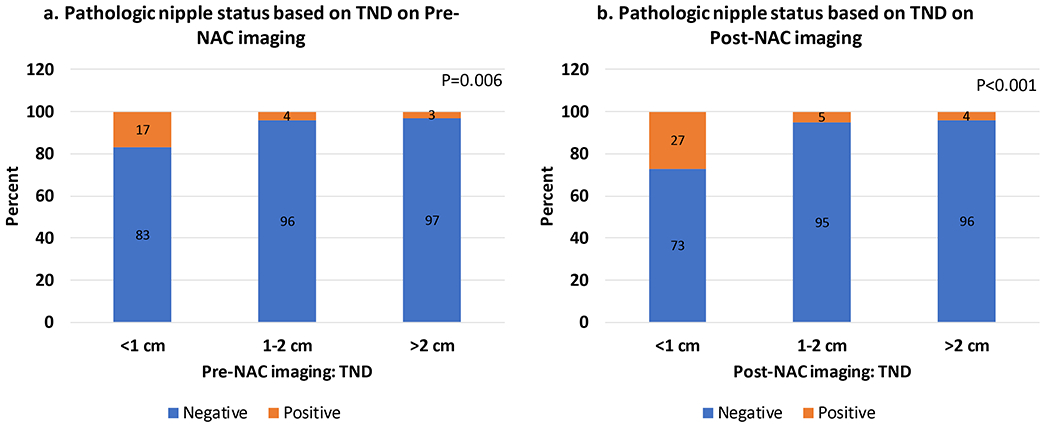
Results: Among 175 women undergoing 179 mastectomies, 74% of tumors were cT1-T2 and 67% were cN+ on pre-NAC staging; 10% (18/179) had invasive or in situ carcinoma in the nipple on final pathology. On multivariable analysis, after adjusting for age, grade, and tumor stage, three factors, namely number of positive nodes, pre-NAC nipple-areolar complex retraction, and decreasing TND, were significant predictors of nipple involvement (p < 0.05). The likelihood of NS- was higher with increasing TND on pre- and post-NAC imaging (p < 0.05). TND ≥ 1 cm predicted NS- in 97% and 95% of breasts on pre- and post-NAC imaging, respectively.
Conclusions: Increasing TND was associated with a higher likelihood of NS-. A TND ≥ 1 cm on pre- or post-NAC imaging is highly predictive of NS- and could be used to determine eligibility for nipple-sparing mastectomy after NAC.
© 2021. Society of Surgical Oncology.
Figures
Comment in
-
ASO Author Reflections: Tumor-Nipple Distance of ≥ 1 cm on Pre- or Post-Neoadjuvant Chemotherapy Imaging can be used to Determine Eligibility for Nipple-Sparing Mastectomy.Ann Surg Oncol. 2021 Oct;28(11):6030-6031. doi: 10.1245/s10434-021-09979-9. Epub 2021 Apr 16. Ann Surg Oncol. 2021. PMID: 33864167 No abstract available.
References
-
- Cortazar P, Zhang L, Untch M, et al. Pathological complete response and long-term clinical benefit in breast cancer: the CTNeoBC pooled analysis. Lancet. 2014;384(9938):164–172. - PubMed
-
- Gianni L, Pienkowski T, Im YH, et al. 5-year analysis of neoadjuvant pertuzumab and trastuzumab in patients with locally advanced, inflammatory, or early-stage HER2-positive breast cancer (NeoSphere): a multicentre, open-label, phase 2 randomised trial. Lancet Oncol. 2016;17(6):791–800. - PubMed
-
- Singh JC, Mamtani A, Barrio A, et al. Pathologic complete response with neoadjuvant doxorubicin and cyclophosphamide followed by paclitaxel with trastuzumab and pertuzumab in patients with HER2-positive early stage breast cancer: a single center experience. Oncologist. 2017;22(2):139–143. - PMC - PubMed
-
- Young WA, Degnim AC, Hoskin TL, et al. Outcomes of > 1300 nipple-sparing mastectomies with immediate reconstruction: the impact of expanding indications on complications. Ann Surg Oncol. 2019;26(10):3115–3123. - PubMed
-
- Bartholomew AJ, Dervishaj OA, Sosin M, et al. Neoadjuvant chemotherapy and nipple-sparing mastectomy: timing and postoperative complications. Ann Surg Oncol. 2019;26(9):2768–2772. - PubMed
MeSH terms
Grants and funding
LinkOut - more resources
Full Text Sources
Other Literature Sources
Medical
Research Materials
Miscellaneous
