


Is Re-introducing Major Open and Minimally Invasive Surgery during COVID-19 Safe for Patients and Healthcare Workers? An International, Multi-centre Cohort Study in the Field of Oesophago-gastric Surgery
- PMID: 33866473
- PMCID: PMC8053024
- DOI: 10.1245/s10434-021-09885-0
Is Re-introducing Major Open and Minimally Invasive Surgery during COVID-19 Safe for Patients and Healthcare Workers? An International, Multi-centre Cohort Study in the Field of Oesophago-gastric Surgery
Abstract
Introduction: The COVID-19 pandemic has resulted in unparalleled changes to patient care, including the suspension of cancer surgery. Concerns regarding COVID-19-related risks to patients and healthcare workers with the re-introduction of major complex minimally invasive and open surgery have been raised. This study examines the COVID-19 related risks to patients and healthcare workers following the re-introduction of major oesophago-gastric (EG) surgery.
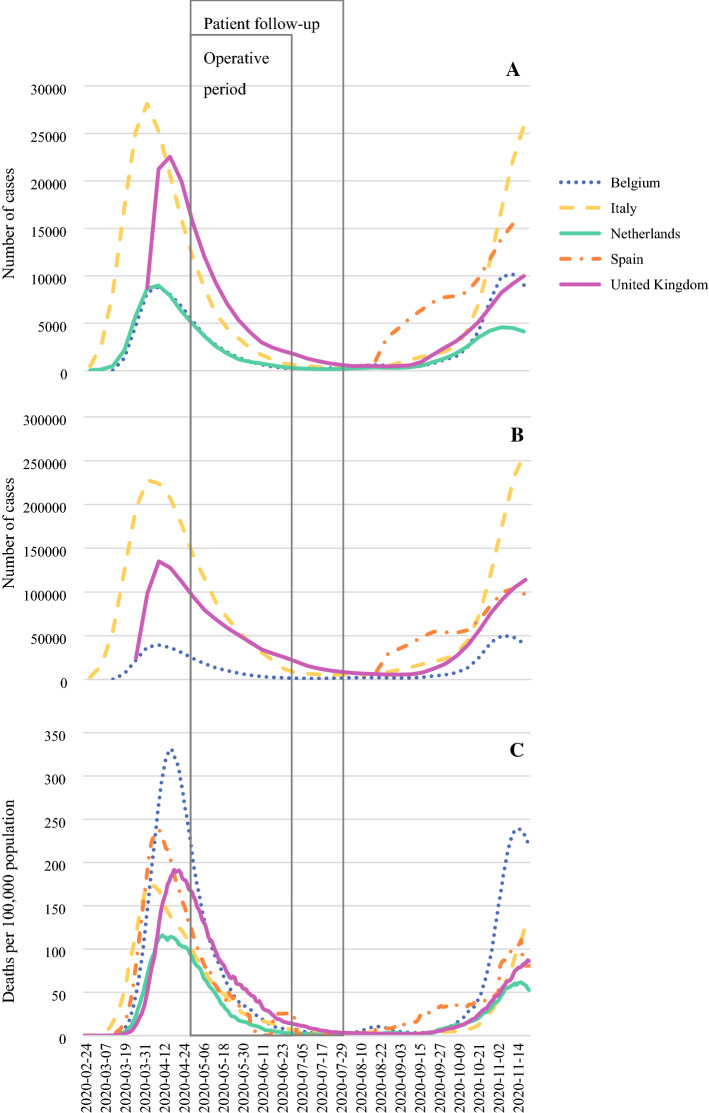
Patients and methods: This was an international, multi-centre, observational study of consecutive patients treated by open and minimally invasive oesophagectomy and gastrectomy for malignant or benign disease. Patients were recruited from nine European centres serving regions with a high population incidence of COVID-19 between 1 May and 1 July 2020. The primary endpoint was 30-day COVID-19-related mortality. All staff involved in the operative care of patients were invited to complete a health-related survey to assess the incidence of COVID-19 in this group.
Results: In total, 158 patients were included in the study (71 oesophagectomy, 82 gastrectomy). Overall, 87 patients (57%) underwent MIS (59 oesophagectomy, 28 gastrectomy). A total of 403 staff were eligible for inclusion, of whom 313 (78%) completed the health survey. Approaches to mitigate against the risks of COVID-19 for patients and staff varied amongst centres. No patients developed COVID-19 in the post-operative period. Two healthcare workers developed self-limiting COVID-19.
Conclusions: Precautions to minimise the risk of COVID-19 infection have enabled the safe re-introduction of minimally invasive and open EG surgery for both patients and staff. Further studies are necessary to determine the minimum requirements for mitigations against COVID-19.
© 2021. The Author(s).
Conflict of interest statement
The authors report no conflicts of interest.
Figures
References
-
- Michalowski J, Salvador A, Napper R. Commissioned by Healthcare Quality Improvement Partnership National Oesophago-Gastric Cancer Audit 2018 An Audit of the Care Received by People with Oesophago-Gastric Cancer in England and Wales 2018 Annual Report.; 2018.
-
- Messager M, De Steur WO, Van Sandick JW, et al. Variations among 5 European countries for curative treatment of resectable oesophageal and gastric cancer: A survey from the EURECCA Upper GI Group (EUropean REgistration of Cancer CAre) Eur J Surg Oncol. 2016;42(1):116–122. doi: 10.1016/j.ejso.2015.09.017. - DOI - PubMed
-
- Fear of Covid-19 Leads Other Patients to Decline Critical Treatment - The New York Times. https://www.nytimes.com/2020/05/25/health/coronavirus-cancer-heart-treat.... Accessed December 5, 2020.
Publication types
MeSH terms
LinkOut - more resources
Full Text Sources
Other Literature Sources
Medical
